
Plane vs drone vs ground
Drone spraying cost per acre vs a crop duster
By the Sutter Butte Dusters team · · 8 min read
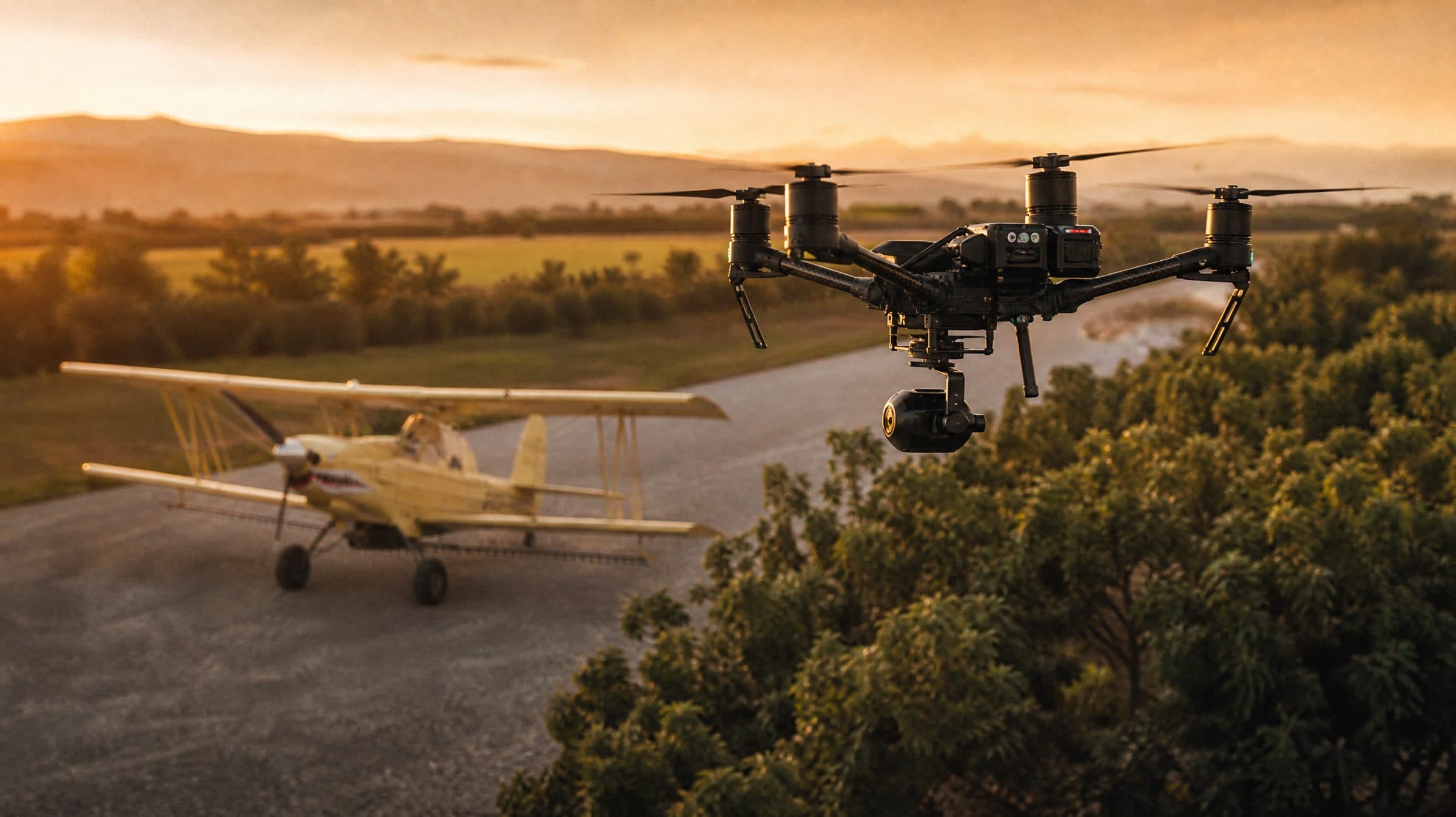
Growers in the Sacramento Valley now get quotes from drone operators as well as from crop dusters. A 2026 university survey puts the drone spraying cost per acre at about $12.50, almost the same as an airplane pass. This post explains that number, why your field can cost more or less, and how to compare quotes.
What is the drone spraying cost per acre in 2026?
The largest published survey of custom rates comes from Iowa State University. Its 2026 Iowa Farm Custom Rate Survey lists drone spraying next to airplane and ground spraying. Each rate includes fuel and labor, but not the product.
| Spraying job, 2026 Iowa survey | Average per acre | Median per acre | Range | Responses |
|---|---|---|---|---|
| Drone | $12.50 | $12.00 | $8.00 to $16.00 | 47 |
| Aerial (airplane) | $12.00 | $11.60 | $9.00 to $18.00 | 54 |
| Ground, tractor broadcast | $8.50 | $8.00 | $5.00 to $14.00 | 35 |
A national trade survey shows a similar price. The American Spray Drone Coalition surveyed drone operators with an FAA Part 137 certificate. It reported that the average price fell 38 percent, from $21 per acre in 2024 to $13 in 2025.
Members blamed price cuts by operators without a Part 137 certificate, mainly in the Corn Belt. The coalition estimates that such operators own about 86 percent of the spray drones sold. A very low quote can come from an operator who flies without the federal and state approvals.
No public survey lists drone rates for California yet. The UC Davis 2021 Sacramento Valley rice study budgets $12.00 per acre for an aerial spray. Our post on crop dusting cost per acre explains the local airplane rates. Use these numbers to check a quote; only a quote for your specific field gives the real price.
Why do drone spraying quotes for the same field differ?
The drone spraying cost per acre depends on how many times the drone must land. The carrier volume and the swath width set that count.
Carrier volume
Carrier volume is the total gallons of spray mix for each acre, and drones work fastest at low volumes. In a University of Kentucky corn trial published in 2025, the drone applied fungicide at 2.5 gallons per acre, and the ground rig applied 15.
The label can forbid that low volume. Penn State Extension reviewed aerial-labeled herbicides in January 2026. The minimum carrier volumes ran from 2 to 10 gallons per acre, and some products were not labeled under 4 gallons.
The table shows the effect on a 160-acre field, with an example 10-gallon drone tank.
| Carrier volume on the label | Acres per 10-gallon load | Loads for 160 acres |
|---|---|---|
| 2 gallons per acre | 5 | 32 |
| 5 gallons per acre | 2 | 80 |
| 10 gallons per acre | 1 | 160 |
Each load means a landing, a refill and often a battery change. An airplane carries a much larger load, so a higher volume costs it less. In a small 2024 Mississippi State University survey, airplane rates rose only from $7.50 per acre at 3 gallons to $9.50 at 10 gallons.
Swath width
The swath is the width of ground that one pass covers. The Kentucky team measured a 10-foot swath for the DJI T-10 drone. A University of Minnesota Extension session in March 2025 reported 24 to 25 feet for the larger DJI T-50. A field 1,320 feet wide needs 132 passes at 10 feet and about 53 passes at 25 feet. Trees, power lines and odd corners add more turns.
Can a spray drone seed rice or spread dry fertilizer?
A spray drone can carry a spreader for dry products, but the load is small. The Minnesota session reported that a DJI T-50 carries up to 125 pounds. That load seeds about 3 acres of cover crop at the rates that the Natural Resources Conservation Service (NRCS) approves.
Rice seed is a much heavier job. The UC Davis rice study plans 175 pounds of seed per acre. A 125-pound load therefore seeds less than 1 acre, and a 160-acre field needs about 224 loads. This is one reason growers seed most California rice by airplane.
Is it cheaper to buy a spray drone or hire drone spraying services?
University of Minnesota Extension listed the cost of one working spray drone system in March 2025:
- Drone, batteries and chargers: at least $35,000
- Service trailer: about $40,000, and a charging generator: about $2,000
- Total for one system: $80,000 to $85,000
- Commercial setup with at least 3 drones: about $150,000
The University of Missouri Extension ownership study from March 2025 modeled a DJI Agras T40, with batteries as a major cost. The cost was about $12.27 per acre at 1,000 acres a year and $7.39 at 4,000 acres. The study found break-even near 980 acres a year against a $16 custom rate.
The custom rate now changes that answer. At the 2026 Iowa average of $12.50, a 1,000-acre owner saves only about 23 cents per acre, or $230 a year. One week with the drone in the shop in June can cost more than that saving.
How to estimate your own break-even acres
- Write down the full system cost, for example $85,000.
- Divide it by the years of use, for example 5 years.
- Record the result as your fixed cost per year, here $17,000.
- Estimate the running cost per acre for labor, parts, fuel and batteries, for example $4.
- Subtract the running cost from the custom rate, here $12.50 minus $4, or $8.50.
- Divide the fixed cost per year by that difference.
- Read the result as your break-even acres per year, here 2,000 acres.
For the labor line, the USDA Economic Research Service reports a 2024 average wage of $19.07 per hour for agricultural equipment operators. A pilot and a loader cost about $38 an hour together.
This simple method leaves out interest, insurance, training, certificate fees and lost days, and each one raises the break-even acres. Parts and replacement drones can also be scarce. The coalition estimates that new spray drone sales fell 59 percent in 2025, after customs enforcement stopped DJI imports.
What licenses do crop dusting drones need in California?
A spray drone that applies pesticide needs an FAA Part 137 agricultural aircraft operator certificate. The FAA page on dispensing chemicals with drones lists these extra steps:
- A drone under 55 pounds, with its load, flies under Part 107. It needs an exemption from section 107.36 and from several Part 137 rules.
- A drone of 55 pounds or more flies under Parts 91 and 137. It needs exemptions from rules in Parts 61, 91 and 137.
- The operator must file each exemption petition at least 120 days before it must take effect.
- Under section 107.35, one person may fly only one drone at a time, so a swarm needs an exemption.
California adds its own pilot rules. The Department of Pesticide Regulation (DPR) requires a Pest Control Aircraft Pilot Certificate for anyone who uses a drone for pest control in the state. The rule includes growers who treat their own property. A new unmanned apprentice must pass two exams at 70 percent or higher. DPR charges a $135 application fee and $115 for each exam.
An apprentice works only under the direct supervision of a journeyman pilot. A journeyman needs at least 1 year as an apprentice and 50 hours of supervised drone application. Before any work, the pilot registers with each county agricultural commissioner, usually for a yearly fee.
A business that sprays for hire needs a DPR pest control business license. See our guides to pesticide application rules in California and FAA Part 137.
Spray drone or crop duster: which costs less for your job?
The 2026 Iowa fees differ by only 50 cents per acre. The real difference comes from the job size, the label and the time window.
| Cost factor | Spray drone | Ag airplane |
|---|---|---|
| 2026 Iowa average fee | $12.50 per acre | $12.00 per acre |
| Load per trip | Small, so many landings | Large, so fewer trips |
| Label needs 10 gallons per acre | Loads rise fast | Fee rises a little |
| 160-acre field in a short window | Many landings, so a longer job | Fewer loads, so a shorter job |
| Rice seed at 175 pounds per acre | About 224 loads | The usual method in California |
| Small block near trees or lines | Strong fit | Edges may need other equipment |
Drift is also a cost. Penn State notes that early research shows more drift from drones than from ground broadcast sprayers. In the Kentucky trial, more spray landed on one edge of each plot, with wind at or below 4.4 mph. The drone also put less spray on the leaves than the ground rig did. Our post on spray drift in aerial application explains drift control.
Timing often decides the real cost, because a late pass can cost more in yield than any gap in the fee. Our drone versus airplane comparison covers field fit, and aerial spraying versus a ground rig covers the ground option.
How do you compare drone and airplane quotes?
Use the same job details for every quote.
Caution: Do not lower the carrier volume or change the product to fit a drone. Follow the label and your pest control adviser's (PCA) written recommendation.
- Get the PCA's written recommendation with the product, rate and gallons per acre.
- Find the APN or the FSA farm and tract number for each field.
- Mark power lines, homes, water and sensitive crops on a map.
- Send the same details to each operator.
- Ask for the total job price, with any travel or minimum charge.
- Ask for the latest date each operator can finish the job.
- Ask for the FAA Part 137 and DPR pilot certificate numbers, and the county registration.
- Compare the total price against the finish date.
Our guide to finding your APN or FSA farm number shows where to look.
How Sutter Butte Dusters fits in
We fly aerial application (crop dusting) with five Ag Cats and one Air Tractor 602 from our airstrip at 4080 Clark Rd in Live Oak. We serve growers in Sutter, Yuba, Butte, Glenn and Colusa counties. We use drones for data, and our drone mapping and crop health imaging can show which parts of a field need treatment. Our price depends on acres, product, rate, ferry distance, and field shape and obstacles. Send us the field and the job, and get a quote for your field.
Questions
Yes. The Department of Pesticide Regulation requires a Pest Control Aircraft Pilot Certificate for anyone who uses a drone for pest control, including growers on their own land. You also need FAA approval for agricultural drone work, which includes a Part 137 certificate and an exemption.
For most growers, hiring costs less unless they spray well over 1,000 acres a year. A 2025 University of Missouri study found break-even near 980 acres against a $16 rate. With 2026 rates near $12.50, the owner saves only cents per acre.
The label may require more gallons per acre, which means more refills and landings. A narrow swath, small or odd-shaped fields, obstacles and travel charges also add cost. A very low quote can come from an operator without the FAA and state approvals.
On the fee alone they are close. Iowa State's 2026 survey shows $12.50 per acre for a drone and $12.00 for an airplane. On large fields, high-volume labels or dry products such as rice seed, the airplane usually needs far fewer loads.
