Plane vs drone vs ground
Crop duster helicopter vs airplane: which fits your field?
By the Sutter Butte Dusters team · · 8 min read
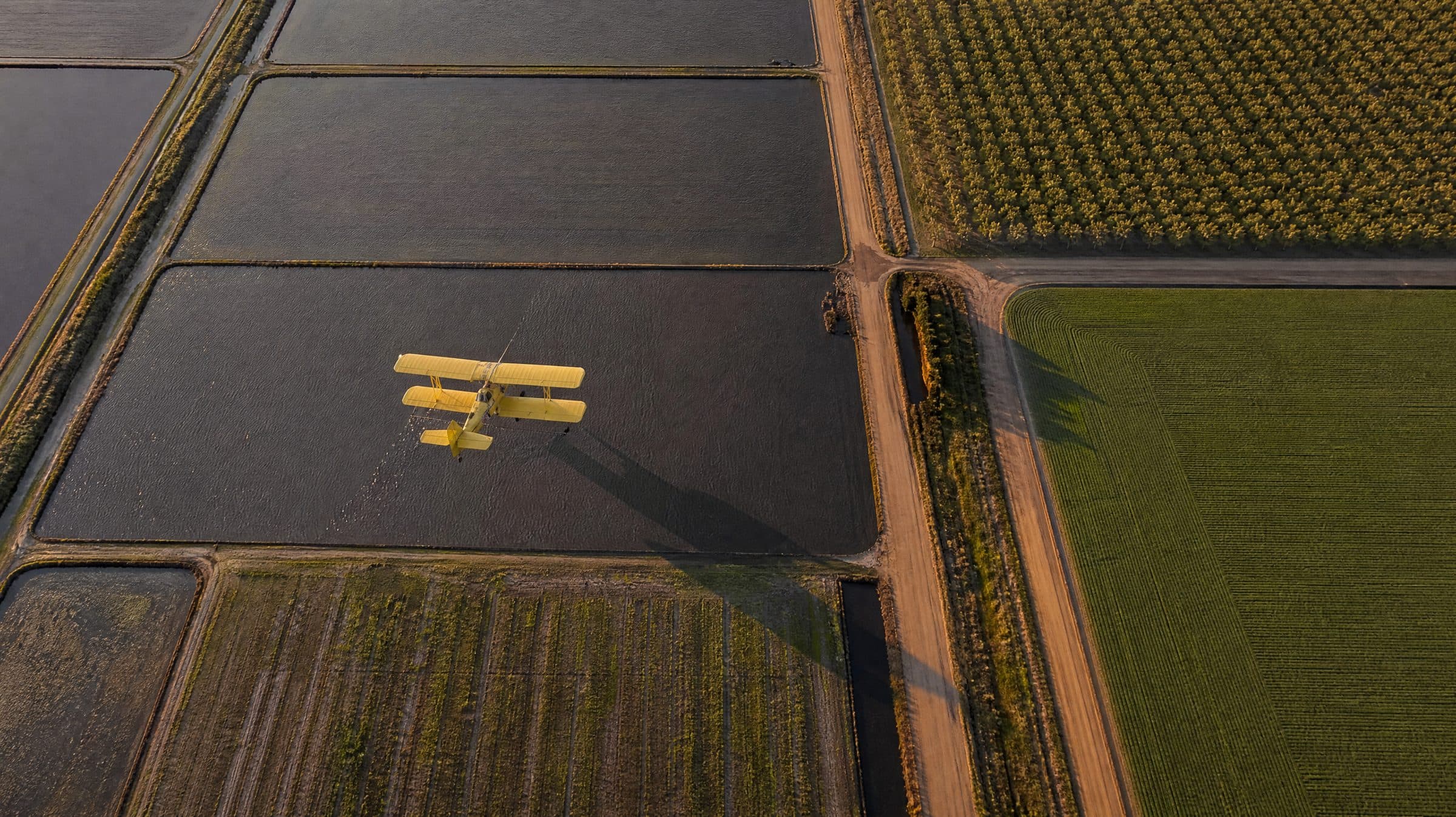
A crop duster helicopter and an ag airplane both put seed, fertilizer and crop protection products on a field from the air. They do the job in different ways, and each one fits a different kind of field. This guide compares the two with real numbers, so you can tell which aircraft suits your ground.
What is the difference between a crop duster helicopter and an airplane?
Aerial application (crop dusting) is the application of products to land from an aircraft. A fixed-wing aircraft is an airplane, such as an Ag Cat biplane or an Air Tractor. A rotary-wing aircraft is a helicopter. Both types fly under the same federal rule, FAA Part 137, which our guide to FAA Part 137 for agricultural aircraft explains.
Airplanes do most of the work in the United States. The National Agricultural Aviation Association (NAAA) counts 84 percent of ag aircraft as fixed-wing and 16 percent as helicopters.
The EPA's National Aerial Applicator Manual states the basic trade-off. Fixed-wing aircraft are fast and carry heavier loads. Helicopters are more maneuverable but slower. A helicopter needs no runway, so the ground crew can load it at or near the field.
Helicopter vs fixed-wing spraying: how do they compare?
The airplane figures in this table use the Air Tractor 602, one of the aircraft in our fleet.
| Point | Ag airplane (fixed-wing) | Crop duster helicopter (rotary-wing) |
|---|---|---|
| Working speed | 145 mph for the Air Tractor 602 | Slower; the EPA manual uses 50 mph in a calibration example |
| Load per trip | 630 US gallons for the Air Tractor 602 | 370 gallons for a large Bell 212 system; most models carry less |
| Where it loads | An airstrip | A nurse truck at or near the field |
| End-of-row turn | A wide, climbing turn | A short, tight turn |
| Boom length | About 75 percent of the wingspan | About 75 percent of the rotor diameter |
| Dry products | Ram-air spreader under the hopper | Centrifugal spreader on a cable under the helicopter |
| Best field | Large, open, rectangular fields | Small, odd-shaped or hemmed-in blocks |
Air Tractor's AT-602 specification sheet gives the speed and hopper size. The Bell 212 figure comes from Simplex Aerospace, which announced that 370-gallon system in 2013 and called it industry-leading. Helicopter tank sizes vary a lot by model, so ask the operator for the tank size of the aircraft that will fly your job.
What spray equipment does each aircraft carry?
The two aircraft carry the same basic spray system. The EPA manual lists a pump, a tank or hopper, lines, control valves, a pressure gauge, filters, booms and nozzles. Check valves in each nozzle body shut off the flow and stop drips at the end of each pass. Both types use GPS guidance to steer each pass.
Speed causes the differences. Some systems adjust the flow to the airspeed, which the manual calls flow control. Rotary atomizers are spinning nozzles that make uniform droplets. On an airplane, a small fan in the airstream turns the atomizer. A helicopter flies too slowly for a fan, so its atomizers need an electric or hydraulic motor.
Dry products show the biggest difference. An airplane carries seed, fertilizer or sulfur in its hopper and meters it through a ram-air spreader under the fuselage. A helicopter carries a separate spreader bucket on a cable. The bucket drops product onto a spinning disc. Many helicopter crews use two buckets, so the ground crew fills one while the pilot spreads with the other.
Why does an airplane cover more acres per hour?
Acres per hour depend on ground speed and swath width. The swath is the width of ground that one pass treats.
Here is the arithmetic for a 60-foot swath. One mile of a 60-foot swath covers about 7.3 acres. At 145 mph, an airplane flies about 2.4 miles each minute and treats about 17.6 acres per minute. At 50 mph, an aircraft with the same swath treats about 6.1 acres per minute. That is about one-third of the airplane's rate.
Spray time is only part of the day. The pilot also turns at each end of the field, ferries to and from the field, and lands to reload. NAAA gives one real-world figure: an Air Tractor 502B with a 60-foot swath treats about 1,800 acres in a 12-hour day.
Load size sets the number of stops. At 5 gallons per acre, a 630-gallon load covers about 126 acres. The same rate empties a 370-gallon tank after about 74 acres. The helicopter gets some time back because it turns faster and reloads beside the field. On a 20-acre block with short passes, those savings matter. On a 300-acre rice field with half-mile passes, speed and load matter more.
When does helicopter crop spraying make sense?
Helicopter crop spraying is the better choice when the field shape or the area around it limits an airplane. If several items in this checklist are true for your field, ask for a helicopter quote too.
- The field is small, narrow or irregular, with many short passes.
- Tall trees, power lines, buildings or towers surround the field on several sides.
- The field is on steep or broken ground, such as a hillside vineyard or forest land.
- No airstrip is near the field, and a nurse truck can park beside it.
- The job is in a congested area. Part 137 bars a loaded single-engine airplane from a takeoff or turnaround over a congested area, but it exempts helicopters. Every aircraft still needs public notice, an FAA-approved plan and written local approval.
- A local agency requires a rotary-wing aircraft. The EPA manual notes that some agencies prohibit fixed-wing work in certain situations.
Frost protection is one job that a helicopter can do and an airplane cannot. On a clear, still night, the air some distance above the orchard can be warmer than the air at the trees. This warm layer is an inversion. The helicopter hovers and moves slowly over the block to push that warm air down into the trees. An airplane cannot hover, so it cannot move the air this way.
The method has limits. A UC farm advisor's guidance on the Sacramento Valley Orchard Source says the helicopter needs a warm inversion. It usually fails in a wind-driven freeze with wind over 4 mph, because no inversion forms. In a mild frost, one small helicopter can protect 50 to 100 acres. In colder conditions, the same guidance calls for about one helicopter per 40 acres.
When is a fixed-wing crop duster the better choice?
An airplane is the better choice when the job is large and the time window is short. The northern Sacramento Valley floor is flat, and many rice and row-crop fields there are large and open. That layout suits the speed and load of a fixed-wing aircraft.
The airplane fits these jobs:
- Rice seeding onto flooded checks, where the whole field must go in at once
- Herbicide, fungicide or insecticide on large rice, orchard or row-crop blocks
- Fertilizer top-dressing across many fields in one day
- Dry products such as granular fertilizer and granular herbicide, which the Ag Cat's hopper handles well
- Jobs far from the operator's base, where cruise speed shortens the ferry flight
Our guide to crop duster planes describes these airplanes. We also compare the Air Tractor 602 and the Ag Cat.
Does rotor downwash give a helicopter better coverage?
Rotor downwash can help, but it does not guarantee better coverage. Downwash is the column of air that the main rotor pushes toward the ground. At low speed, it can drive droplets down into a dense canopy.
Downwash also causes a problem that the operator must correct. The EPA manual calls it rotor distortion. A helicopter can put too little product in the middle of the swath and too much at the boom ends. The operator adds nozzles between the skids to fix the pattern. An airplane has a similar effect from prop wash, and the operator corrects it with nozzle placement.
Both aircraft types shed vortices at the ends of the wing or rotor. These spinning masses of air catch spray and carry it off target. For this reason, the EPA manual keeps the boom near 75 percent of the span on both types. Good coverage comes from the setup: nozzle choice, droplet size, height, speed and a pattern test. Our article on spray drift explains these factors, and our post on why crop dusters fly so low covers height.
Crop dusting helicopter vs plane: which costs less per acre?
The answer depends on the field, but productivity drives the price. An aircraft that treats more acres per hour spreads its fuel, pilot and maintenance costs over more acres. On large, open fields, that usually favors the airplane. On a small block that an airplane cannot fly well, a crop duster helicopter may be the only good aerial option.
Compare quotes on the same terms: the same field, product, rate in gallons per acre and time window. Our guide to crop dusting cost per acre lists the factors that set the price. A low quote is not a low-cost job if the application is late and the crop loses yield.
Other tools may also fit your field. For small blocks, read our comparison of drone vs airplane crop spraying. For wet ground and tall crops, see when aerial spraying beats a ground rig.
How do you choose the right aircraft for your field?
Use these steps and a map of the field before you ask for quotes.
- Find the field acres and the length of the longest pass.
- Mark power lines, towers, trees and buildings on the map.
- Mark homes, schools, water and sensitive crops near the field.
- Note the product, the rate in gallons per acre and the treatment window.
- Ask each operator which aircraft will fly the job and its load size.
- Ask where the aircraft will load and how far it must ferry.
- Compare the quotes on the same field, product, rate and timing.
Your licensed pest control adviser (PCA) sets the product and rate. Follow the label and the PCA's written recommendation for every application. For more questions to ask an operator, see how to hire a crop duster.
Aerial application in the northern Sacramento Valley
We fly fixed-wing aircraft: five Ag Cats and one Air Tractor 602, based at 4080 Clark Rd in Live Oak. We seed, spray and fertilize rice, orchards and row crops in Sutter, Yuba, Butte, Glenn and Colusa counties. Send us the field location, acres, product and timing, and we will tell you if an airplane fits the job. Get a quote for your field.
Questions
Yes, but helicopters are a small share of the ag fleet. The National Agricultural Aviation Association reports that 16 percent of U.S. ag aircraft are helicopters and 84 percent are fixed-wing airplanes. Our own fleet is fixed-wing: five Ag Cats and one Air Tractor 602.
On large, open fields, a helicopter usually costs more per acre because it flies slower and carries a smaller load. On small or hemmed-in blocks, the gap narrows because the helicopter turns fast and reloads at the field. Compare quotes for the same field, product, rate and timing.
It depends on the model. Simplex Aerospace called its 370-gallon Bell 212 spray system industry-leading in 2013, and most helicopter tanks are smaller. The Air Tractor 602 airplane carries 630 gallons. Ask the operator for the tank size of the aircraft that will fly your job.
Yes, on a clear, still night with a warm inversion above the trees. The helicopter pushes the warm air down into the orchard. UC guidance says it usually fails in a wind-driven freeze and calls for about one helicopter per 40 acres in colder conditions.