Rules and licensing
FAA Part 137 explained: the rules for agricultural aircraft
By the Sutter Butte Dusters team · · 8 min read
Every commercial crop dusting flight in the United States falls under FAA Part 137, the federal rule for agricultural aircraft operations. The rule sets who may fly, which aircraft they may use, how low they may go and what records they keep.
What is FAA Part 137?
The rule sits in Title 14 of the Code of Federal Regulations (14 CFR 137). The current text on eCFR has four subparts: general rules, certification, operating rules, and records.
Section 137.3 defines an agricultural aircraft operation as a flight that dispenses one of three things:
- An economic poison: a pesticide, plant regulator, defoliant or desiccant
- Any other substance for plant nourishment, soil treatment, propagation of plant life or pest control
- Any other material in an activity that directly affects agriculture, horticulture or forest preservation
The definition covers aerial application (crop dusting) of pesticides, fertilizer and seed, but not the release of live insects. Under section 137.11, a government that flies public aircraft needs no certificate. Neither does a helicopter external-load operator that drops only water on forest fires.
The rule also applies to drones. A spray drone needs the same certificate plus an FAA exemption, as the FAA page on dispensing chemicals with drones explains.
Who needs an agricultural aircraft operator certificate?
Section 137.11 says that no person may conduct agricultural aircraft operations without an agricultural aircraft operator certificate. The table compares the private and commercial certificates.
| Rule | Private certificate | Commercial certificate |
|---|---|---|
| Work for hire | Not permitted (137.35) | Permitted |
| Land the operator may treat | Land the operator owns or leases, or where it has an interest in the crop | Any land, under the operating rules |
| Flights over congested areas | Not permitted (137.35) | Permitted with the approvals in 137.51 and 137.53 |
| Minimum pilot certificate | Private, commercial or airline transport (137.19) | Commercial or airline transport (137.19) |
| Job records under 137.71 | Not required by this section | Required, kept 12 months |
The certificate has no expiry date. It stays in effect until the holder surrenders it or the FAA suspends or revokes it (137.21). The holder must tell the FAA in writing before it moves its home base (137.75). It must surrender the certificate when it stops operations (137.77). A commercial operator may work only under the business name on its certificate (137.55).
How does an operator get a Part 137 certificate?
The operator applies on FAA Form 8710-3 to the Flight Standards office for the area of its home base (137.15). The FAA certification page for agricultural operators lists five phases. Since January 24, 2024, the FAA has combined the first two phases with an Applicant Readiness Checklist.
- Read the certification and operating rules in 14 CFR 137.
- Contact the local Flight Standards District Office (FSDO).
- Complete the Applicant Readiness Checklist and Form 8710-3.
- Submit your documents for the FAA to approve or reject.
- Let the FAA inspect your base, aircraft and equipment.
- Take the knowledge and skill tests with an FAA inspector.
- Receive the certificate when all phases are complete.
Section 137.19 also requires at least one certificated, airworthy aircraft equipped for agricultural work. A commercial applicant may be its own pilot. The applicant, or its designated chief supervisor, must pass the knowledge and skill tests.
What is on the knowledge and skill tests?
The tests come from section 137.19(e). The pilot flies the skill test at the maximum certificated takeoff weight, or at the special-purpose maximum weight if that is greater. FAA Advisory Circular 137-1B says the hopper carries water, lime or sand for the test, not chemicals.
| Knowledge test | Skill test |
|---|---|
| Steps before you start work, including a survey of the area | Short-field and soft-field takeoffs (airplanes and gyroplanes) |
| Safe handling of economic poisons and disposal of used containers | Approaches to the work area |
| Effects of chemicals on plants, animals and people, and precautions | Flare-outs |
| Symptoms of poisoning, emergency measures and poison control center locations | Swath runs |
| Performance and limits of the aircraft | Pullups and turnarounds |
| Safe flight and application procedures | Quick stops (helicopters only) |
An applicant that accepts a ban on economic poisons on its certificate skips the three chemical items of the knowledge test.
What crop dusting license does a pilot need?
No single federal "crop dusting license" exists. A pilot in command must hold the pilot certificate that section 137.19 requires for the operation, as the table above shows. The pilot must also show the operator, or its chief supervisor, that the pilot meets the knowledge and skill requirements (137.41).
States add their own licenses. In California, the Department of Pesticide Regulation issues an aircraft pilot pest control certificate, which a pilot needs before applying pesticides by air. Our guide to California pesticide application rules covers the state side. Pilots can read our post on crop dusting jobs and how pilots get hired.
What are the operating rules for ag aircraft?
Subpart C holds the day-to-day crop dusting regulations.
- Shoulder harness (137.31 and 137.42): Each pilot needs a shoulder harness. The pilot fastens the belt and harness unless the harness prevents a required duty.
- Certificate on board (137.33): Each aircraft carries a copy of the operator certificate. The registration and airworthiness certificates may stay at the base instead.
- No hazard (137.37): No person may dispense any material in a manner that creates a hazard to people or property on the ground.
- Label (137.39): No person may apply a registered pesticide from an aircraft for an unregistered use, or contrary to its label. Growers should follow the label and the written recommendation of their licensed pest control adviser (PCA).
- Class D airspace (137.43): The pilot needs approval from air traffic control, except for flights to and from the work area.
- Traffic patterns (137.45): A pilot may leave the pattern with tower approval. At an airport without a tower, the pilot coordinates with airport management first.
- Inspections (137.57 and 137.59): The operator keeps the certificate at its home base. The FAA may inspect the operation at any time and place, including on the job.
- Emergencies (137.1): In a public emergency, an operator may deviate from the rules for approved relief work. It reports the flight to the FAA within 10 days.
How low can a crop duster fly under Part 137?
Section 137.49 lets an ag aircraft fly below 500 feet above the surface over areas that are not congested. It may also fly closer than 500 feet to people, vessels, vehicles and structures. This permission covers only the dispensing operation, with the approaches, departures and turnarounds that the job needs. The pilot must not create a hazard to people or property on the ground. Our post on why crop dusters fly so low explains the reasons. Our guide to spray drift in aerial application covers drift control.
What does the rule require over congested areas?
Section 137.51 adds steps for work over a town or other congested area:
- Get written approval from the city, county or other local government.
- Give public notice by newspaper, radio, television or door-to-door notice.
- Send a plan for the full operation to the FAA office for approval.
The plan must cover obstructions, emergency landing options and coordination with air traffic control. A single-engine airplane may not take off loaded or turn around over the congested area. It must fly a pattern that lets it land in an emergency without danger to people or property.
Section 137.53 adds limits on the pilot and the aircraft. The pilot in command needs 25 hours as pilot in command in that make and basic model, with 10 in the last 12 calendar months. The pilot also needs 100 hours as pilot in command of dispensing work.
The aircraft needs a 100-hour or annual inspection within the last 100 hours of time in service. An airplane must be able to jettison at least half its maximum load within 45 seconds. See our post on crop dusting near homes.
Why does an ag plane say "RESTRICTED"?
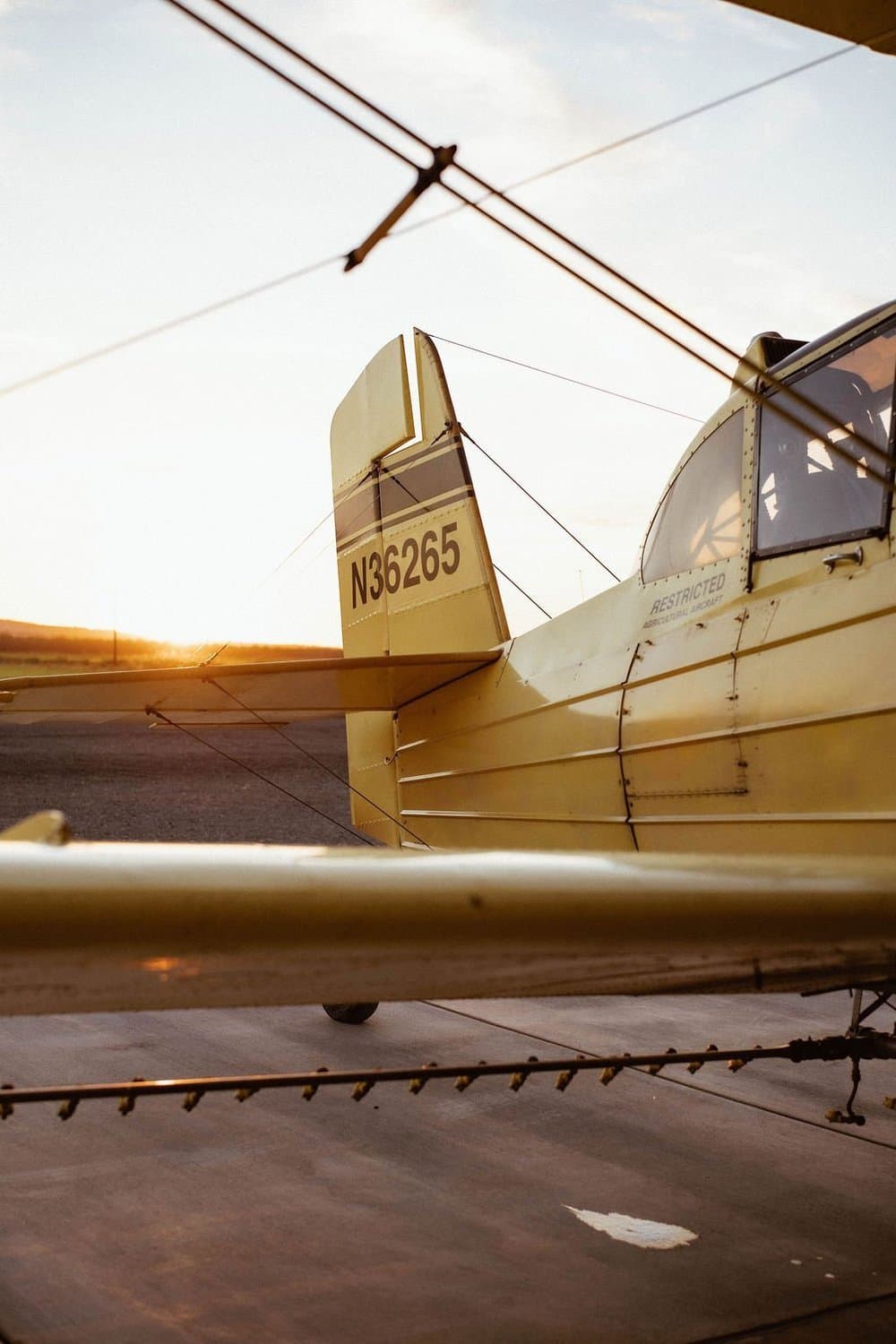
Many agricultural airplanes have a restricted category airworthiness certificate for special-purpose work. Section 45.23(b) requires the word "RESTRICTED" near each entrance to the cockpit, in letters 2 to 6 inches high. Section 91.313 sets the main limits for these aircraft:
- The aircraft flies only for its special purpose, plus training, proficiency and positioning flights.
- It carries only crew and people essential to the work.
- It stays away from densely populated areas and busy airports, unless a waiver or its operating limitations allow it.
Under section 91.313(c), the seed or spray for a crop dusting job does not count as property carried for hire.
What records must an ag operator keep?
Section 137.71 requires each commercial operator to keep these records at its home base:
- The name and address of each customer
- The date of each job
- The name and quantity of the material for each operation
- The name, address and certificate number of each pilot, and the date the pilot passed the knowledge and skill tests
The operator keeps them for at least 12 months and shows them to the FAA on request. Field acreage and the aircraft registration are not on the federal list. California adds its own pesticide use records and reports.
What safety practices does the FAA recommend?
FAA Advisory Circular 137-1B adds guidance that is not mandatory. It lists these checks before work on a new field:
- Get a description of the work area from a person who knows it, or make a ground survey.
- Fly an in-flight survey for towers, wind turbines and other uncharted obstacles.
- Check the land next to the field for people and property that the material could harm.
- Find fish ponds, streams and drainage ditches, because some pesticides kill fish and wildlife.
A ground survey may be crucial before a pilot flies under wires. The circular warns that pilots tend to push the controls forward under wires, and wheels that catch the crop can pull the aircraft down. A pilot may choose to fly the field parallel to the wires instead.
Agricultural aircraft rules in the northern Sacramento Valley
We fly five Ag Cats and one Air Tractor 602 from our base at 4080 Clark Rd in Live Oak. Every job we fly in Sutter, Yuba, Butte, Glenn and Colusa counties follows these federal rules and California pesticide law. County permit conditions add local limits, as on our Colusa County and Sutter County pages. Learn more about Sutter Butte Dusters, or get a quote for your field.
Questions
Yes. Federally, the pilot needs a commercial or airline transport pilot certificate and must pass the operator's knowledge and skill test under 14 CFR 137. The business needs an FAA agricultural aircraft operator certificate. California also requires an aircraft pilot pest control certificate from DPR.
No. Under section 137.21, the certificate stays in effect until the holder surrenders it or the FAA suspends or revokes it. The holder must notify the FAA in writing before a move of its home base, and must surrender the certificate when it stops operations.
Yes, with a private agricultural aircraft operator certificate. A private pilot certificate is enough for that operator. The private certificate allows work only on land the operator owns or leases, or where it has an interest in the crop. It does not allow work for hire or over congested areas.
Yes. The FAA treats crop spraying by drone as an agricultural aircraft operation. The drone operator needs a Part 137 certificate, an FAA exemption, a remote pilot certificate and a registered drone. In California, pesticide applications also need the state licenses that apply to the work.