
Rice
Rice fertilizer by air: top-dress nitrogen without wheel tracks
By the Sutter Butte Dusters team · · 8 min read
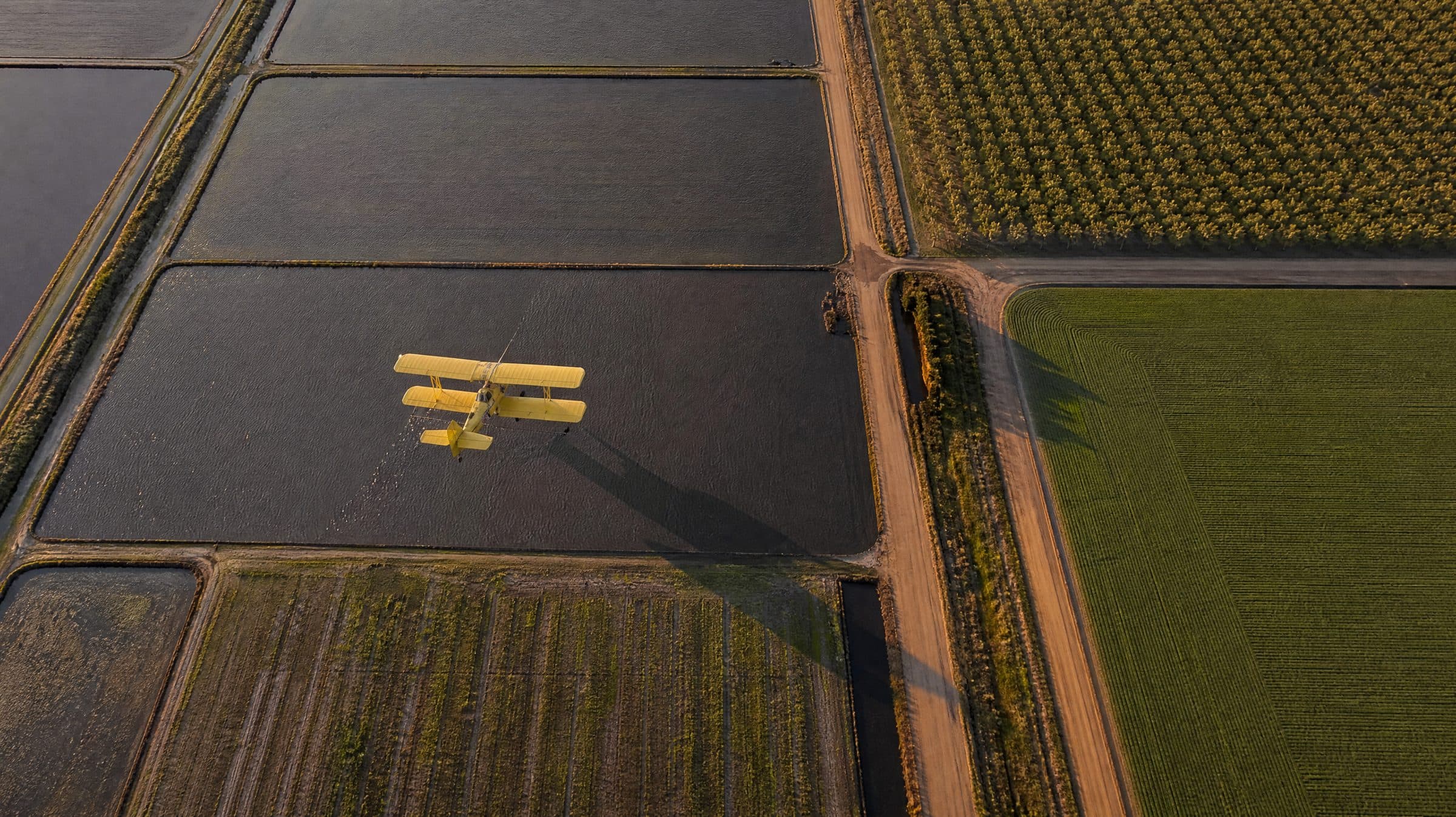
California rice gets most of its nitrogen before the flood, so a midseason top-dress is a decision, not a habit. This post explains how rice fertilizer goes on in the Sacramento Valley and how to decide on a top-dress. It also explains why aerial application (crop dusting) is the usual method on a flooded field.
How is rice fertilizer applied in California?
Most of the nitrogen goes on before the field floods. The usual source is aqua ammonia, which a rig chisels 3 to 4 inches into dry soil. At that depth, the soil protects the nitrogen from loss to the air (volatilization) and from loss as gas after the flood (denitrification). The California fertilization guidelines tell growers to apply it as close to the flood date as possible.
The same guidelines give 150 pounds of nitrogen per acre as an average season total. The highest yields in the trials, up to 12,000 pounds of grain per acre, came from 140 to 190 pounds of nitrogen per acre. Specialty varieties often need less. Fields with years of straw incorporation and winter flood may need 10 to 20 pounds less.
The table shows each part of a rice fertilizer program.
| Stage | What goes on | How it goes on | Notes |
|---|---|---|---|
| Before the flood | Most of the season's nitrogen, usually aqua ammonia | Ground rig, 3 to 4 inches deep in dry soil | Apply close to the flood date |
| Before planting | Potassium, where soil tests show a need | Ground rig, incorporated | A top-dress at tillering works less well |
| Seeding | Starter fertilizer, if used | Incorporated or lightly harrowed in | Starter left on the surface is not justified |
| Before 30 days after seeding | Phosphorus in deficient fields | Applied into the water | Do not drain for 2 weeks after |
| Panicle initiation | Top-dress nitrogen, only if the crop needs it | By air, into the flood | Ideally 30 pounds of nitrogen or less |
Source: CDFA FREP fertilization guidelines for rice, built from UC research.
Phosphorus depends on the soil test. Above 15 ppm Olsen phosphorus, the field does not need it. From 6 to 15 ppm, a maintenance rate replaces what the crop removes. Below 6 ppm, the guidelines raise the rate to 60 pounds of P2O5 per acre. For potassium, a soil test under 60 ppm calls for a higher rate before planting. Adequate potassium also reduces aggregate sheath spot.
Zinc deficiency can also limit California rice early in the season. The UC Rice Blog reports that it is more common in alkaline soils, above pH 7. Seedlings yellow from the base up, leaves float on the water, and stands thin out 4 to 6 weeks after seeding. The blog suggests a zinc fertilizer in the starter blend or a zinc seed coat. Zinc is a start-of-season fix, not a top-dress.
For the full season, see our guide to California rice farming.
When should you top-dress rice with nitrogen?
Top dressing rice means a midseason application of fertilizer onto the growing crop. In California, the time to decide is panicle initiation (PI). PI is the stage when the young panicle starts to form inside the stem, about 50 to 55 days after seeding. The first sign is a light green band above the top node, often called the green ring.
UC research, as reported on the UC Rice Blog, found that Calrose varieties gave no yield gain from nitrogen applied after PI. The CDFA guidelines say to apply the top-dress before PI.
The guidelines say that a midseason top-dress is usually not necessary. There are two main exceptions:
- A long early drain. In one trial, a 10 to 11 day drain, 1 to 2 weeks after planting, built up to 30 pounds of nitrate nitrogen per acre. The field lost about 60% of that nitrate when the water came back.
- A low test at midseason. A leaf analysis or sensor reading shows a nitrogen shortage.
If you must drain, the guidelines say to apply nitrogen just before the field floods again. That timing limits nitrification, the soil process that changes ammonium into nitrate. The flood then loses less nitrate.
How do you know if your rice needs a top-dress?
Measure the crop before you order fertilizer. The CDFA guidelines describe a nitrogen-short crop as stunted and yellowish green, with chlorotic (yellow) leaf tips. But color alone is a poor guide, because too much nitrogen also costs yield through lodging, late maturity and disease.
You can use three tools. Each one checks the Y-leaf, the newest leaf that is fully open.
| Tool | What it measures | Value that calls for a top-dress | Limits |
|---|---|---|---|
| Leaf analysis | Total nitrogen in Y-leaves, by a lab | Under 3.2% at PI; 3.0 to 3.2% is the critical range | Results take a few days |
| Leaf color chart | Leaf color against 8 panels | Panels 1 to 8 match 1.4% to 4.4% nitrogen | One leaf per reading |
| Canopy sensor | Leaf reflectance against an enriched strip | Index of 0.96 or less for a yield gain; 0.86 or less to pay for the flight | Dew, weeds and thin stands give poor readings |
The sensor values come from a 2023 UC Davis study in the journal Sensors, with trials across the Sacramento Valley. Its sufficiency index is the field reading divided by the reading in an area with plenty of nitrogen.
At an index of 0.96 or less with a handheld GreenSeeker, a top-dress gave a measurable yield gain of about 190 pounds per acre. To pay for the application, the authors estimated that the gain must be about 270 pounds per acre. That gain needed an index of 0.86 or less.
Use this procedure to make an enriched strip and compare it with the field:
- At preplant, ask the rig operator to overlap one pass in a representative check.
- Mark the strip with a flag on the levee.
Caution: Do not take readings when dew or rain is on the leaves. Skip areas with weeds or a thin stand. UC rice specialist Bruce Linquist gave these limits in Rice Farming magazine in 2018.
- At PI, take sensor readings in the strip.
- Take readings in the field at the same distance from the levee.
- Divide the field reading by the strip reading.
- Give the result to your agronomist or certified crop adviser (CCA).
- Decide with your adviser whether the gain will pay for the flight.
How much nitrogen goes on in a rice top-dress?
The CDFA guidelines say that ideally, a midseason application is no more than 30 pounds of nitrogen per acre. Above 60 pounds per acre, the efficiency of the nitrogen drops greatly. The UC Davis study gives about 20 to 40 pounds of nitrogen per acre as the usual range, with about 30 pounds as typical.
The pilot needs the product rate in pounds per acre to set the spreader gate. The table converts a 30-pound nitrogen rate for two common products.
| Product | Label analysis | Product for 30 lb of nitrogen per acre | Other nutrient |
|---|---|---|---|
| Ammonium sulfate | 21-0-0 | About 143 lb per acre | Supplies sulfur |
| Urea | 46-0-0 | About 65 lb per acre | None |
Check the analysis on your label, because blends differ. Your adviser sets the rate for each field. A heavier product rate means fewer acres per hopper load, and this affects the cost per acre. For general price ranges, see crop dusting cost per acre.
Urea on rice or ammonium sulfate: which is better?
The CDFA guidelines say that ammonium sulfate and urea are equally efficient on rice when the soil has enough sulfur.
Ammonium sulfate is the more popular product for an aerial top-dress. The guidelines give the reason: it has a lower nitrogen content and greater mass than urea, which suits an aerial spreader. The product also adds sulfur where a field needs it.
Urea has more nitrogen, so the airplane carries fewer pounds per acre. But urea on the soil surface can have high losses to the air as ammonia gas. For this reason, the guidelines say to incorporate urea when it goes on before the flood. Ask your adviser which product fits the field and the water conditions.
Why use aerial fertilizer application on rice?
At PI, the field holds water and the crop is tall. A ground rig would cut wheel tracks through the crop and cross the levees. The CDFA guidelines note that because fields are usually flooded at this time, fertilizer most often goes on by aircraft.
An aerial fertilizer application leaves no wheel tracks and no damage to the levees. The water stays in the checks. An airplane also covers many fields in a day, so several fields fit inside the PI window.
Federal rules cover this work. The FAA definition in 14 CFR 137.3 covers pesticides and also any substance "intended for plant nourishment," such as fertilizer. Our post on FAA Part 137 explains the rule.
Liquid fertilizer application uses the spray system instead of the spreader. Ask your adviser whether a liquid product fits your crop.
How do you prepare a field for a top-dress flight?
Overlap at field edges adds extra nitrogen. UC IPM reports that excess nitrogen increases rice blast risk, and that leaf blast often appears first on headlands where equipment overlaps. Tell the pilot about irregular edges and small checks before the flight.
Use this checklist when you hire a crop duster for a top-dress:
- The field location: an address, an APN or an FSA farm and tract number. See how to find your APN or FSA farm number.
- The product, the analysis and the product rate in pounds per acre.
- Who supplies the fertilizer, and where the ground crew loads it.
- The crop stage, with the date of the PI check.
- The water plan: a held flood or a drained field.
- Power lines, homes, roads and other hazards near the field.
- Any areas to skip, such as a check that tested high.
If you drained the field, flood it again right after the application. For the rest of the rice season, see our posts on herbicide application in rice and rice pests and diseases.
Rice top-dressing from Live Oak
Sutter Butte Dusters applies dry and liquid rice fertilizer by air across Sutter, Yuba, Butte, Glenn and Colusa counties. Rice is the main crop we fly, from our base at 4080 Clark Rd in Live Oak. Our fleet has five Ag Cats and one Air Tractor 602. We top-dress at the rate your adviser sets, inside your PI window, without wheel tracks in the crop. Learn more about our fertilizer service and our rice work, or get a quote for your field.
Questions
CDFA guidelines rate ammonium sulfate and urea as equally efficient when the soil has enough sulfur. Ammonium sulfate is the more popular choice for an aerial top-dress because it has a lower nitrogen content and greater mass. Your agronomist or crop adviser picks the product and rate for each field.
Yes. A top-dress at panicle initiation goes on into the floodwater, and CDFA guidelines rate urea as efficient as ammonium sulfate when sulfur is not short. The high loss risk is for urea left on a dry soil surface, so preplant urea should be incorporated. Your adviser sets the product and rate.
Ammonium sulfate is 21% nitrogen, so 30 pounds of nitrogen takes about 143 pounds of product per acre. Urea is 46% nitrogen, so the same rate takes about 65 pounds. Check the analysis on your label, because blends differ.
Yes. The FAA definition of an agricultural aircraft operation in 14 CFR 137.3 includes dispensing any substance intended for plant nourishment. An operator that spreads fertilizer from the air works under Part 137, the same rule that covers aerial pesticide work.
