Cost and planning
Crop dusting season: a Sacramento Valley month-by-month calendar
By the Sutter Butte Dusters team · · 8 min read
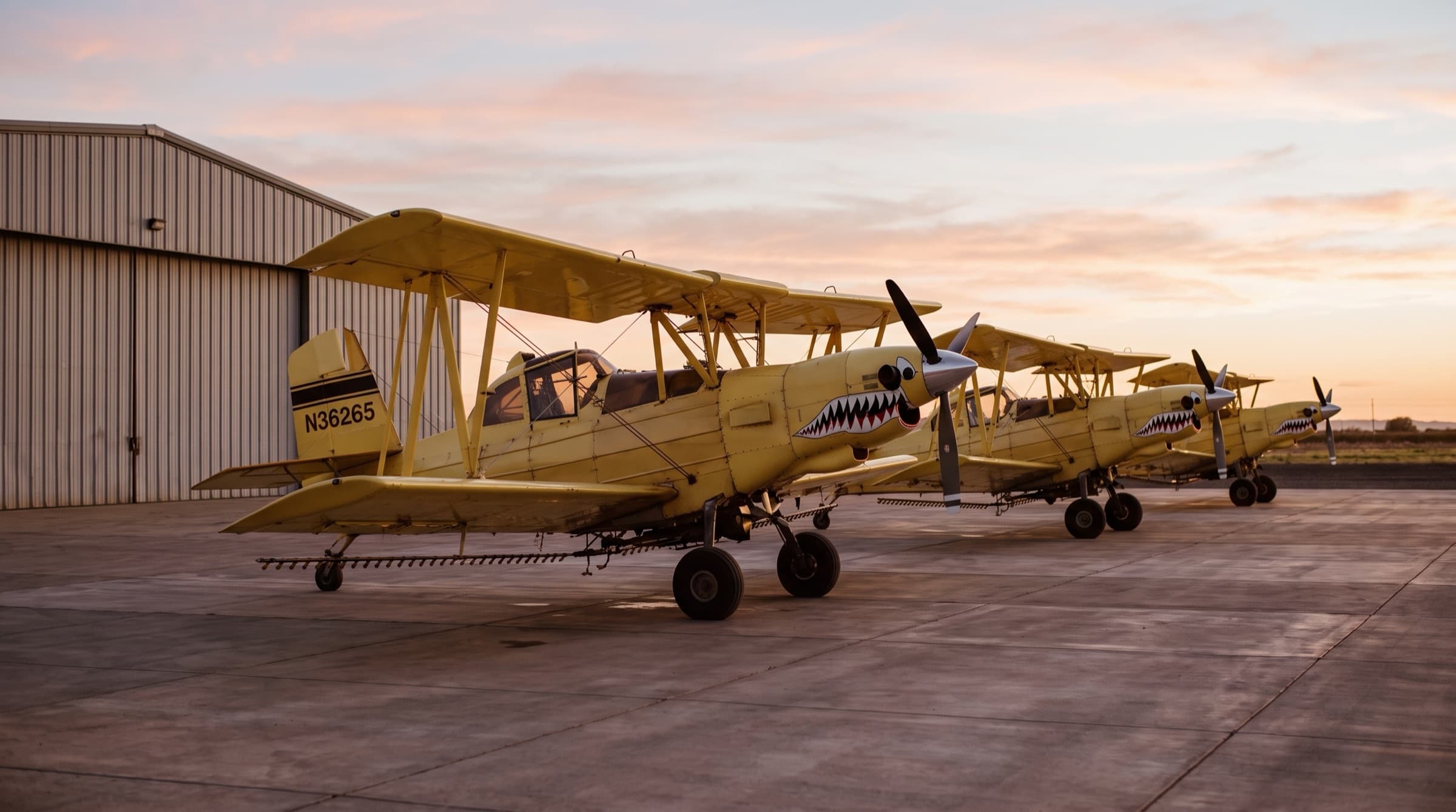
In the northern Sacramento Valley, crop dusting season peaks from April to August. In those months, rice and orchards need seed, herbicide, fertilizer and pest control on a tight schedule. This calendar shows the jobs that fly each month, from February bloom work to winter maintenance, and what sets each date.
When is crop dusting season in the Sacramento Valley?
Aerial application (crop dusting) follows the crop, not a fixed date. In our area, rice sets the pace. Most rice goes in by air in late April and May, and the same fields need more flights through August. Orchards add bloom work in late winter and insect work in midsummer. After harvest, cover-crop seed is the main fall job.
Weather moves every date in this calendar. A wet spring delays rice flood-up and seeding. A hot June can bring insects early. Use the months below as a planning guide, and let crop stage and your pest control adviser (PCA) set the real date.
When do crop dusters spray? A month-by-month calendar
The table lists the typical aerial work in Sutter, Yuba, Butte, Glenn and Colusa counties. The rice details come from the UC Cooperative Extension 2021 rice cost study for the Sacramento Valley. The orchard details come from UC Cooperative Extension orchard advisors and the UC Statewide IPM Program (UC IPM).
| Month | Typical aerial work | What sets the date |
|---|---|---|
| January | Very few flights. Aircraft inspections and pilot training. | Maintenance schedule |
| February | Almond bloom fungicide, mainly when rain keeps sprayers out | Bloom stage and rain forecast |
| March | End of orchard bloom work. Rice fields get tilled and leveled. | Soil moisture |
| April | Rice seeding starts late in the month. Some starter fertilizer goes on by air. | Flood-up date |
| May | Rice seeding ends. Grass herbicide, algae and seedling insect flights. Sulfur starts. | Rice leaf stage |
| June | Broadleaf rice herbicide, by air or ground. Almond hull split can start. | Leaf stage, scouting |
| July | Rice top-dress, armyworm control and rice fungicide. Almond hull split sprays. | Crop stage and PCA thresholds |
| August | Last rice disease and insect flights. Walnut husk fly work. | Trap counts, panicle stage |
| September | Rice harvest starts. Last walnut husk fly flights. | Grain moisture |
| October | Rice harvest and drying end. Cover-crop seeding. | Rain or irrigation |
| November | Cover-crop seeding ends early in the month. | Soil temperature |
| December | Season over. Annual inspections start. | Weather |
The rice cost study gives the core rice dates. Most planting happens from April 20 to May 20, with seed broadcast by air into a few inches of water. The study then assumes three May flights: grass herbicide on all acres, algae control on 30 percent and seedling insect control on 30 percent. In July, aircraft top-dress fertilizer on 75 percent of the acres and treat armyworms on 25 percent. One fungicide flight covers 75 percent of the acres between July and August. The broadleaf and cleanup herbicides in the study go on by ground, and harvest starts in September.
How long is crop dusting season?
The main crop dusting season in our area lasts about 5 months, from April to August. Most rice and orchard flights fall inside that window. With almond bloom work in February and cover-crop seed in October, aircraft can fly in most months from February to November.
The peak is short and busy. Rice seeding, rice herbicide, fertilizer and sulfur all overlap in May. For this reason, operators fill their schedules fast from April to July. The length of the season also changes with the crop mix. A region with cotton or winter wheat has a different calendar from a rice and orchard region like ours.
What flies in spring? Rice seeding and the first herbicide
Spring starts the busy part of the year. Most California rice is water-seeded. The grower floods the field, and the airplane broadcasts soaked seed into the water. The cost study uses a seeding rate of 175 pounds per acre, but rates vary by field and variety. Our page on aerial seeding explains how the plane covers flooded checks.
Herbicide follows soon after seeding. The UC IPM rice weed guidelines give each herbicide a window by rice leaf stage. They put the end of the postemergence herbicide period at about 45 days after seeding. Some herbicides also require the grower to hold water on the field after the flight. Our guide to herbicide application in rice covers the timing in detail.
Fertilizer flights start in April and continue into July. An airplane puts dry or liquid fertilizer on wet or planted ground without wheel tracks. See our aerial fertilizer page and the post on rice fertilizer top-dressing.
What flies in summer? Pest control and sulfur
Summer flights depend on scouting. Your PCA checks the field and writes a recommendation only when a pest passes a threshold. For this reason, the cost study treats armyworms on only a quarter of the rice acres. Our post on rice pests and diseases explains the main problems. These jobs fall under crop protection by air.
Orchards have their own summer peaks. Sacramento Valley UC Cooperative Extension advisors report that almond hull split starts between late June and mid-July. The first navel orangeworm spray goes on at the start of hull split. UC IPM reports that walnut husk fly adults emerge from early June until early September. Growers time those flights with traps, not with a calendar date. Read more in walnut husk fly and orchard spraying by air.
Sulfur demand is highest from May to July. Sulfur protects some crops from powdery mildew and some mites. High heat can make sulfur burn the crop, so the date often moves with the forecast.
What flies in fall? Harvest and cover-crop seed
Fall is the quiet end of the crop dusting season. Harvest fills September and October, and seed is the main fall job. Growers use the plane to put cover-crop seed onto fields after harvest, or into a standing crop just before harvest.
UC Cooperative Extension orchard advisors give October to early November as the planting window for cover crops in the Sacramento Valley. After that, cold soil slows germination. Plan the flight with the first irrigation or a reliable rain forecast, because the seed needs moisture to sprout. Our guide to aerial cover-crop seeding explains seed rates and stand results.
What do crop dusters do in the winter?
In winter, crop dusters do maintenance, training and paperwork. Few fields need an aircraft in December and January, so operators prepare for spring. These are the main winter tasks:
- Aircraft inspection. FAA rules require an annual inspection within the preceding 12 calendar months (14 CFR 91.409). The rule allows a progressive inspection program instead. Mechanics also repair the spray systems, hoppers and spreaders.
- Equipment calibration. Mechanics check nozzles, pumps and flow meters so that each load goes on at the label rate.
- Continuing education. A California pest control aircraft pilot needs at least 20 hours of approved continuing education every 2 years. At least 4 hours must cover pesticide laws and regulations, and at least 4 hours must cover aerial equipment and application techniques.
- Certificate renewal. The state pilot certificate lasts 2 years and expires on December 31. Pilots with last names A through L renew in even-numbered years, and M through Z in odd-numbered years.
- County registration. Pilots must register with the county agricultural commissioner in each county where they work. The registration covers one calendar year, and most counties charge a fee.
- Trade meetings. The National Agricultural Aviation Association (NAAA) holds its Ag Aviation Expo each year after the main season. The 2026 expo ran November 16 to 18 in Savannah, Georgia.
The certificate, education and registration rules come from the California Department of Pesticide Regulation pilot certificate packet. The federal rules for ag operators are in our post on FAA Part 137. Many operators want a new pilot to work a season on the ground crew first, as our post on crop dusting jobs explains.
Why is winter slow for orchards?
Winter orchard work is real, but most of it suits ground sprayers. UC IPM lists dormant fungicide treatments for peach leaf curl in late November or early December, after most leaves fall. For several of those treatments, UC IPM calls for at least 100 gallons of water per acre. That volume is a job for a ground rig.
Bloom is different. UC Cooperative Extension advisors list almond bloom disease work as a February task. Flowers stay susceptible to brown rot from pink bud until petal fall. A wet bloom often means two fungicide sprays. Rain can also make the orchard floor too soft for a sprayer, but an airplane can still cover the block.
The product label must still allow aerial use. The UC IPM walnut blight guidelines, for example, list one bactericide that must not go on by air.
Do crop dusters still use dust?
Yes. Some articles say that every aerial product today is a liquid, but that is wrong. Airplanes still apply dry seed, granular fertilizer, granular rice herbicide and sulfur dust. California DPR reports that sulfur ranked first of all pesticides by pounds in 2023, with about 39.75 million pounds used statewide. The Ag Cat carries a hopper and spreader for dry products. Our post on what crop dusters spray covers the materials by crop.
How should you plan around the crop dusting season?
Book early for the spring rush, and keep your field information ready. Use these steps before each season:
- List each field, crop and expected planting date.
- Find the APN or FSA farm and tract number for each field.
- Mark power lines, homes and water on a field map.
- Ask your PCA which flights the crop will likely need.
- Confirm that each product label allows aerial application.
- Call the operator in March for April and May work.
- Call again as soon as scouting shows a pest problem.
If you need help with step 2, see how to find your APN or FSA farm number. For costs, read crop dusting cost per acre. For choosing an operator, read how to hire a crop duster.
Our season in the northern Sacramento Valley
Sutter Butte Dusters flies from 4080 Clark Rd in Live Oak with five Ag Cats and one Air Tractor 602. We fly rice seeding, herbicide and top-dress, orchard and row crop protection, and cover-crop seed. See all of our aerial application services. Send us your fields and your timing before the spring rush, and we will give you a quote for your field.
Questions
It depends on the crop and the region. In the northern Sacramento Valley, the first flights are often almond bloom fungicide in February. The main season starts with rice seeding in late April. The UC Cooperative Extension rice cost study places most rice planting from April 20 to May 20.
Very little in our area. December and January have few aerial jobs, because most crops are dormant or harvested. Operators use those months for aircraft inspections, equipment repair and pilot continuing education. Flying picks up again when orchards bloom in late winter, if the label and the weather allow it.
Several jobs overlap in May. Rice seeding ends, the first rice herbicide goes on, and fertilizer and sulfur flights are under way. Many growers need a short window at the same time. Call before the spring rush and send your field details early, so the operator can plan the route.
Yes. A wet spring delays rice flood-up and seeding, and a hot June can bring insects early. High heat can also move a sulfur application, because sulfur can burn the crop. Wind decides the day of each flight. If the wind is wrong for the field, the pilot waits.