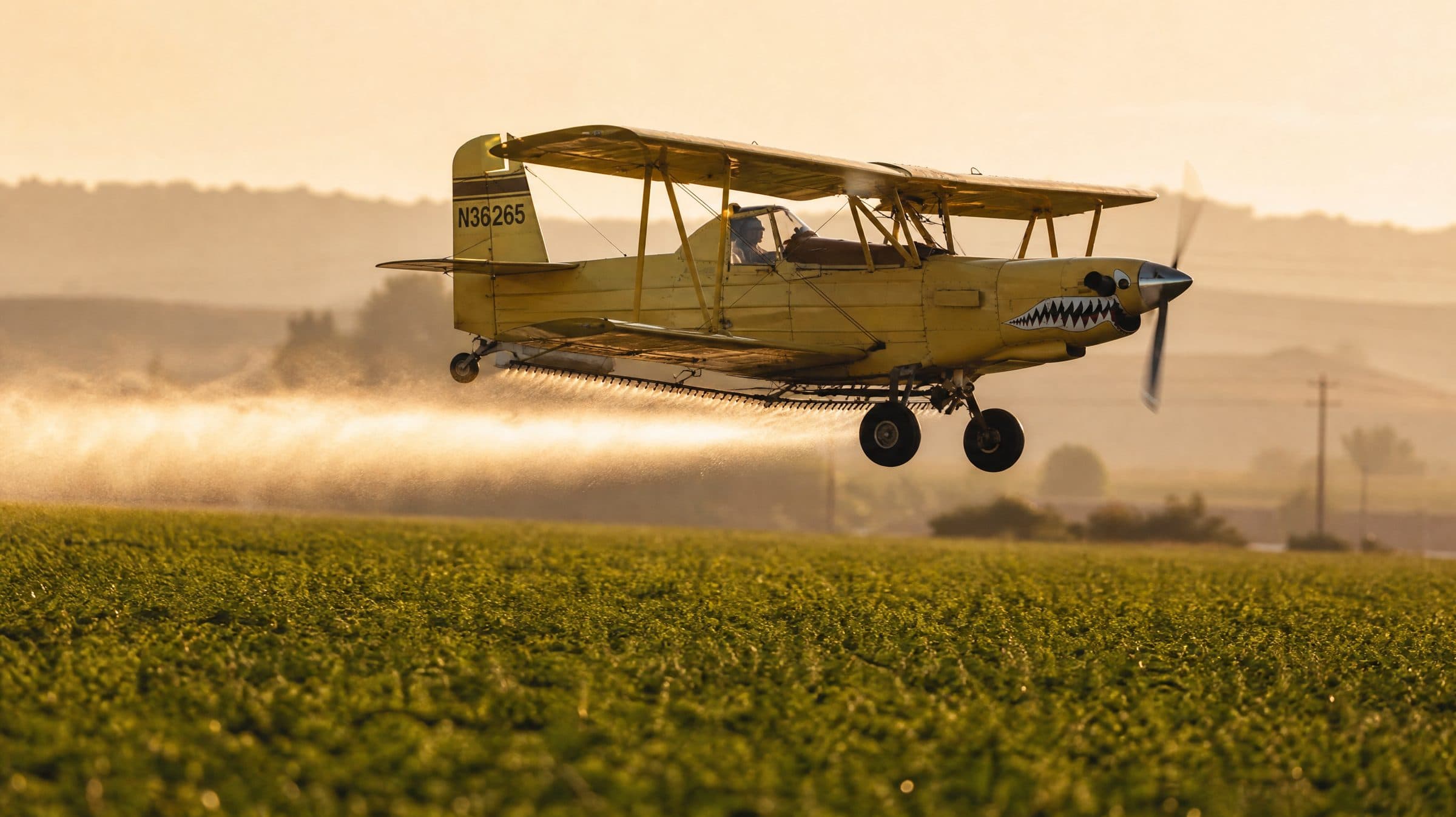
An airplane never drives through the crop. Purdue Extension measured what sprayer wheel tracks cost in Indiana soybeans sprayed at early flowering or later. The average yield loss was 4.9 percent with a 30-foot boom, 2.5 percent with a 60-foot boom and 1.3 percent with a 120-foot boom. More trips in the same tracks did not add more loss. Those trials were soybeans in Indiana, not Sacramento Valley crops, but the point holds here: the first pass through a standing crop costs plants. Wet ground is the other reason. After rain or an irrigation, a field may not carry a sprayer for days. The plane can work it as soon as the label and the weather allow. Speed matters as well. Most crop protection flights here are from May to August, and one aircraft covers many fields in a day.
Source: Purdue Extension SPS-103-W, wheel-track yield loss
Processing tomatoes lead the row crops here. Sutter County's 2025 crop report lists 13,400 acres of processing tomatoes, its third crop by value at $78.7 million. Colusa County's 2024 report lists 14,700 acres, worth $96.0 million. In 2025, Sutter County also harvested 8,970 acres of field corn, 7,820 acres of wheat and 2,210 acres of safflower. Each crop has its own pests and its own labels. In tomatoes, UC IPM says tomato russet mite damage usually shows first when green fruit is about 1 inch across. For that mite it prefers ground application, because the plants need thorough coverage. Other row-crop jobs, such as fertilizer, or cover-crop seed after harvest, suit the plane well. Your PCA decides which method fits each target, and we tell you if the job fits the airplane.
Sources: Sutter County 2025 crop report; Colusa County 2024 crop report; UC IPM, tomato russet mite
Start with the label and the county rules. The label sets the aerial spray volume. A January 2026 Penn State Extension table of corn and soybean herbicides labeled for aerial use listed minimum carrier volumes of 2 to 10 gallons per acre. Some herbicides also have season limits. Yuba County's phenoxy conditions (2019) ban fixed-wing and helicopter applications of herbicides such as 2,4-D on non-orchard sites from April 1 through October 15. On rice, DPR's suggested conditions set the same window in all five of our counties. Yuba County does not allow propanil by air at all. Then gather the job details: your PCA's written recommendation with the product, the rate and the gallons per acre, the field location, the acres, and the crops and homes next door. Mark power lines and other hazards on the map. With those details, we can confirm whether the job fits the airplane.
Sources: Penn State Extension, corn and soybean herbicides labeled for aerial use (2026); Yuba County permit conditions; DPR recommended permit conditions for rice pesticides (Compendium Vol. 3, Appendix D)