
Free guide for rice growers and PCAs
What to expect in a rice season.
Enter your seeding date. See the flights most rice fields get, about when they come, and what your PCA will look for.
Start hereWe filled in May 1 so you can see a full season. Change it to your own date.
These dates are for rice seeded onto a flooded field. They are rough. Cool weather and early seeding make rice grow slower. Dry-seeded rice heads about 5 to 7 days later.
Seeding by air
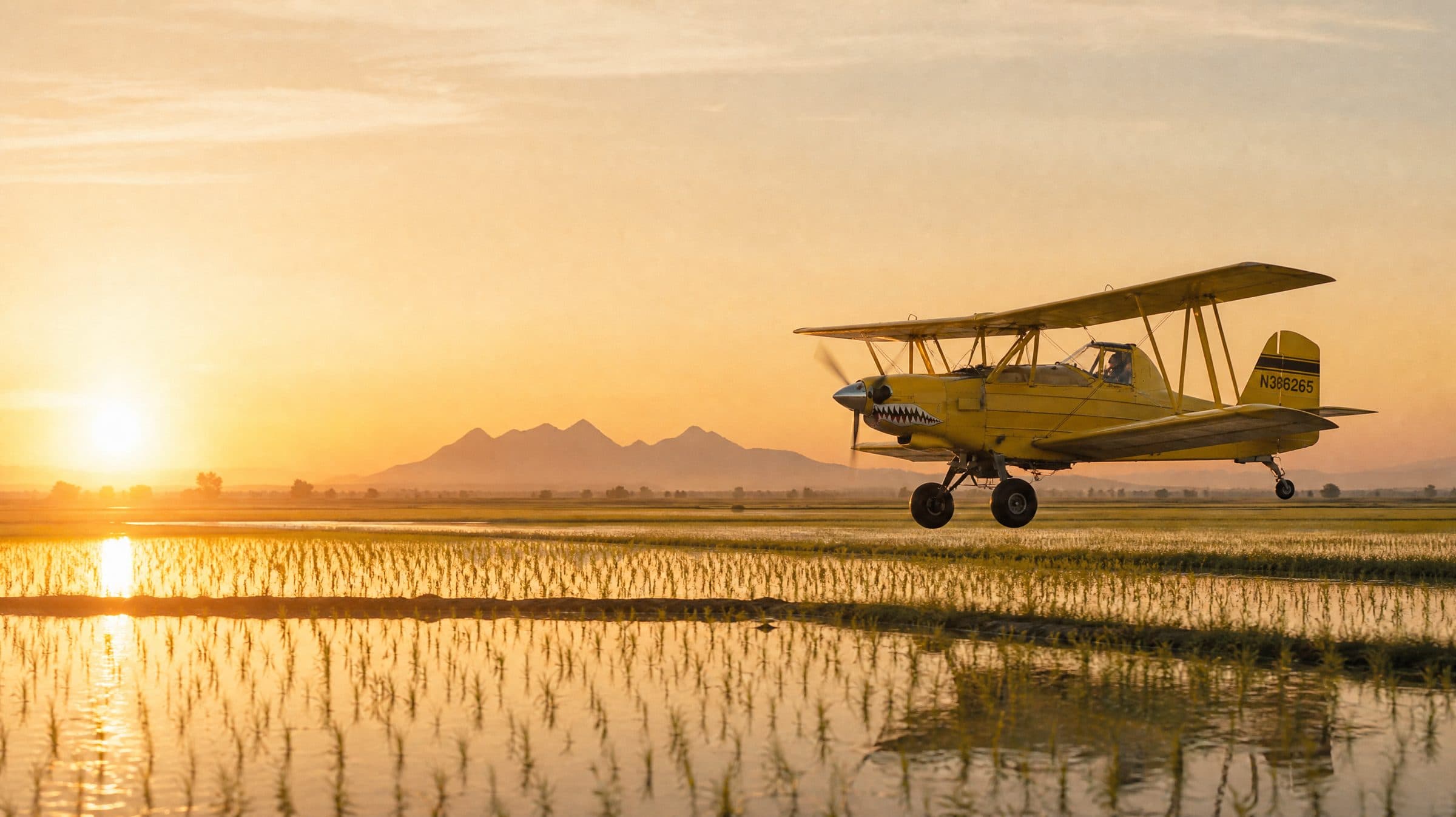
Most California rice is seeded by air onto a flooded field.
Good to know
- Seed as soon as you can after the field floods. Waiting gives shrimp and midges time to grow.
In UC's cost study, seed goes on by air from about April 20 to May 20.
Tadpole shrimp
These small animals hatch in the new flood. They chew sprouting seed and muddy the water.
Your PCA may call for this if
- While the seed is sprouting: you find shrimp in the field.
- After the rice has a spike and roots: you count fewer than 25 healthy seedlings per square foot, and you see signs of shrimp.
In UC's cost study, about 30% of acres get an insecticide flight for shrimp and weevils.
Algae
Algae can build up on the water while the rice is small. UC's best time to treat is from the first leaf to the third leaf.
Your PCA may call for this if
- Algae is building up on the water.
In UC's cost study, about 30% of acres get a flight for algae.
Rice water weevil
This small gray beetle lays eggs in flooded rice. Its young eat the roots. UC's best time to treat is from the first leaf to the fourth leaf.
Your PCA may call for this if
- This field has had weevil damage before, or it sits close to weedy ditch banks.
Timing matters most. Too early, and the spray is gone before the beetles come. Too late, and the eggs are already laid. Often only the 30 to 50 feet next to the levees needs a spray.
Watergrass and other weeds
Weeds take food and light from young rice. UC's best time to treat is from the first leaf until side shoots start to grow. A follow-up flight can go on soon after the side shoots start.
Your PCA may call for this if
- Watergrass, sprangletop, ducksalad or sedges are coming up in the field.
Some weeds no longer die from some herbicides. Your PCA picks a product that still works on your field.
In UC's cost study, a grass herbicide goes on all acres by air in May.
Nitrogen top-dress
Top-dressing means adding fertilizer to the growing crop. Decide at panicle initiation. That is when the young head starts to form inside the stem.
Your PCA may call for this if
- A leaf test or a crop sensor shows the rice is short on nitrogen.
In UC's cost study, about 75% of acres get a nitrogen top-dress by air.
Armyworm
These caterpillars chew rice leaves. Later they chew the stems that hold the grain.
Your PCA may call for this if
- Early summer: more than 25% of the leaves are gone in that part of the field, and the worms are still there.
- After heads come out: 10% of the heads are damaged, and the worms are still there.
See no worms? Check again in the evening. UC says not to spray if you still find none, and to treat only the damaged parts of the field.
In UC's cost study, about 25% of acres get an armyworm flight.
Stem rot, sheath spot and blast
These fungus diseases hurt the plant late in the season. The spray goes on at early heading, when the first heads show above the crop.
Your PCA may call for this if
- Stem rot was bad in this field last year.
- Aggregate sheath spot is climbing close to the top leaf.
- You see blast on the leaves, or blast is in your area. UC says blast sprays are only needed when the season is unusually wet.
In UC's cost study, about 75% of acres get one fungicide flight.
This is only a guide to what to expect. Most of these flights need a recommendation from your PCA (pest control adviser) first. Your PCA decides what your field needs and picks the product and rate. The label is the law.
Want to learn more? Read about rice growth stages and herbicide flights on rice. Grow orchards too? Try our orchard spray timing tool.
Questions
Common questions.
Your PCA (pest control adviser) decides that for your field. This guide shows what to expect. Most Sacramento Valley rice gets a grass herbicide by air in May. Many fields also get a flight for shrimp or weevils, a nitrogen top-dress, and a fungicide at early heading.
Talk to your PCA first. We need a recommendation from your PCA before we can fly most of these jobs. Once you have it, call us or send a request.
We count days from your seeding date. The day counts come from University of California rice research. The rules for when to spray come from the UC pest guides. Weather changes how fast rice grows, so use the dates to plan and check your field.
In California, a licensed PCA (pest control adviser) recommends the product and the rate for your field. This guide shows what to look for and when. Your PCA does the rest.
Our orchard tool counts heat units from trap catches. UC times most rice work by plant stage and by what you find in the field, so this guide starts from your seeding date.
UC says dry-seeded rice takes about 5 to 7 days longer to head. Move the later dates back by about that much. Ask your PCA about the early weeks, because shrimp and weeds act differently without a flood.

Ready to fly?
Talk to your PCA first. Once you have the recommendation, call us at (530) 695-2294, Mon–Fri, 8am–3pm. PCAs can send it to us directly.