
Rice
Herbicide application in rice: timing, water and drift control
By the Sutter Butte Dusters team · · 8 min read
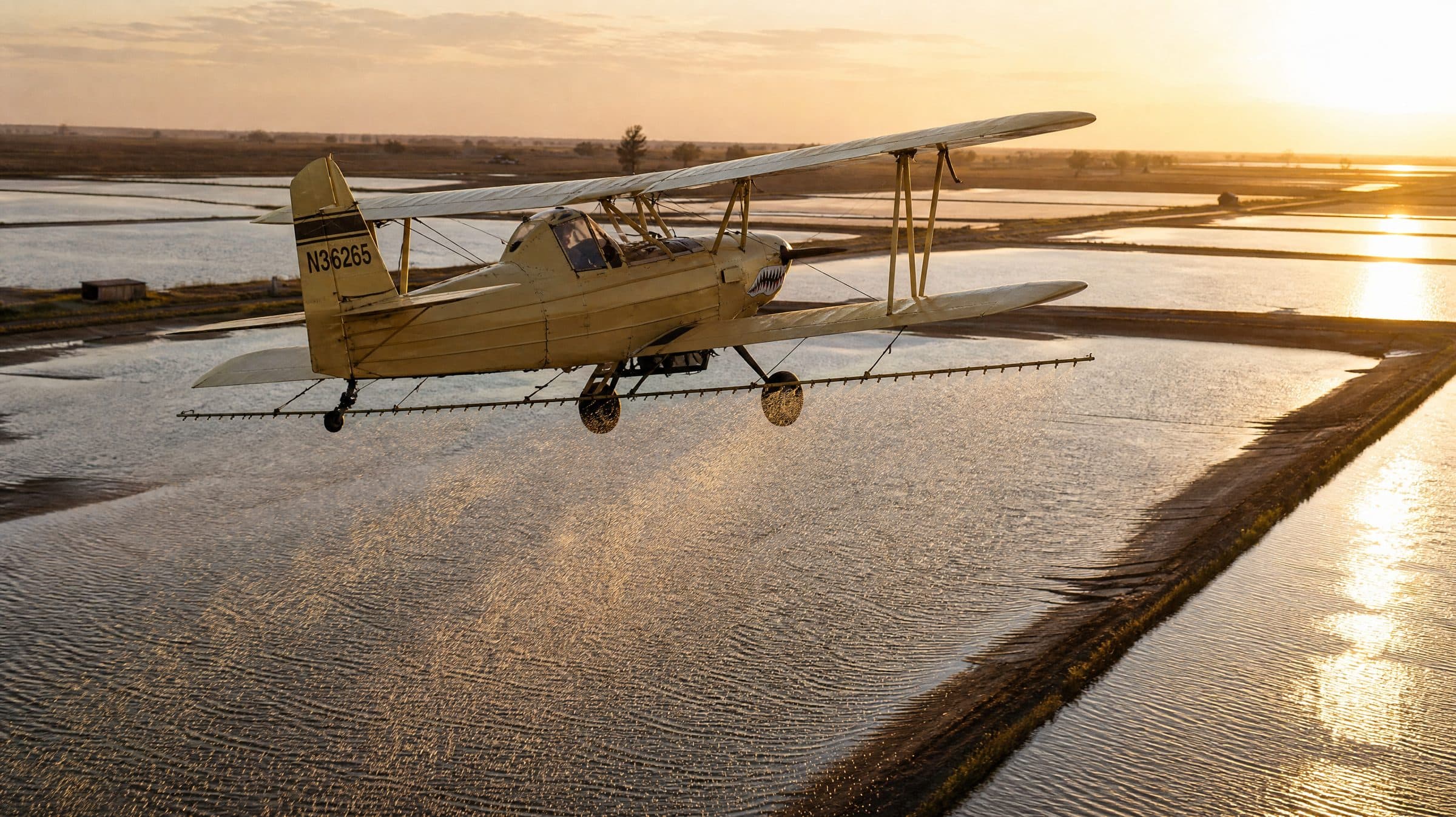
A successful herbicide application in California rice depends on three things: the rice leaf stage, the weed stage and the water in the check. If one of the three is wrong, the weeds survive and the grower pays for a second pass. This post covers timing, water, coverage, resistance and the drift rules for aircraft in our counties.
Which weeds does a rice herbicide program have to control?
California rice weeds fall into three groups: grasses, sedges and broadleaf weeds. The UC Statewide IPM Program (UC IPM) calls watergrass the most serious weed in continuously flooded rice. The name covers terrestrial barnyardgrass, early watergrass and late watergrass. Sprangletop is the other major grass.
The sedges include smallflower umbrella sedge and ricefield bulrush. The broadleaf weeds include ducksalad, redstem, California arrowhead and waterhyssop. Each rice herbicide controls only some of these species, so UC IPM puts monitoring and weed identification first (UC IPM integrated weed management for rice).
In California, a licensed pest control adviser (PCA) writes the recommendation, with the product, rate and timing for each field. The applicator follows the label and that recommendation.
How does water management change rice weed control?
UC IPM calls water management the most important cultural factor in rice weed control. The water depth decides which weeds emerge and whether a rice herbicide reaches them.
UC IPM gives these depth effects:
- 4 inches of water still gives good control of terrestrial barnyardgrass.
- Early and late watergrass grow through 4 inches of water. Their control by flood alone needs about 7 inches.
- Sprangletop usually does not emerge through more than 4 inches of water.
- Water up to 2 inches deep promotes the growth of all rice weeds.
- A drain of 3 to 5 days lets watergrass seedlings grow secondary roots. This greatly reduces the effect of the common watergrass herbicides.
Level ground makes these depths possible. UC IPM suggests a maximum basin depth of 5 inches. The shallow and deep areas should differ by 2 to 3 inches at most.
Each water system changes the herbicide timing.
| Water system | What the grower does | Effect on herbicide timing |
|---|---|---|
| Permanent flood | Holds 4 to 5 inches from seeding until about one month before harvest | Products go into the water, or onto weeds above it |
| Pinpoint flood | Drains the field 2 to 4 weeks after seeding, then refloods to 4 to 6 inches | Foliar products go onto the drained field |
| Leathers method | Drains the field right after seeding for 3 to 5 days, until the seed anchors | Plan the herbicide around the drain and the reflood |
| Stale seedbed | Flushes the field in spring and kills the weeds that emerge before planting | Good for resistance management, but planting can slip a few weeks |
| Dry seeding | Flies seed onto a dry field and flushes it | Allows a soil-applied product that a flood would break down |
Source: UC IPM integrated weed management for rice.
When is herbicide application timed in rice?
The UC IPM herbicide table times each product by the leaf stage of the rice or by the tillering stage. The leaf stage is the number of leaves on the rice seedling. Tillering is the stage when the plant produces side shoots. Many early products go on between the 1-leaf and 4-leaf stage. Many later products go on from the 4-leaf stage to mid-tillering.
The table also lists a water condition for each product.
| Mode of application | Field condition | Why it matters |
|---|---|---|
| Into the water | Field flooded, water held static | Moving water carries the product away from the weeds |
| Drained field | Water off, soil wet or dry as the label states | The spray must touch the weeds or the soil |
| Water lowered | About 70% of weed foliage above the water, 80% for some labels | A foliar product needs enough exposed leaf to work |
Source: UC IPM herbicide treatment table for rice.
Static water is the key to an into-water treatment. UC IPM notes that control fails first in the uppermost basins and around rice boxes, where water moves. Many labels also set a water-holding period after the herbicide application, of 20 days or more for some products. Your county agricultural commissioner sets the water-hold conditions on your permit.
Rice safety sets the other edge of the window. UC IPM warns that rice at the 1-leaf stage is very sensitive to thiobencarb. Propanil can burn rice leaf tips when the temperature is above 85 to 90°F.
What do REI, PHI and permits mean on a rice herbicide label?
The UC IPM table lists two intervals for each product. The restricted-entry interval (REI) is the time that workers must stay out of the treated field. The preharvest interval (PHI) is the minimum time from the application to harvest. In the table, the REI is 12, 24 or 48 hours, and a listed PHI is 60 to 120 days.
Two rice herbicides in the table need a permit from the county agricultural commissioner to buy or use: propanil and thiobencarb. For a tank mix, UC IPM says to follow every label in the mix and to use the most restrictive limits. For permits and who does what, see pesticide application rules in California.
Why does herbicide mode of action matter for resistance?
A resistant weed survives a product that once killed it. The UC IPM table lists resistant populations of watergrass, barnyardgrass, sprangletop, smallflower umbrella sedge, ricefield bulrush, California arrowhead and redstem.
The Weed Science Society of America gives each herbicide a mode-of-action group number.
| Group | How it acts | Use in rice, per UC IPM |
|---|---|---|
| 1 | ACCase inhibitor | Grasses, including sprangletop |
| 2 | ALS inhibitor | The largest group; broadleaf weeds, sedges and some grasses; many resistant populations |
| 4 | Auxin mimic | Broadleaf weeds and sedges |
| 5 | Photosystem II inhibitor | Contact action on grasses and sedges |
| 13, 14, 15, 27 | Other modes of action | Grass or broadleaf control with a different mode |
UC IPM advises growers with suspected resistant watergrass to avoid combinations and sequences of the groups where that resistance is common. A sequence of different groups helps slow resistance. A change of water system also helps, for example a stale seedbed in place of a permanent flood.
How does an airplane apply rice herbicide?
Aerial application (crop dusting) suits rice, because the fields hold water for most of the season. A ground rig cannot drive through the checks without crop damage. For a full comparison, see aerial spraying versus a ground rig.
Rice herbicides go on by air in three forms.
- Liquid spray. A boom under the wing applies the mix. This herbicide spraying suits foliar products.
- Granules. A spreader drops granules into the floodwater.
- Dry flowable products. UC IPM describes precision low-volume metering equipment for some dry products.
Coverage depends on the carrier volume and the exposed leaf. UC IPM lists propanil by ground or air in 10 to 15 gallons of water per acre. A higher volume gives better coverage on large grasses and dense weeds. A translocated product needs only about 70% of the weed foliage above the water.
Insecticide flights can conflict with the herbicide. UC IPM says to keep propanil and thiobencarb 14 days from a carbamate or organophosphate insecticide. Tell your PCA about every flight.
What drift rules apply to herbicide spraying over rice?
California has extra rules for propanil, because a small dose can injure a sensitive crop nearby. Under 3 CCR 6460, liquid propanil, 2,4-D and dicamba must follow these limits unless the permit allows otherwise:
- No release more than 10 feet above the crop or target.
- No application in wind over 10 mph.
- Boom pressure on aircraft at or under 40 psi.
- Nozzles that point backward, parallel to the line of flight.
- No nozzle device that makes a sheet, cone or fan pattern.
- A positive shutoff at each nozzle.
3 CCR 6462 adds rules for propanil in Butte, Colusa, Glenn, Placer and Yuba counties. It also covers Sutter County north of Sankey Road and Yolo County north of Highway 16. In these areas, emulsifiable concentrate formulations are not allowed. Aircraft must stay 4 miles from commercial prune plantings, and ground rigs must usually stay 1 mile away. Aircraft may treat no more than 720 acres per county per day. Yuba County's permit conditions go further and allow propanil by ground only.
The same rule sets the droplet size for each aircraft nozzle. The volume median diameter must be at least 600 microns. No more than 10% of the spray volume can be in droplets under 200 microns.
Some labels restrict aircraft further. UC IPM notes that cyhalofop needs ground application in some areas near fruit trees. For carfentrazone, Special Local Need labels (state registrations for a local use) cover the aerial methods. Our post on spray drift in aerial application covers the general methods.
How do you prepare a rice field for an herbicide flight?
Use these steps for each flight. The label and the PCA's recommendation come first.
- Get the PCA's written recommendation, with the product, rate and target weeds.
- Get the commissioner's permit if the product needs one.
- Record the rice leaf stage and the size of the weeds.
- Find the water condition that the label requires.
Caution: a drain of 3 to 5 days lets watergrass grow secondary roots. Keep the drain short.
- Set the water level for the label: static flood, drained field or water lowered.
- Close the rice boxes so that the water stays still.
- Mark the sensitive sites and the power lines near the field on a map.
- Send us the field location, acres, product, rate and gallons per acre.
Caution: an early release of treated water can break the permit conditions. Check the water hold before you open a box.
- Hold the water for the full period on the label and the permit.
- Keep workers out of the field until the REI ends.
- Scout the field after treatment and report surviving weeds to your PCA.
Surviving weeds can be a sign of resistance. For the other flights of the rice season, see rice pests and diseases, rice fertilizer top-dressing and our crop dusting season calendar.
Rice herbicide flights from Live Oak
Sutter Butte Dusters flies rice herbicide jobs across Sutter, Yuba, Butte, Glenn and Colusa counties. Rice is the main crop we fly, from our airstrip at 4080 Clark Rd in Live Oak. Our fleet has five Ag Cats and one Air Tractor 602. We apply the product your PCA recommends, at the label rate, and we plan each pass around the wind and the sensitive sites nearby. Learn more about our crop protection service and our rice work, or get a quote for your field.
Questions
Most rice herbicides go on at a set rice leaf stage, from about the 1-leaf stage to mid-tillering, while the weeds are still small. The label also sets the water condition: still floodwater, a drained field, or water lowered to expose the weeds. Your PCA picks the date for each field.
Still water keeps an into-water herbicide in place, so it reaches the weeds across the whole check. UC IPM reports that control fails first where water moves, near rice boxes and upper basins. Labels and county permit conditions also set holding periods for treated water.
Yes, with a county permit and extra limits. In Butte, Colusa, Glenn, Placer and Yuba counties and Sutter County north of Sankey Road, aircraft must stay 4 miles from commercial prunes, treat no more than 720 acres per county per day, and use nozzles that make droplets of at least 600 microns.
Identify the weeds, then use sequences or tank mixes of herbicides from different mode-of-action groups. Avoid repeated use of the groups that your weeds already resist. A change of water system, such as a stale seedbed in place of a permanent flood, also helps. Your PCA plans the program for each field.