Ag pilot careers
Crop duster loader: the ground job that keeps ag planes flying
By the Sutter Butte Dusters team · · 9 min read
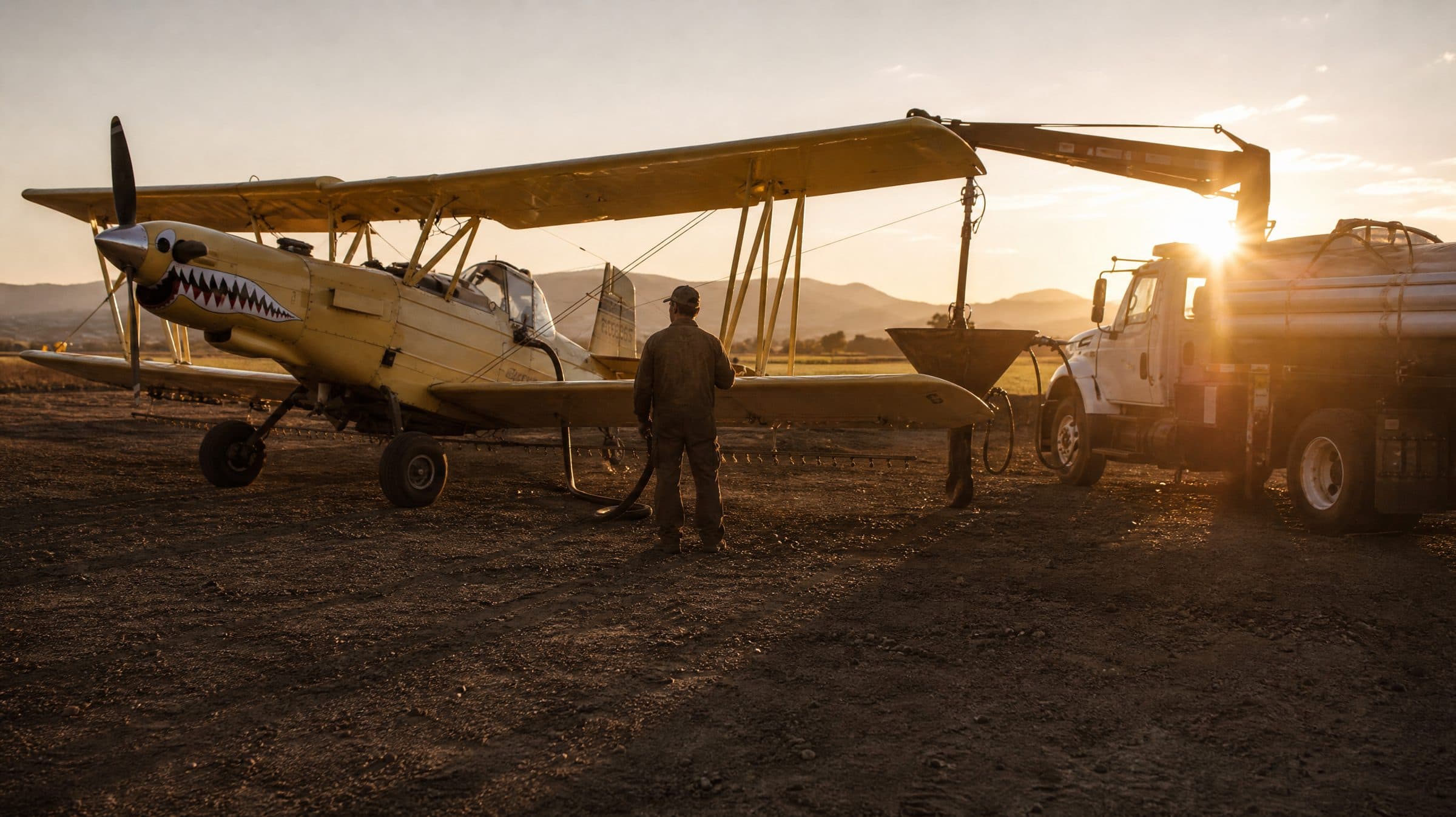
A crop duster loader is the ground worker who mixes the product and fills the aircraft between flights. The pilot cannot start the next field until the load is in the hopper, so the loader sets the pace of the day. This guide covers the work, the California rules, the season, the pay data and the path to the cockpit.
What does a crop duster loader do?
Aerial application (crop dusting) is the use of an aircraft to apply seed, fertilizer and crop protection products. The loader gets each load ready on the ground. Job boards also call an ag loader job a mixer-loader or aircraft loader job. In California, a loader who mixes or loads a pesticide is a pesticide handler under state rules.
A loader's main tasks are these:
- Read the work order for the field, the product and the amount for each load.
- Mix liquid products with water in the mix tank, as the label directs.
- Pump the liquid mix into the hopper, or fill the hopper with dry seed or fertilizer.
- Check the hopper for a secure cap and for leaks.
- Record each load.
- Rinse empty containers and clean the equipment.
- Keep people, vehicles and loose objects away from the aircraft.
The work order is the job sheet for the loader and the pilot. Our guide to preparing a field for aerial application shows what it holds. The grower's licensed pest control adviser (PCA) sets the product and the rate, and the loader never changes them.
How does one load cycle work?
A load cycle is the time from landing to takeoff with the next load. The loader mixes the next load while the aircraft is over the field, so the hopper fills as soon as the aircraft stops.
Warning: The engine can run while you load. Treat the propeller as live at all times, and stay out of its arc.
- Read the work order for the next load before the aircraft lands.
- Mix the next load in the tank, as the label directs.
- Wait for the pilot's signal before you go near the aircraft.
- Connect the load hose to the aircraft's fill connection.
- Pump the measured amount into the hopper.
- Close the valve and disconnect the hose.
- Check the fill point for leaks and a secure cap.
- Move clear of the aircraft and signal the pilot that the load is complete.
- Write the load on the load record.
A dry load follows the same steps with different equipment. A truck with an auger, or a machine with a bucket, fills the hopper with seed or granular fertilizer. Rice seed arrives soaked and drained, and soaked seed cannot wait long. Our guide to aerial rice seeding explains why.
How much does each load cover?
The hopper size and the application volume decide how many acres one load covers. The label and the PCA's written recommendation set the gallons per acre. The table uses two example volumes to show the arithmetic, not a recommendation.
| Aircraft we fly | Hopper | Acres per load at 5 gallons per acre | Acres per load at 10 gallons per acre |
|---|---|---|---|
| Schweizer Super B Ag Cat | 400 gallons | 80 acres | 40 acres |
| Air Tractor 602 | 630 gallons (type capacity); we usually load up to 500 gallons | 100 acres at 500 gallons | 50 acres at 500 gallons |
The loader's numbers become the dose on the crop, so each load must be exact. We fly about 4,000 applications a year, and each acre we fly gets 5 to 8 applications in a season. See the aircraft on our fleet page, or compare the Air Tractor 602 and the Ag Cat.
What pesticide handler training does California require?
California requires pesticide handler training before your first contact with a pesticide. The rule is Title 3 of the California Code of Regulations, section 6724 (3 CCR 6724). The employer must have a written training program and keep a record for each handler. DPR explains the program on its page for employers and trainers.
| Rule under 3 CCR 6724 | What it means for a new loader |
|---|---|
| Training before handling | You get training before you mix or load any pesticide. |
| Repeat each year | The employer repeats the training at least once a year and adds each new pesticide. |
| A qualified trainer | The trainer stays for the whole session and answers your questions. |
| Your language | The employer must give the training in a manner you can understand. |
| Age | A handler in commercial agricultural production must be at least 18 years old. |
| Records | The employer keeps your training record for 2 years. |
The topics include the label, how pesticides enter the body, the signs of overexposure and first aid. They also cover protective equipment, spill cleanup, heat illness and how to keep pesticides away from your family. Handler training is not a license. For the license path, read our guide to the California pesticide applicator license.
What safety gear and protections does a loader get?
The pesticide label sets the personal protective equipment (PPE) for each product. PPE is the gear that keeps the product off your skin, out of your eyes and out of your lungs. Our guide on how to read a pesticide label shows where to find the PPE list. California adds these employer duties:
- PPE care (3 CCR 6738). The employer supplies the PPE and inspects and cleans it each day. You do not take contaminated PPE home.
- Closed systems (3 CCR 6746). Some liquids must move through a closed system of sealed hoses and couplings. A label that says "Fatal if absorbed through skin" or "May be fatal if absorbed through skin" needs one. So does a label that says "Corrosive, causes skin damage," with a few exceptions. You still wear protective eyewear.
- Respirators (3 CCR 6739). If a label requires a respirator, you get a medical evaluation first. If the respirator has a tight-fitting facepiece, you also pass a fit test before first use and at least once a year. The employer pays for the respirator, the training and the evaluation.
- Wash water and eye flush (3 CCR 6734). The employer supplies at least 3 gallons of water per handler at the start of the day, with soap and single-use towels. Each decontamination site also has one clean change of coveralls. When the label requires eyewear or you use a closed system, the mix site needs an eye flush. It gives 0.4 gallons per minute for 15 minutes, or holds 6 gallons in containers.
- Emergency care (3 CCR 6726). The employer posts the name, address and phone number of the emergency medical facility.
- Medical supervision (3 CCR 6728). A handler who regularly mixes or loads certain organophosphate or carbamate products gets regular cholinesterase blood tests.
Caution: Read the label PPE list before you open any container. Different products need different gear.
How hot does the work get?
Summer loads go out in the hottest months of the Sacramento Valley year. Cal/OSHA's heat rule, 8 CCR 3395, protects outdoor workers. The employer supplies 1 quart of drinking water per worker per hour. Shade must be up when the temperature is over 80 degrees F. At 95 degrees F, agricultural employers give a 10-minute cool-down rest every 2 hours. A supervisor closely observes a new worker in a hot area for the first 14 days.
What happens in a new loader's first week?
Rules set most of a new loader's first week, before speed matters. Use this checklist to know what to expect and what to ask for:
- Complete pesticide handler training before you handle any pesticide.
- Learn where the decontamination site and the eye flush are.
- Find the posted emergency medical facility and its phone number.
- Get your PPE, and check the fit of the gloves, coveralls and eyewear.
- Complete the respirator evaluation and fit test, if a label needs a respirator.
- Read the written instructions for the closed system.
- Learn the hand signals that you and the pilot use near the aircraft.
Ask questions before you act. A short delay costs less than a wrong load.
When is the season for loaders in the Sacramento Valley?
Our season runs about March to September, and most of the work comes from May through July. The type of load changes with the crop calendar. The months below are our typical timing, and weather can move them.
| Work | Typical months | Main load type |
|---|---|---|
| Rice seeding | April and May | Dry: soaked rice seed |
| Fertilizer | April to July | Dry or liquid |
| Herbicide | May and June | Liquid |
| Fungicide and insecticide | June to August | Liquid |
Spring brings heavy dry loads of seed and fertilizer. Summer brings mostly liquid loads. Our rice, orchard and row crop pages show the crops behind each job.
What does a crop duster loader earn?
No public survey reports pay for ag aviation loaders alone. The closest federal figure is for pesticide handlers, sprayers and applicators of vegetation. The BLS Occupational Outlook Handbook gives these May 2025 figures.
| BLS occupation | Median hourly wage, May 2025 |
|---|---|
| Pesticide handlers, sprayers and applicators, vegetation | $22.28 |
| All grounds maintenance workers | $19.27 |
The BLS counts 25,700 pesticide handler jobs in 2025 and projects 4 percent growth from 2025 to 2035. This group also includes lawn and landscape spraying, not only farm work. Our starting pay is on our loader job page. For pilot pay, read our guide to crop duster pilot salary.
Can you get crop dusting jobs with no experience?
Yes. A loader job needs no pilot certificate and no prior ag work. The employer gives the handler training, and you must be at least 18 years old. These skills help a new loader most:
- Careful work with gallons, acres and load counts
- The ability to read a label and follow it exactly
- Calm work near a running aircraft
- Comfort with long days outdoors in heat and dust
Some ground jobs include truck work. Ask us whether the job includes a truck and which driver license it needs. For the other roles, read our overview of crop dusting jobs.
How do you go from loader to ag pilot?
No rule requires ground work before you fly, but a loader season teaches the job from the ground. You learn the products, the labels, the work orders and the pace of a season. A loader job does not replace the flight certificates.
- Get an FAA second-class medical certificate before you pay for flight training.
- Earn a private pilot certificate.
- Build flight time and earn the FAA commercial pilot certificate.
- Pass the two DPR exams for the apprentice pilot certificate.
- Fly as an apprentice under a journeyman pilot.
The FAA requires 250 hours of flight time for a commercial pilot certificate with an airplane rating under 14 CFR 61.129. The DPR pilot certificate packet (revision 7/24) sets the California steps. An apprentice passes the Laws, Regulations and Basic Principles exam and the Apprentice Pilot exam with 70 percent or higher. A journeyman needs at least 1 year as an apprentice and 150 hours of fixed-wing operation in the past 2 years.
Our guides to ag pilot training and agricultural pilot jobs cover the next steps. If you like engines more than flying, read about the ag aircraft mechanic job.
Crop duster loader jobs in Live Oak
We hire loaders and ground crew, ag pilots and A&P mechanics for each season. We fly five Schweizer Super B Ag Cats and one Air Tractor 602 from our airstrip at 4080 Clark Rd in Live Oak. Our loads go to rice, orchards and row crops in Sutter, Yuba, Butte, Glenn, Colusa, Placer and Yolo counties. The business has roots in 1951, and its incorporation dates to 1964. See the pay, the work and how to apply on our loader job page.
Questions
In California, you must be at least 18 years old to handle pesticides for commercial or research crop production. The state handler training rule, 3 CCR 6724, lists this age limit. A loader job that touches pesticides falls under that rule.
The work is physical and seasonal. Loaders move containers and hoses and work outdoors through the summer heat. Cal/OSHA requires drinking water, shade over 80 degrees F and cool-down rests at 95 degrees F. The hardest part is accuracy, because each load must hold the right product at the right amount.
The pesticide label sets the gear for each product. Labels often list chemical-resistant gloves, coveralls and protective eyewear, and some add a respirator. In California, the employer supplies the gear, inspects and cleans it each day, and keeps it. You never take contaminated gear home.
Yes, but loader work does not count toward the flight certificates. You still need an FAA commercial pilot certificate, which takes 250 hours of flight time, and the DPR apprentice pilot exams. A loader season teaches the products, labels and work orders that ag pilots use each day.