
Rice
Planting rice by airplane: soak, seed rate and timing
By the Sutter Butte Dusters team · · Updated · 8 min read
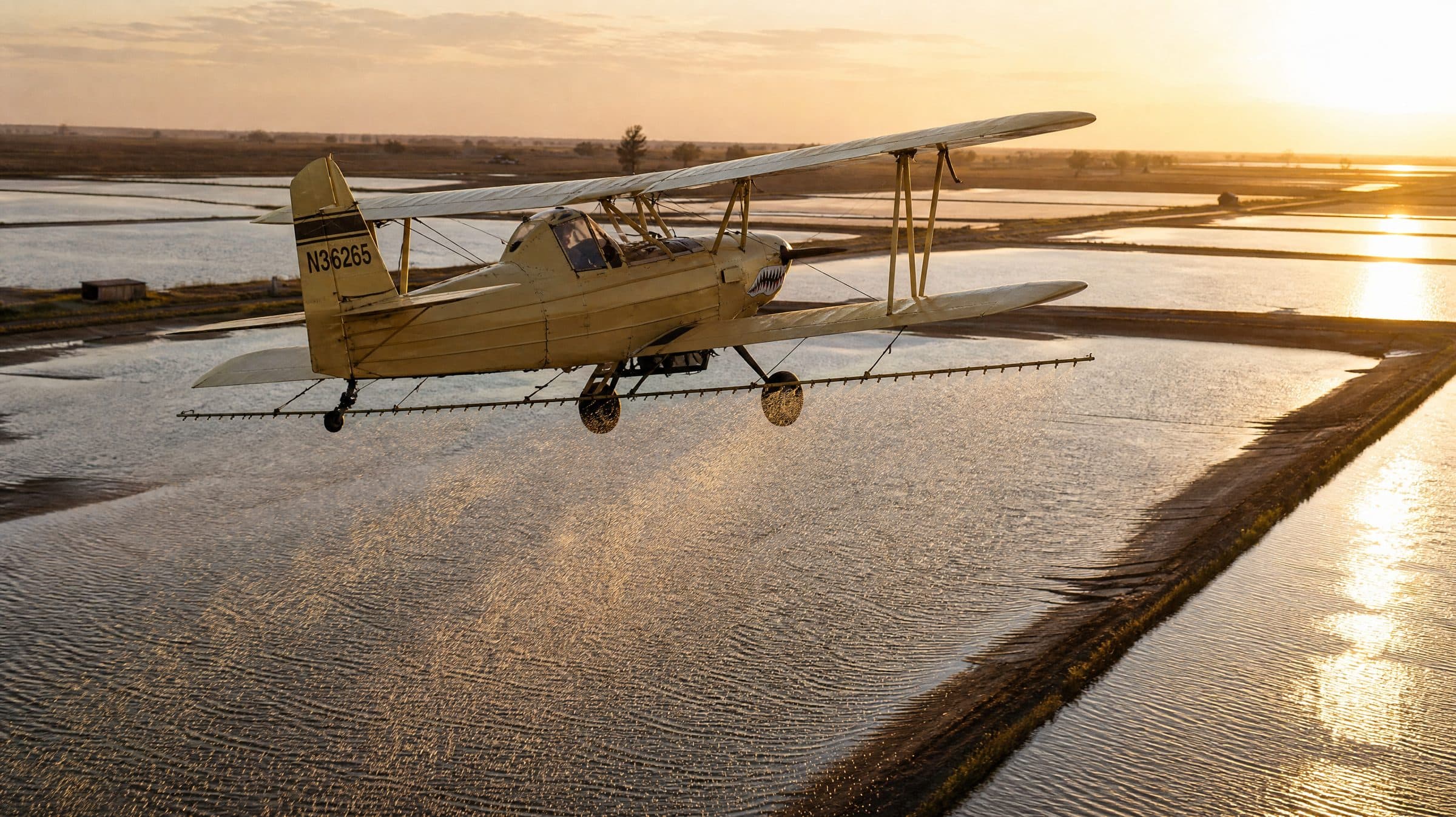
Planting rice by airplane is the normal way to sow rice in the Sacramento Valley. The grower floods each check (a level basin inside low levees), soaks the seed, and an airplane broadcasts the seed onto the water. This guide gives the soak times, seed rates, dates, costs and stand counts that decide whether the flight gives you a good stand.
Why is California rice planted by airplane?
California growers use a water seeded rice system: the field floods first, and the seed goes onto the water. UC IPM says this system started as a way to control terrestrial barnyardgrass, a grass weed that a deep flood suppresses. Ground equipment cannot work in a flooded check. An airplane does not compact the seedbed or leave wheel tracks.
Time is the second reason. Most of the valley sows in the same few weeks, and soaked seed cannot wait long. An airplane covers many checks quickly and puts the seed down while it is in good condition.
Aerial sowing rice is not new here. Local histories credit Floyd "Speed" Nolta, a pilot from the Willows area, with the first aerial rice seeding in the late 1920s. For the rest of the crop year, see how rice is grown in California.
How does planting rice by airplane work, step by step?
This usual sequence follows UC guidance. Your seed supplier or pest control adviser (PCA) may set different times.
- Roll the dry seedbed with a corrugated roller.
- Flood the check to a few inches of water.
- Soak the seed for about 24 hours in a soak bin or truck.
- Drain the seed for about 24 hours so that it flows freely.
Caution: Wet seed makes its own heat. Do not leave drained seed in a closed truck in the sun.
- Haul the drained seed to the airstrip.
- Load the seed into the hopper of the airplane.
- Fly even passes across the check at the seed rate on the work order.
- Hold or drain the water as your water plan says.
- Count the stand in the first weeks, and reseed thin areas early.
How long does rice seed soaking take before the flight?
Rice seed soaking does two jobs, says the 2023 UC rice production manual. Water replaces the air inside the seed, so the seed sinks and does not drift or bunch. The soak also starts germination in a tank, which is safer than a cold, flooded field full of pests.
The UC guideline is 24 hours in the water and 24 hours of drain, for a total of 48 hours. Drained seed flows well through the truck and the aircraft spreader. Seed with too little drain time sticks together, and the spread in the field is uneven.
Heat is the main risk when the flight is late. Soaked seed that waits in a warm truck can heat up and lose its ability to sprout. If north wind or a slow flood delays the plane, refill the bins with cool water. Park seed trucks in shade, take off the tarps and put sprinklers on top.
Most soak water also gets a disinfectant against bakanae, a seedborne fungal disease. UC IPM describes a chlorine seed soak for bakanae and says to sow within 12 to 24 hours after the drain. For any seed treatment, follow the label and your PCA's written recommendation.
The table shows how a rice seed changes in water at a steady 68 degrees F.
| Hours after the soak starts | What happens in the seed |
|---|---|
| 0 to 3 | The seed absorbs water fast |
| 12 | The seed looks hydrated; moisture is over 25% |
| 24 | UC guideline: end the soak and start the drain |
| 42 | The embryo swells and turns translucent; moisture is 36.5% |
| 48 | The embryo starts to split the hull; UC guideline: sow now |
| 60 | The first shoots break through the hull |
Source: California Rice Production Workshop manual, UC, 2023, chapter 4.
How much seed per acre does an airplane put on rice?
The 2021 UC cost study for Sacramento Valley rice uses 175 pounds of seed per acre, flown into a few inches of water. The UC manual gives a common range of 125 to 200 pounds per acre. A large-seeded variety gives fewer seeds per square foot at the same weight.
Water seeded rice needs a high rate because many seeds never become plants. In a 2015 UC trial with M-206, the plant density was about half of the seed density. Yield peaked at about 25 plants per square foot. At half of that stand, the yield potential was still about 90%.
The UC manual calls a high seed rate a form of insurance against stand loss. A very heavy rate can give weak stems and more foliar disease. For comparison, the UC example for dry seed drilled into a stale seedbed uses about 100 pounds per acre. Give us your seed rate when you book, and the pilot flies to that rate.
The table converts common seed rates into seeds per square foot, and into an estimate of plants if about half of the seed establishes.
| Seed rate, pounds per acre | Seeds per square foot, range by variety | Seeds per square foot, M-206 | Estimated plants per square foot, M-206 |
|---|---|---|---|
| 125 | 40 to 58 | 45 | about 22 |
| 150 | 48 to 69 | 54 | about 27 |
| 175 | 60 to 81 | 63 | about 31 |
| 200 | 65 to 92 | 72 | about 36 |
Source: California Rice Production Workshop manual, UC, 2023, chapter 1. Plant estimates assume that half of the seed makes a plant.
When is rice planted in the Sacramento Valley?
The 2021 UC cost study puts most planting from April 20 to May 20. For M-206, a common medium grain, the UC manual gives a preferred range of April 20 to May 25. The optimum is May 5 to 10. The manual defines warm areas as the valley north of Highway 20 and west of Highway 99. It says to avoid an early date in those warm areas for the very early varieties, such as S-102.
Temperature sets the pace of the stand. The UC manual gives a minimum germination temperature of 54 to 56 degrees F, and an optimum of 77 to 94 degrees F. In cool weather, rice comes up slowly, and seedling disease does more damage. In warm weather, tadpole shrimp and rice seed midge do more damage.
Most growers want the plane in the same weeks, so book early. For later flights, see our crop dusting season calendar.
How do you prepare a check for aerial rice planting?
The seedbed decides where the seed stops. UC IPM says to groove the seedbed with a heavy, ridged roller, across the prevailing wind. The grooves protect young seedlings from wind and wave drift.
Remove large clods and high spots before you roll. A roller needs dry soil, because moist soil cakes, the UC manual says. Seed must stay on the soil surface. Seed buried more than about 1 centimeter (0.4 inch) has low vigor or does not germinate, because flooded soil holds almost no oxygen.
Before the flight, complete this checklist:
- Flood the check to an even depth of a few inches.
- Set wind checks where UC IPM suggests them to stop seedling drift.
- Mark power lines, homes and other hazards on the field map.
- Send the field address, APN, or FSA farm and tract number. See how to find your APN or FSA farm number.
- Tell us the acres, the seed rate and the time the seed will finish its drain.
For the map and hazard steps, see how to prepare a field for aerial application.
What can go wrong after the seed hits the water?
Wind is the first risk. Wind and waves can push seed to one end of the check and leave open areas. Some growers drain the field 1 to 2 days after sowing and reflood it 4 to 7 days later. UC Davis researchers call this Leathers' method. A UC Cooperative Extension brief from Colusa County advises growers to avoid this drain. A drain also lets new weeds start, so match it to your weed plan.
Pests and disease are the second risk. Tadpole shrimp, rice seed midge and seedling disease all thin a new stand. Our guide to rice pests and diseases covers each one, and your PCA chooses any treatment.
Count the stand early. The UC manual suggests a sampling cylinder of a known size, such as 1 square foot, pushed gently into the soil. Count the healthy seedlings inside it at several places. If you reseed, UC gives a rate of 50 to 100% of the original rate, with the normal soak and drain.
What does it cost to plant rice by airplane?
The cost of planting rice by airplane has two parts: the seed and the flight. Aerial seeding is often priced by the weight of seed flown, not only by the acre. In the 2021 UC cost study, the air application of seed cost $12.00 per hundredweight, or about $21 per acre at 175 pounds. The seed itself cost much more, at about $57 per acre.
These figures are from 2021, and rates change with fuel, labor and demand. Our price depends on the acres, the seed rate, the ferry distance from Live Oak, and the field shape and obstacles. A quote for your field gives the real price. For other jobs, see crop dusting cost per acre.
The table shows the seeding costs in the 2021 UC study, priced per hundredweight (cwt, 100 pounds) of seed at 175 pounds per acre.
| Item | 2021 study price | Cost per acre |
|---|---|---|
| Medium-grain rice seed | $32.50 per cwt | $57 |
| Chlorine seed soak | $2.25 per cwt | $4 |
| Seed delivery | $0.70 per cwt | $1 |
| Air application of seed | $12.00 per cwt | $21 |
| Total for seed and seeding | $83 |
Source: UC Davis, Sample Costs to Produce Rice, Sacramento Valley, 2021. These are study figures from 2021, not Sutter Butte Dusters prices.
Rice seeding from Live Oak
Rice is the main crop we fly. Our five Ag Cats and one Air Tractor 602 fly from our strip at 4080 Clark Rd in Live Oak. Rice ground in Sutter, Yuba, Butte, Glenn and Colusa counties is a short flight away. We seed flooded checks in spring, then fly the later herbicide, fertilizer and insect control flights. See our aerial seeding service and our rice page. Send your field location, acres, seed rate and target date, and book rice seeding.
Questions
Water seeded rice is rice sown onto a flooded field, so the seed settles on the soil under a few inches of water. Most Sacramento Valley rice grows this way. In the Delta, many growers drill dry seed instead, because the light, high organic matter soils can bury water-sown seed.
Drones and helicopters can sow seed, but most California rice is seeded by airplane. At 175 pounds per acre, a 100-acre field takes 17,500 pounds of dry seed. An airplane carries large loads and covers that acreage inside the short planting window.
Birds can feed in a newly seeded check. The 2021 UC cost study notes that some growers use propane cannons, also called zon guns, to scare birds away, and someone must check them daily. Soaked seed sprouts and anchors quickly, so it spends less time exposed.
Yes. In dry seeding, the grower puts unsoaked seed on the soil and covers it shallowly with a roller or harrow, or drills it like wheat. The grower then flushes water across the field until the rice is up. The permanent flood usually starts at the 3 to 4 leaf stage.
