
Rice
California rice: where it grows and how it is farmed
By the Sutter Butte Dusters team · · 8 min read
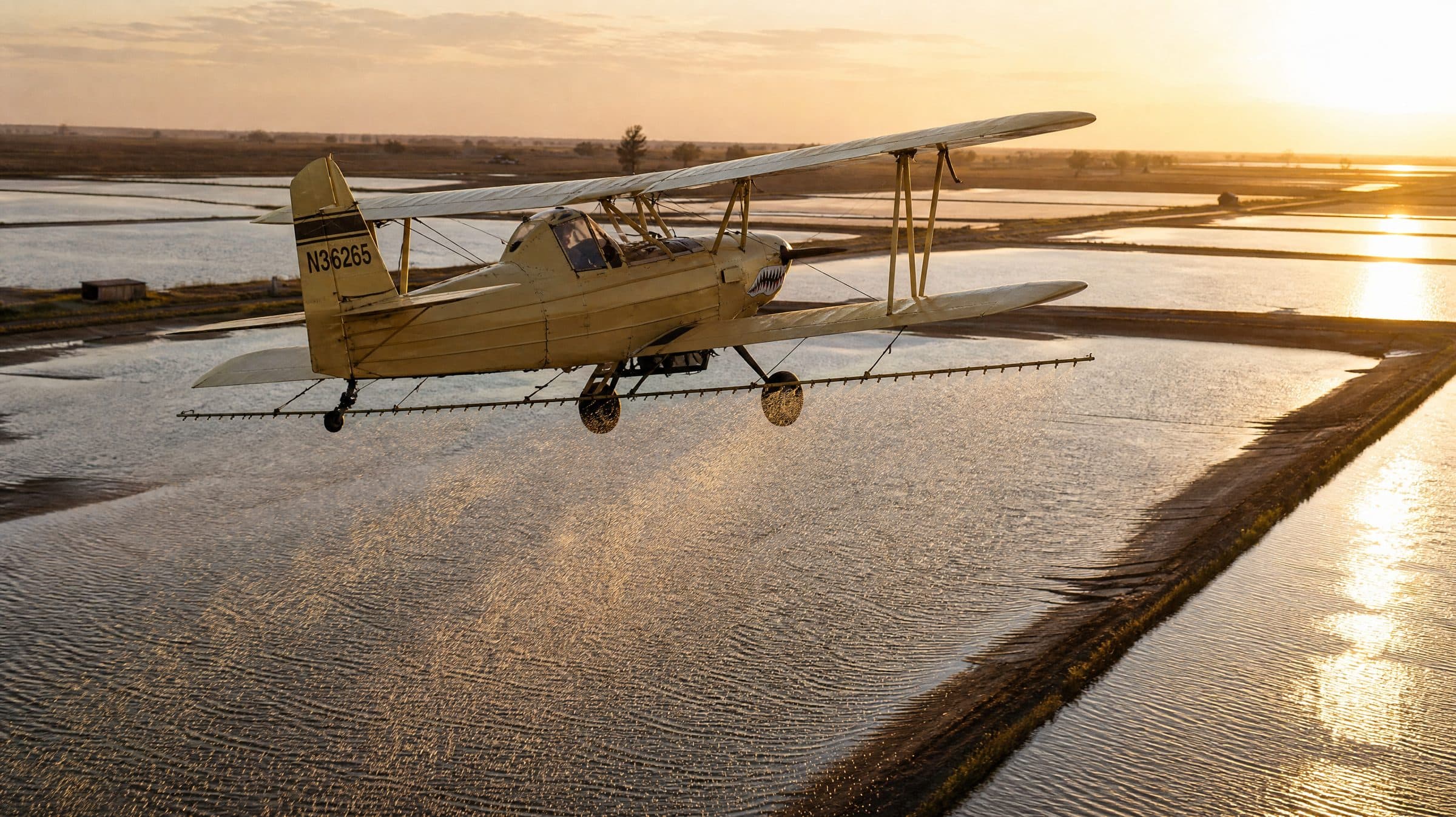
California rice is a flooded crop, and about 95% of it grows in the Sacramento Valley. Growers flood level fields in spring, seed most of them by airplane, hold water on the crop all summer and harvest in the fall. This guide covers where it grows, how many acres the state plants, and each step from the spring flood to the winter flood.
Where is rice grown in California?
Rice grows mainly in the Sacramento Valley, on heavy clay soils that hold water. The UC Davis rice agronomy program puts the valley's share at about 95%, with the rest in a few northern San Joaquin Valley counties. These soils drain slowly, which suits a flooded crop but limits many other crops. According to USDA Farmers' Bulletin 1141, the first commercial crop was 1,400 acres near Biggs in Butte County in 1912.
The table shows the latest county data from the USDA National Agricultural Statistics Service (NASS), in its March 2024 California Rice County Estimates. NASS withholds a county number that could show one farm's data, and adds those acres to "other counties."
| County | Planted acres, 2022 | Planted acres, 2023 | Yield in 2023, pounds per acre |
|---|---|---|---|
| Colusa | 20,600 | 135,000 | 8,670 |
| Sutter | 50,000 | 109,000 | 8,260 |
| Glenn | 21,600 | 75,500 | 8,740 |
| Butte | 86,500 | Withheld | Withheld |
| Yuba | Withheld | 34,600 | 8,480 |
| San Joaquin | Withheld | 10,000 | 8,460 |
| Other counties | 75,300 | 150,900 | 8,710 |
| State total | 254,000 | 515,000 | 8,590 |
All five counties in our service area are major rice counties: Sutter, Yuba, Butte, Glenn and Colusa.
How many acres of rice does California plant?
Water supply sets the acreage each year. In the 2022 drought, growers planted less than half of the 2023 total. The June 2026 NASS Acreage report gives these planted acres for California:
- 2025: 524,000 acres, with 480,000 acres of medium grain
- 2026: 455,000 acres, with 420,000 acres of medium grain, 25,000 acres of short grain and 10,000 acres of long grain
The 2026 number is a June estimate, and NASS can revise it. By the same report, California planted about 23% of all U.S. rice in 2026.
What kind of rice is California rice?
Most of it is medium-grain japonica rice. The 2023 UC California Rice Production Workshop manual says that about 80% of the acreage is Calrose-type medium grain. The grower-funded Rice Experiment Station at Biggs released the original Calrose in 1948. Today, growers plant newer "M" varieties, and M-206 alone covered about 131,000 acres in 2021. Short grain, sweet rice and aromatic long grains fill smaller acreage.
How is rice grown in California?
Rice farming in California uses a water-seeded system. The grower floods the field first, and then the seed goes onto the water. A check is one level basin of a rice field, held in by low levees. Ground equipment cannot cross a flooded check, so aerial application (crop dusting) seeds most California rice. UC IPM says the system started as a way to control terrestrial barnyardgrass, which 4 inches of water still suppresses.
The table shows the usual order of work. The planting and harvest dates are from the 2010 NASS usual planting and harvesting dates, and weather moves them each year.
| Stage | Usual timing | What the grower does | Aircraft work |
|---|---|---|---|
| Field preparation | March and April | Tills, levels, fertilizes, rolls | None in most fields |
| Flood and seed | April 20 to June 10; most active May 1 to May 25 | Floods the checks, then seeds | Aerial seeding of soaked seed |
| Stand and weed control | First 45 days after seeding | Scouts weeds, adjusts water, treats weeds | Herbicide flights |
| Midseason | June to August | Top-dresses, scouts insects and disease | Fertilizer, insecticide and fungicide flights |
| Drain | About 1 month before harvest | Drains the field for the combines | None |
| Harvest | September 5 to November 10; most active September 15 to November 1 | Harvests at the target grain moisture | None |
| Winter | November to February | Breaks down straw, often under a flood | None |
How do growers prepare a rice field?
Field preparation starts with a level seedbed. UC IPM says a basin should vary no more than 2 to 3 inches between its shallow and deep areas. It gives a maximum water depth of 5 inches and a slope between levees of 0.25 feet or less.
UC IPM advises growers to inject or incorporate nitrogen and phosphate 2 to 4 inches deep before the flood. At that depth, it feeds the rice more than surface weed seedlings. Last, a heavy ridged roller grooves the seedbed to protect young seedlings from wind and wave drift.
How is rice planted and watered?
Most growers soak the seed so it sinks, and then the airplane seeds it onto the flood. Our post on aerial rice seeding in the Sacramento Valley describes the flight. UC Davis rice specialist Bruce Linquist reported that growers had planted about 25% of the 2025 crop by May 1. The 50% date was May 16, a few days later than the May 13 average.
After seeding, the grower chooses a water plan. UC IPM describes three common plans:
- Permanent flood: The grower sets 4 to 5 inches of water soon after seeding., and holds it all season.
- Pin-point flood: The grower drains the field 2 to 4 weeks after seeding for a foliar herbicide, then refloods to 4 to 6 inches.
- Leathers' method: The grower drains the field for about 3 to 5 days after seeding, so the roots anchor, then refloods.
How do growers control weeds, insects and disease?
UC IPM says early and late watergrass grow through 4 inches of water, so control by water alone takes about 7 inches. UC IPM tells growers to scout every 3 to 4 days for 21 days after the flood. After that, scouting is weekly until about 45 days after seeding. The period from 21 to 45 days is critical for weeds with herbicide resistance.
Your licensed pest control adviser (PCA) chooses the herbicide and the timing, and every application follows the label and the PCA's written recommendation. See herbicide application in rice for how the flights fit the water plan. UC IPM also warns against a top-dress into the water before the rice canopy covers the field. See rice fertilizer top-dressing.
Pest pressure changes each year. For 2025, Linquist reported more bakanae disease and armyworms than normal, and early signs of pyrethroid resistance in tadpole shrimp. Our guide to rice pests and diseases covers each common problem.
Use this checklist before you book an aerial job on rice:
- Send the field location: address, APN, or FSA farm and tract number.
- Send the PCA's written recommendation and the product label.
- Tell us the acres and the target date.
- Mark power lines, homes and other hazards on a map.
Caution: UC IPM says a long drain lets new weeds start, and a late reflood reduces herbicide control.
- Tell us when the check will drain and when it will reflood.
- Confirm the water level on the day of the flight.
To find the numbers for step 1, see how to find an APN or FSA farm number.
When is the rice harvest in California?
The rice harvest usually runs from mid-September to the start of November. Growers drain the field about a month ahead, so the soil can carry a combine. The goal is a grain moisture that keeps head rice yield (whole kernels after milling) high.
The 2023 UC workshop manual gives these facts about harvest moisture:
- Most newer Calrose varieties keep a stable head rice yield down to about 18 to 19% moisture.
- M-209 and M-211 are less stable, so growers avoid a low-moisture harvest with them.
- Kernels at 15% moisture or less are likely to crack after several hours of dew.
Grain moisture can change 5 or more percentage points in 24 hours around a dry north wind. For this reason, growers sample at the same time each day, such as noon. The west side gets more north wind days, from about 1 near Nicolaus to about 4 near Orland. Rain also delays harvest: in 2025, some fields were still in harvest in early December, Linquist reported.
What happens to rice fields after harvest?
Straw management is the main fall job. The Connelly-Areias-Chandler Rice Straw Burning Reduction Act of 1991 limits straw burning (Health and Safety Code section 41865). Since 2001, a grower can burn only with a conditional permit, after the county agricultural commissioner confirms a rice disease. A grower can burn up to 25% of planted acres, and the Sacramento Valley Air Basin total cannot exceed 125,000 acres.
Most growers now chop and incorporate the straw, then flood the fields in winter so it breaks down. UC IPM notes that the wetter soil limits fall tillage for weed control.
How do rice fields feed birds and salmon?
Winter-flooded rice is habitat on the Pacific Flyway. Audubon California reported that growers flood about 235,000 acres of rice after harvest in a good year. Some waterbirds find half of their food there.
A February 2025 UC Davis and Point Blue report sets a conservation footprint of about 470,000 to 500,000 acres of rice. Within it, the report lists 30,000 acres for native fish, 43,000 for sandhill cranes and 80,000 for giant garter snakes. The authors call winter flooding especially critical.
In the Nigiri Project, UC Davis and its partners raised young Chinook salmon on flooded rice at Knaggs Ranch in the Yolo Bypass. UC Davis reported the fastest juvenile Chinook growth ever recorded in the Central Valley. The fish fed on zooplankton, tiny animals that multiply in the flooded fields.
Some farms now send that food to the river. Growers hold winter water on the straw for a few weeks, then pump or drain it into the Sacramento River. In 2018, Capital Public Radio reported 12 farms on about 50,000 acres, at about $45 per acre for one farm. In March 2025, the Floodplains Forward Coalition reported 147,500 pounds of fish food from 25,000 acres.
Rice work in the northern Sacramento Valley
Rice is the main crop we fly. Our five Ag Cats and one Air Tractor 602 work from our strip at 4080 Clark Rd in Live Oak. They seed flooded checks and fly herbicide, fertilizer top-dressing and insect control in Sutter, Yuba, Butte, Glenn and Colusa counties. Our rice page and our crop dusting season calendar show where each job falls in the year. To book work on your rice fields, get a quote for your field.
Questions
The flood controls weeds. UC IPM says the water-seeded system began as a way to control terrestrial barnyardgrass, which 4 inches of water still suppresses. After harvest, many growers flood again so the straw breaks down and waterbirds can feed.
NASS reports an average of 8,590 pounds per acre in California in 2023 and 8,770 pounds in 2022. County averages in 2023 ranged from 8,260 pounds in Sutter County to 8,740 pounds in Glenn County.
Of the counties NASS reported for 2023, Colusa planted the most rice, with 135,000 acres. Sutter followed with 109,000 acres and Glenn with 75,500. NASS withheld the Butte County figure that year. In the 2022 drought, Butte had the largest published acreage, 86,500 acres.
Only in limited cases. Under Health and Safety Code section 41865, a grower needs a conditional permit for a rice disease that the county agricultural commissioner confirms. The limit is 25% of planted acres, with a Sacramento Valley total of 125,000 acres. Most growers incorporate the straw instead.
