
Rice
Rice water weevil, blast and other Sacramento Valley rice pests
By the Sutter Butte Dusters team · · 8 min read
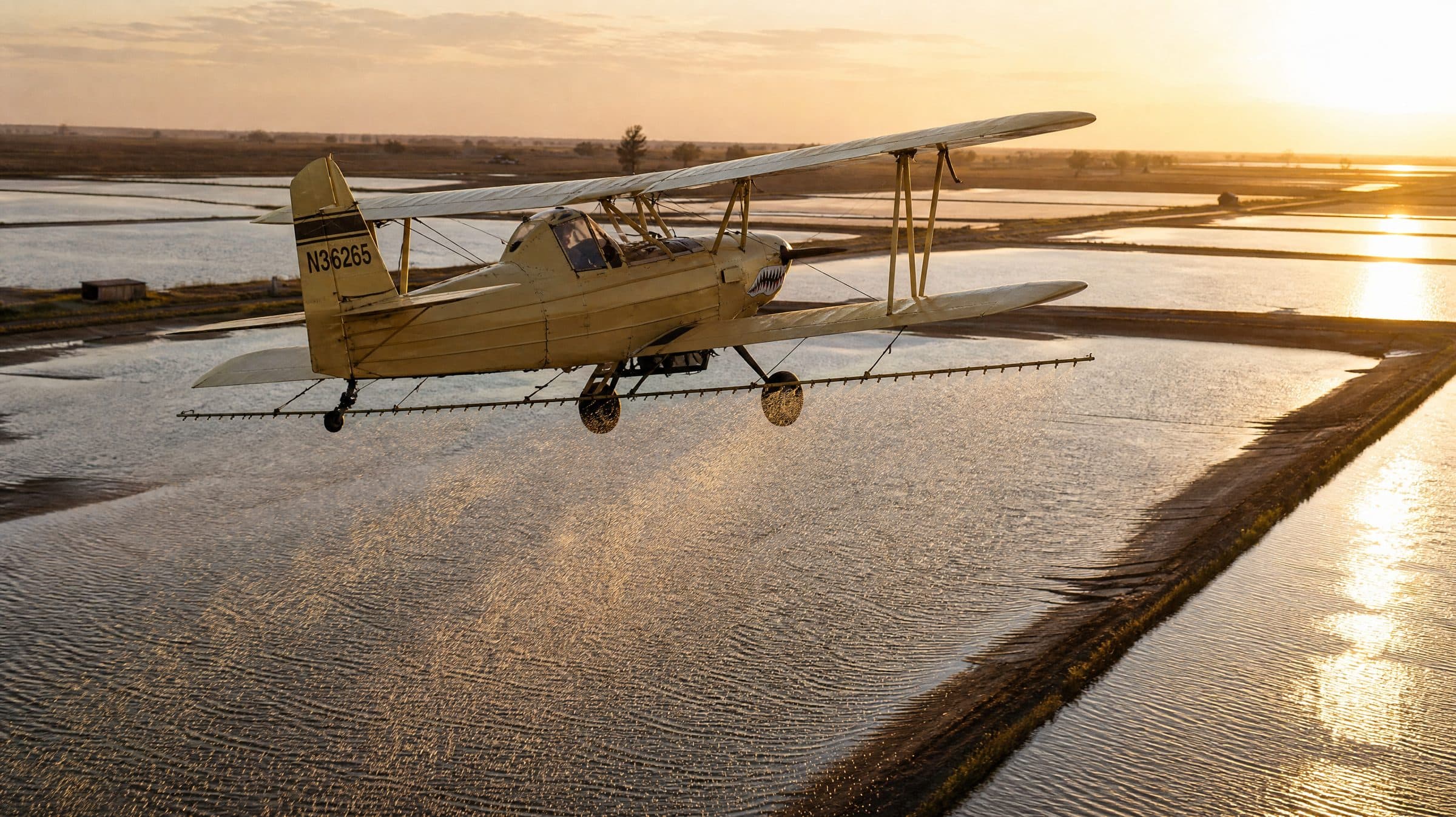
The rice water weevil, the true armyworm, rice blast and stem rot are four common pest and disease problems in Sacramento Valley rice. Each one has a short window when a treatment works, and the windows fall at different crop stages. This post explains how to identify and scout each problem, and where an aerial application (crop dusting) fits.
Which pests and diseases matter most in California rice?
The table puts the four problems in crop-stage order, with the action point from the UC Statewide IPM Program (UC IPM). A PCA is a licensed pest control adviser, who writes the treatment recommendation in California.
| Problem | Type | When it starts | What to look for | UC IPM action point |
|---|---|---|---|---|
| Rice water weevil | Insect | At flooding | Thin feeding scars on upper leaves | No numeric threshold; use field history |
| True armyworm | Insect | Late June | Ragged leaves, then white panicle branches | Over 25% defoliation, or 10% damaged panicles, with larvae present |
| Rice blast | Fungus | Boot to heading | Diamond-shaped leaf spots, rot below the panicle | Protect panicles as they leave the boot |
| Stem rot | Fungus | Tillering | Black spots on sheaths at the water line | Use last year's disease level |
Sources: UC IPM guidelines for rice water weevil, armyworms, rice blast and stem rot.
For the full season, see our guide to California rice farming.
What is the rice water weevil, and how does it damage rice?
The adult is a gray beetle about 1/8 inch long, with a long beak and a dark mark on its back. In California, all weevils are female, and they lay eggs without mating. The adults spend the winter in grass and weedy debris on levees and ditch banks. They start to feed when daytime highs go above 70°F in late winter or early spring.
The adults fly to flooded fields on calm, warm evenings, from sunset to midnight. Each female lays eggs under water, inside the leaf sheath, and one female can lay more than 200 eggs. The legless white larvae hatch in about 7 days and feed on the roots. Root loss stunts the plants, reduces tillers and panicles, and delays maturity.
The pest has one generation per year. Damage is heaviest from late May to July, within 15 to 20 feet of levees and field edges. Damage is moderate from 20 to 35 feet out.
How do you scout for rice water weevil?
Look for feeding scars on the upper leaves soon after the field floods. The scars are long, pale slits that run along the leaf. They prove that adults are present, but they do not measure the population. Some southern extension services count adults with a sweep net near the levees. UC IPM gives no sweep-net count or numeric treatment threshold for California.
Use these factors to decide with your PCA:
- Field history. A field with damage in past seasons will probably have damage again.
- Overwintering sites. Fields next to ditch banks, riparian areas or weedy canal banks get more weevils.
- Field shape. Small fields with many levees have more edge per acre.
- Early egg-laying. Females can lay eggs before the rice comes out of the water, so a few scars can still mean serious injury.
When should you treat for the weevil?
Timing is critical, because the pest has only one generation. A late treatment misses the eggs and larvae, and an early treatment breaks down before the adults arrive.
UC IPM describes three groups of rice insecticide for the rice water weevil. Pyrethroids kill the adults, but the foliar sprays do not kill the larvae, which do the most damage. An insect growth regulator sterilizes adult females for about 7 days and kills eggs up to 3 days old. A neonicotinoid gives the best larval control when it goes on after the flood, at the 1 to 3 leaf stage. A rescue treatment at the 5-leaf stage gives only partial control.
Placement and water rules differ by product. For a pyrethroid or the insect growth regulator, a band 30 to 50 feet wide along the levees usually gives acceptable control. The growth regulator goes on 2 to 5 days after the rice emerges above the water. UC IPM lists a 7-day floodwater hold for the pyrethroids and a 14-day hold for the growth regulator. California neonicotinoid rules took effect on January 1, 2024, and they can lower the permitted rate. Your PCA's written recommendation and the label set the product, rate, timing and water hold.
Southern growers often rely on insecticide seed treatments, but the UC IPM guideline for California lists only treatments timed to the flood.
Cultural steps reduce weevil numbers before any spray. UC IPM reports that winter flooding can cut weevil numbers by about 50%. Spring weed control on levees removes shelter, and large, laser-leveled fields have less edge per acre. Dry or drill seeding, with the flood 4 to 6 weeks later, also reduces injury.
How do you know when rice armyworm needs treatment?
UC IPM reports that only the true armyworm causes economic damage to rice, so "rice armyworm" usually means this species. The moth is buff-colored, with a 1.5-inch wingspan and one white spot on each forewing. The pest has two generations per year in rice. The larvae feed at night and hide near the water during the day. They chew the leaves first, and later they feed on the panicle branches, which break and turn white.
Follow this scouting procedure from late June:
- Walk a line through the field, and stop every 5 to 10 feet for 10 stops.
- Examine the plants from the water line to the leaf tips.
- Check the water surface for larvae that dropped off the plants.
- After the panicles emerge, examine a 1-square-foot area at each stop.
- Record the percent of damaged panicles and whether larvae are present.
- Repeat the survey in several parts of the field, twice a week.
UC IPM sets these action points:
- Late June to early July. Consider a treatment only where defoliation is more than 25% and larvae are present.
- Mid to late July. Do not treat if you find no larvae, because they have probably finished feeding.
- Panicle emergence to maturity. Consider a treatment if 10% of panicles have damage and larvae are present.
- Damage but no larvae. If an evening check finds no larvae, do not treat. They have probably pupated.
Stem rot, cool-temperature blanking and rat damage also cause white panicles, so confirm the cause first. Parasitic wasps, disease and drowning kill many larvae. UC IPM lists a Bt (Bacillus thuringiensis) product for organic fields, with 50 to 60% larval mortality, and two insect growth regulators. Treat only the parts of the field with economic damage.
What causes rice blast, and when do you apply a rice fungicide?
Rice blast is a fungal disease that UC IPM reports was first identified in California in 1996. On leaves, it makes diamond-shaped spots about 1/2 inch long, with a gray center and a brown border. The most serious form is neck blast, a rot just below the panicle. An early neck infection leaves the panicle white and empty.
Weather sets the risk. Blast develops fastest with long leaf wetness, humidity above 90%, little night wind and night temperatures above 68°F. Infected seed is the main source of the fungus, and infected straw is the second.
Cultural steps come first:
- Plant certified, disease-free seed.
- Keep the field continuously flooded, and avoid long drain periods.
- Do not apply excess nitrogen.
- UC IPM rates M-210 as resistant to current California races, and M-105 and M-209 as very susceptible.
Leaf blast alone seldom needs a rice fungicide; the goal is to protect the panicles. UC IPM lists a FRAC group 11 fungicide, with the first application at mid-boot to boot-split. Under heavy pressure, a second application follows 7 to 14 days later, when 60 to 90% of the panicles have emerged. The label requires a 14-day water hold.
How do you manage stem rot in rice?
Stem rot is a fungal disease that starts at the water line during tillering, as small black spots on the leaf sheaths. Early infection kills tillers, and later infection reduces grain fill and causes lodging. UC IPM reports yield losses of 6 to 24% in California.
The fungus survives the winter as small black resting bodies in the straw and soil. After the flood, these bodies float and infect the plants at the water line. For this reason, most control happens before the season:
- Burn the straw in the fall, or cut it at ground level and remove it.
- Apply potassium to the soil surface, and do not apply excess nitrogen.
- Aim for about 25 plants per square foot, because dense stands increase the disease.
UC IPM gives no in-season threshold. Check tillers for lesions at drain time. If every tiller has lesions, plan a fungicide application for next year, at early heading. UC IPM reports that this reduces stem rot severity by 20 to 30%. A fungicide applied at propanil herbicide timing is not effective.
When does an aerial application fit for rice pests and diseases?
Most rice insecticide and rice fungicide jobs fall while the field holds water. A ground rig cannot drive through the checks without crop damage.
Aerial application also suits narrow windows, such as the early leaf stages for weevils and mid-boot to heading for blast. An airplane covers many fields in one day, inside the same window. A pilot can also fly only the levee bands for a weevil job.
Before you book a flight, prepare this checklist:
- The PCA's written recommendation, with the product, rate and target.
- The crop stage and the date the field flooded.
- The area to treat: whole field, levee band or damaged areas only.
- The label water-hold period, and a plan to keep the water in the field.
- Nearby homes, roads, flowering crops and beehives. Pyrethroid labels prohibit drift onto flowering plants, weeds included.
- Power lines and other hazards near the field.
For more, see our posts on spray drift in aerial application, bees and pesticides and pesticide application rules in California.
Rice pest control from Live Oak
Sutter Butte Dusters flies rice crop protection and fertilizer jobs across Sutter, Yuba, Butte, Glenn and Colusa counties. Rice is our main crop, and we fly five Ag Cats and one Air Tractor 602 from 4080 Clark Rd in Live Oak. We apply the product your PCA recommends, at the label rate, inside your treatment window. Learn more about our crop protection service and our rice work, or get a quote for your field.
Questions
No single product fits every field. UC IPM lists pyrethroids, an insect growth regulator and a neonicotinoid, and each has a different timing, placement and water-hold rule. Your licensed pest control adviser chooses the product and rate, and the label sets the legal use.
Some southern rice states drain the field as a rescue step for the weevil. In California, UC IPM advises growers to avoid long drain periods, because they favor rice blast. Talk with your PCA before you drain, and weigh the weevil damage against the disease, weed and water costs.
On leaves, rice blast makes diamond-shaped spots with a gray or white center and a brown border, about 10 to 15 mm long. Neck blast rots the stem just below the panicle. An early neck infection leaves the head white and empty.
UC IPM times a stem rot fungicide at early heading, when the first panicles show above the canopy. It reduces severity by 20 to 30%. Growers decide from the past season: if every tiller had lesions at drain time, they plan an application for the next year.