
Safety and the community
Spray drift: what causes it and how aerial applicators stop it
By the Sutter Butte Dusters team · · 8 min read
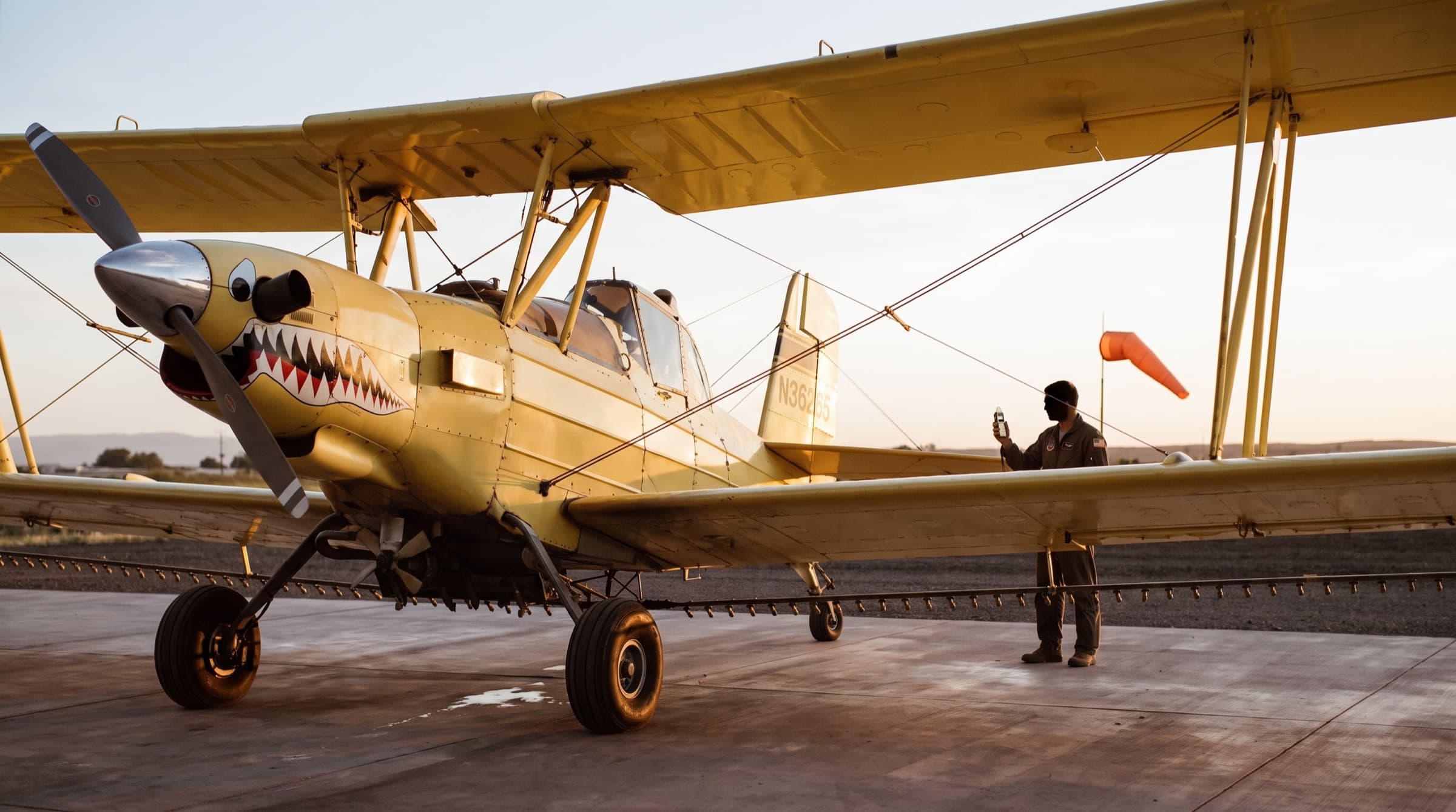
Spray drift is pesticide that moves through the air and lands outside the field that the grower meant to treat. It wastes product, weakens pest control, and can injure people, bees, crops and water nearby. This guide explains what causes drift from an airplane, how pilots prevent it, and what to do if you suspect it.
What is spray drift?
Aerial application (crop dusting) is the use of an aircraft to apply seed, fertilizer or crop protection products to a field. Drift is the part of an application that leaves the target area through the air. The California Department of Pesticide Regulation (DPR) notes that drift can be mist, dust or vapor, and that it can be invisible and odorless. Drift has two forms:
| Particle drift | Vapor drift | |
|---|---|---|
| When it happens | During the application, before the product lands | During the application or for hours after it |
| Main causes | Fine droplets, wind, release height | Product volatility and heat |
| Who controls it most | The pilot, through aircraft setup and weather choice | The pest control adviser and the label, through product choice |
| Typical injury pattern | Worst at the edge nearest the source, less with distance | Can be more even across an area, and not always downwind |
A pest control adviser (PCA) is a person with a California license to write pest control recommendations.
Why does pesticide drift matter?
Pesticide drift costs the grower first. Product that leaves the field does not reach the pest, so the grower can pay for a second flight. Drift can also injure a neighbor's crop, harm bees and fish, and contaminate homes and water.
California law puts the main duty on the applicator. The DPR pocket guide to pesticide drift explains that some movement occurs with every application, but the law does not allow substantial drift. Title 3, California Code of Regulations, section 6614 tells the applicator to evaluate the equipment, weather, field and nearby properties before and during each job. The applicator must not start or continue when there is a reasonable possibility of harm to people, nontarget crops, animals or property. Our guide to pesticide application rules in California covers the permits and notices.
What causes spray drift from an airplane?
Three factors matter most: droplet size, release height and wind. The Pesticide Environmental Stewardship guide to aerial application also lists crop height, terrain, wingspan, nozzle angle, airspeed, humidity and inversions. The pilot cannot change the terrain, but sets up the aircraft for each job and waits out bad weather.
Why does droplet size matter most?
Small droplets fall slowly, so wind has more time to move them. The stewardship site states that droplets smaller than 150 microns are the most prone to drift. A micron is one thousandth of a millimeter. A small increase in diameter adds a lot of weight:
| Droplet diameter | Weight compared with a 150-micron droplet |
|---|---|
| 150 microns | 1 time |
| About 190 microns | 2 times |
| About 240 microns | 4 times |
| 300 microns | 8 times |
When the nozzle cuts the droplet diameter in half, it makes eight times as many droplets, and more of them can drift. Many labels state a spray quality, for example "coarse." Spray quality is the range of droplet sizes that a nozzle makes. ASABE standard S572 defines the categories, from extremely fine to ultra coarse.
Nozzle charts also give a DV0.1, the size below which 10% of the spray volume falls. A larger DV0.1 means less fine spray that can drift. The goal is the coarsest spray quality that still controls the pest.
How do aerial applicators set up the aircraft for drift reduction?
Drift reduction on an airplane starts in the hangar, because each aircraft needs its own setup. The stewardship aerial guide lists these practices:
- Boom length. On fixed-wing aircraft, the boom usually spans no more than 75% of the wingspan. Each wingtip makes a vortex, a spinning column of air that can lift fine droplets. Some airplanes need a boom of 65 to 70% of the wingspan.
- Nozzle angle. The nozzles point back, parallel with the airflow. The pilot checks this angle for the attitude in flight, not on the runway.
- Airspeed. Too much airspeed shears the spray into fine droplets. Too little airspeed makes the tail drop and adds turbulence.
- Release height. Most aerial passes release at 8 to 12 feet, and smaller airplanes usually fly lower. A pass that is too low can push the pattern outward.
Drift retardants are additives that thicken the spray, but no additive stops all drift. Our post on why crop dusters fly so low explains release height in more detail.
How does pattern testing help?
A pattern test shows where the spray lands across the swath, the width of ground that one pass treats. The National Agricultural Aviation Association runs Operation S.A.F.E., a program that started in 1981. At a fly-in clinic, the aircraft makes test passes over sample collectors. Trained analysts measure the deposit and the droplet size, and they recommend changes.
What is the right wind speed for spraying?
The label is the first source for the right wind speed for spraying. Some labels give an exact limit for aerial work. When the label has no specific limit, the stewardship weather guide recommends at least 3 mph and no more than 8 mph. The wind must also blow away from sensitive areas.
- Above 8 mph. Strong wind carries more droplets past the field edge.
- Below 3 mph. Light wind often changes direction fast.
- No wind at all. Dead calm can be a sign of a temperature inversion.
Wind direction matters as much as wind speed. A crosswind moves the spray pattern downwind, so the pilot offsets each flight line upwind. Near a sensitive edge, the pilot can leave a buffer, an untreated strip along the downwind side. A light wind toward a home or a sensitive crop is a reason to wait.
Why is temperature inversion spraying a drift risk?
A temperature inversion is a layer of cool air near the ground, with warmer air above it. The cool air stays low and does not mix with the air above. Inversions usually form from dusk to early morning, when the ground loses heat.
Temperature inversion spraying lets fine droplets hang in the still air as a concentrated cloud. The cloud can move downhill or with the next breeze and cause damage for miles. The stewardship weather guide tells applicators not to spray within an inversion, or above one from an aircraft. These are the signs:
- Smoke that rises to a certain height and then moves sideways
- Dust that hangs in the air behind a vehicle
- Fog in low areas
- Calm air with no wind
How do heat and humidity affect drift?
Hot, dry air makes droplets evaporate on the way down. The water evaporates first, so the droplet gets smaller but keeps the same amount of pesticide. A smaller droplet falls more slowly and drifts farther. The stewardship guide gives an example label limit: no application above 85 degrees F or below 20% relative humidity.
Heat also increases vapor drift from volatile products. Some labels tell the applicator to avoid application when the temperature can exceed 85 degrees F during the job or for 24 hours after it. On hot, dry Sacramento Valley afternoons, an applicator can fly earlier, use a coarser spray, or stop the job. Our post on what crop dusters spray explains the main product types.
How does a pilot plan a flight to prevent drift?
A typical spray job follows this order.
Caution: Stop the job at any step if a condition breaks a label limit.
- Read the label and the PCA's written recommendation.
- Mark homes, schools, water, beehives and sensitive crops on the field map.
- Check the wind speed and direction at the field.
- Look for the signs of a temperature inversion.
- Check the temperature and the relative humidity.
- Choose the flight lines, the upwind offset and any downwind buffer.
- Load the field boundary and flight lines into the GPS guidance system.
- Fly low, level passes, and spray only in level flight.
- Check the wind again during the job.
- Record the weather, the times and the product.
GPS guidance holds each pass at the set swath width, so the passes do not overlap or leave gaps. Schools get extra protection: section 6691 sets a 1/4-mile limit for aircraft on weekdays from 6 a.m. to 6 p.m. Our guide to crop dusting near homes explains that rule and its exceptions.
What can growers and neighbors do?
Before the job, growers should tell the applicator about nearby homes, farmworker housing, organic fields, sensitive crops, canals and beehives. Our post on bees and pesticides explains how growers and beekeepers protect hives.
Neighbors can call the grower or the applicator with a concern. A short call before a spray week lets a greenhouse close its vents or a neighbor bring in laundry. Windbreaks and tall grass strips also help, because they lower the wind speed and catch some drift.
What should you do if you suspect pesticide drift?
Report suspected pesticide drift quickly, because residues in plants break down over time. Other problems can look like drift injury: disease, insects, a nutrient shortage or herbicide carryover.
Warning: If a person has trouble breathing, move away from the area and call 911 first.
- Write down the date, the time and the wind direction.
- Take dated photos of the injury and of an undamaged area of the same crop.
- Call 1-87PestLine (1-877-378-5463) to reach your county agricultural commissioner.
- Ask the grower or the applicator what product they applied.
- Keep your own spray records for the same dates.
- Take more photos later in the season, and compare the yield with an undamaged area.
- Tell your insurance agent about the possible claim.
The county agricultural commissioner investigates drift complaints and takes enforcement action when it finds a violation. You can ask the commissioner to keep your name confidential.
How we prevent spray drift in the northern Sacramento Valley
Sutter Butte Dusters flies five Ag Cats and one Air Tractor 602 from our airstrip at 4080 Clark Rd in Live Oak. We serve growers in Sutter, Yuba, Butte, Glenn and Colusa counties, and each county adds its own permit conditions, such as the wind limits for rice herbicides in Colusa County. Before each job, we map the field and check for hazards and sensitive areas nearby. Our pilots fly low, level passes and check the wind before and during the job. If the wind is wrong, we wait. Read about our aerial crop protection service and our answers to common questions, or get a quote for your field.
Questions
Most droplets that drift land near the downwind edge of the field. Fine droplets can travel farther, and in a temperature inversion a cloud of fine droplets can move for miles. Vapor from a volatile product can also leave the field for hours after the application.
No. The Department of Pesticide Regulation states that some movement occurs with every application, but substantial drift is not allowed. An applicator must not start or continue a job when there is a reasonable possibility of harm to people, crops, animals or property outside the target.
No. A drift retardant thickens the spray and can reduce fine droplets, but no additive stops all drift. Some products break down in the pump or do not work with every pesticide. Correct nozzles, release height and weather limits still matter most.
Early morning is often calm and cool, which helps. But inversions usually form from dusk to early morning, so calm air can be a warning sign. The applicator looks for smoke that spreads sideways, hanging dust or fog before the first pass.
