
Rules and licensing
Pesticide application in California: PCAs, permits and NOIs
By the Sutter Butte Dusters team · · 8 min read
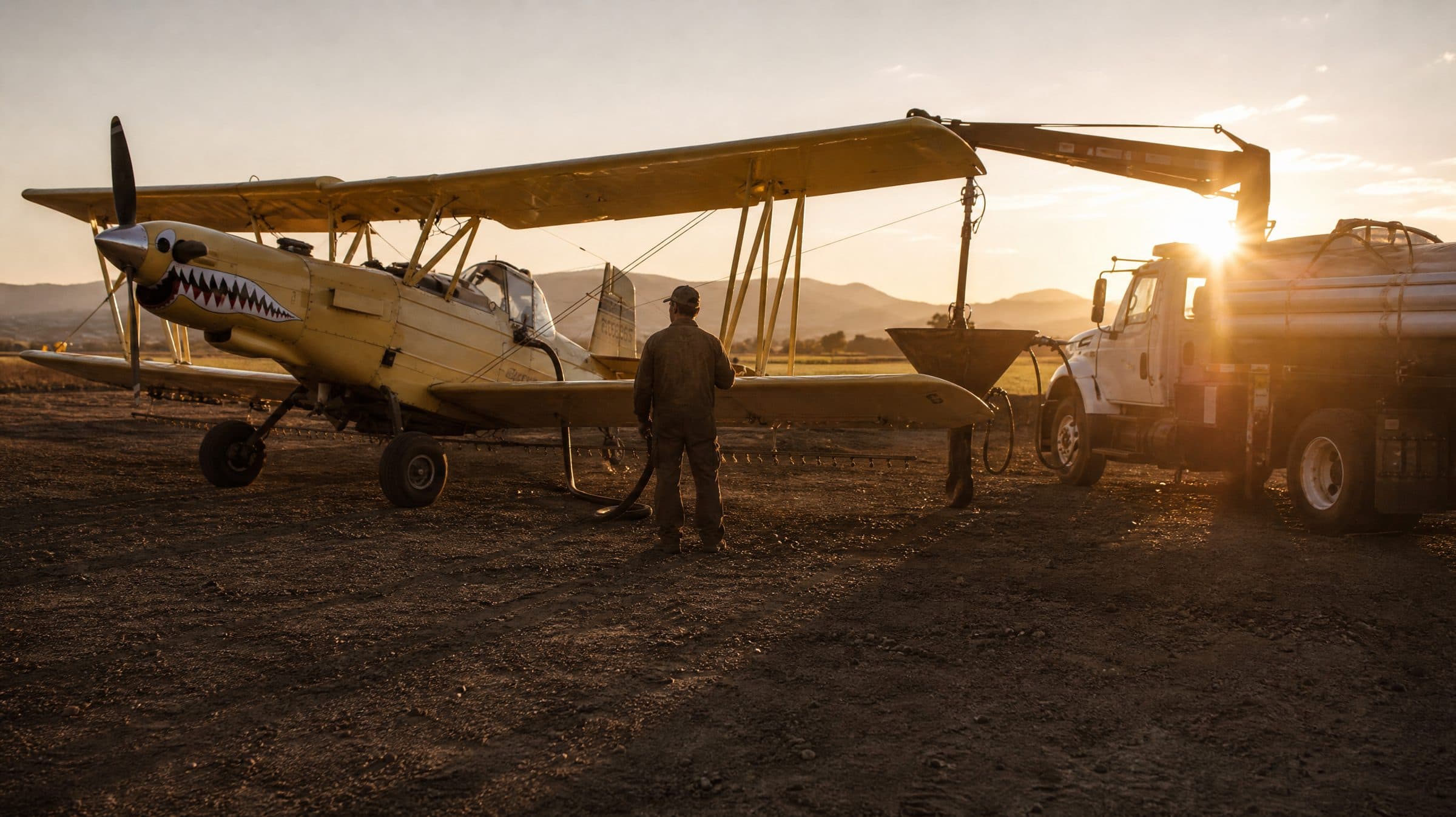
A farm pesticide application in California involves at least three licensed people and two government offices. A pest control adviser writes the recommendation, the county permits the work, and a licensed business applies the product. This guide explains who does what, which papers each person files, and the deadlines for aerial work.
Who regulates pesticide application in California?
| Agency | Main job |
|---|---|
| U.S. Environmental Protection Agency (EPA) | Registers each product and approves its label |
| California Department of Pesticide Regulation (DPR) | Registers products for California, writes the state rules, and licenses advisers, businesses and pilots |
| County agricultural commissioner (CAC) | Enforces the rules in the county: permits, notices, inspections and use reports |
| Federal Aviation Administration (FAA) | Certifies the agricultural aircraft operator and the pilot |
Food and Agricultural Code (FAC) section 12973 states that a use must not conflict with the label or with any permit conditions. Our guide to FAA Part 137 for agricultural aircraft covers the federal flight rules.
Who does what on a farm job?
California law gives each person a separate role. The pilot does not choose the product.
| Person | Role | License or registration |
|---|---|---|
| Grower (the "operator of the property") | Holds the permit and the operator ID number | Certified private or commercial applicator to supervise restricted-material use |
| Pest control adviser (PCA) | Recommends the product, rate and timing in writing | DPR adviser license, registered in each county where the PCA works |
| Pest control business | Applies the pesticide for hire | DPR business license, registered in each county where it works |
| Qualified applicator | Supervises the work at each business location | Qualified applicator license (QAL) |
| Pilot | Flies the application | DPR pest control aircraft pilot certificate, registered in each county |
PCA California rules: who needs the license?
Under FAC sections 11410 and 11411, a PCA is any person who recommends an agricultural use or solicits sales for one. A grower and the grower's employees need no license for decisions about fields under their own control.
To take the exams, an applicant needs a science or pest management degree with 42 semester units of core courses. Another route accepts the 42 units plus 24 months of qualifying work, with no degree. The applicant must score 70 percent or higher on the laws exam and on at least one category exam, such as weed control. After the first renewal, a PCA completes 40 hours of continuing education every two years, and 4 of those hours cover laws and regulations. The DPR adviser license packet lists every requirement.
What must a written PCA recommendation include?
FAC section 12003 requires a written, signed and dated recommendation. The grower, the dealer and the applicator each get a copy before the application, and the PCA keeps one for a year (FAC 12004). Use this checklist to examine a recommendation before you book a flight:
- The pesticide and its dosage, or the method of control
- The pest, by its accepted common name
- The grower, the field location and the crop
- The schedule, time or conditions for the application
- A warning about any possible damage that the PCA should know about
- The total acres to treat
- The concentration and the volume per acre
- The restricted entry interval, the preharvest interval and label restrictions
- The criteria that showed a need for the treatment
- A statement that the PCA considered alternatives and ways to reduce harm
Title 3 of the California Code of Regulations (3 CCR) section 6556 adds the last five items. We fly to the label and to this written recommendation. We do not change the product or the rate.
How do you get a restricted materials permit in California?
A restricted material is a pesticide that DPR controls more tightly because of its hazard. A person needs a permit, or the direct supervision of a permit holder, to possess or use one (3 CCR 6412). For a farm, the county agricultural commissioner issues the permit in the grower's name (3 CCR 6420). So a restricted materials permit in California comes from your county office.
The application lists each field, crop, expected pest and restricted material (3 CCR 6428). It also lists sensitive areas near each field, such as schools, homes, waterways, livestock and other crops. Before the commissioner issues a permit, the office checks for a substantial adverse environmental impact (3 CCR 6432). If a feasible alternative or mitigation exists, the commissioner can deny the permit or add conditions.
A grower who uses only nonrestricted products still needs an operator identification number from each county (3 CCR 6622). The number is valid for up to 36 months.
What is a notice of intent for a pesticide in California?
A notice of intent (NOI) tells the county agricultural commissioner about one specific restricted-material application before it starts. Since February 24, 2025, every agricultural restricted-material application needs an NOI. The grower, the grower's representative or the pest control business submits it online through CalAgPermits.
| Material | NOI deadline under 3 CCR 6434 |
|---|---|
| Soil fumigant that needs a permit | At least 48 hours before the start |
| Any other pesticide that needs a permit | At least 24 hours before the start |
The NOI gives the permit number, field location, crop, acres, method, product, registration number, dosage, pest and start time. The commissioner can allow shorter notice when the pest problem cannot wait. If weather or equipment delays the job, the work can start up to four days after the planned date (3 CCR 6000). The final text of the notification rule is on the DPR site.
DPR started to publish these planned applications in March 2025 on SprayDays California. Anyone can see the square-mile section, the date, the product, the method and the acres, and neighbors can sign up for alerts.
What extra rules apply to aerial work?
Pilot certificate. Each pilot needs a DPR pest control aircraft pilot certificate (FAC 11901). An apprentice needs an FAA commercial pilot certificate, a current FAA medical certificate and passing exam scores. A journeyman needs one year as an apprentice and 150 hours of fixed-wing application flying within two years. The DPR pilot certificate packet has the details, including the separate route for drone pilots.
Business license. A company that applies pesticide for hire needs a DPR business license and a registration in each county where it works. Each business location needs a supervisor with a QAL (FAC 11701.5).
Drift. FAC 12972 requires every application to prevent substantial drift. Under 3 CCR 6614, the applicator must not start or continue when the product could reasonably harm people, crops or property outside the job.
Schools. 3 CCR 6691 sets a 1/4 mile minimum distance between an aerial application and a schoolsite or child day care facility. The limit applies Monday through Friday, 6:00 a.m. to 6:00 p.m., on school days. Under 3 CCR 6692, the grower sends an annual notice to each school within 1/4 mile by April 30.
Hormone-type herbicides and propanil. 3 CCR 6460 covers liquid 2,4-D, MCPA, dicamba, propanil and related herbicides, unless the permit allows otherwise. The aircraft must not release them more than 10 feet above the crop, or in wind over 10 mph. Boom pressure must not exceed 40 psi.
Propanil in our counties. 3 CCR 6462 covers Butte, Colusa, Glenn and Yuba counties, and Sutter County north of Sankey Road. Aerial applications must stay 4 miles from commercial prune plantings. Aircraft may treat no more than 720 acres per county per day. Each nozzle must produce droplets of at least 600 microns volume median diameter. Yuba County's permit conditions go further and allow propanil by ground only, and Colusa County sets a 2 to 10 mph wind range for aerial propanil. For rice weed programs, read our post on herbicide application in rice.
How do application methods compare on drift?
| Method | Typical use | Main drift factor |
|---|---|---|
| Seed treatment | Coats seed before planting | Almost no drift in the field |
| Granules | Soil or flooded-field placement | Heavy particles drift less than spray |
| Ground boom | Pre-emergent and post-emergent herbicides in row crops | Low release height |
| Airblast sprayer | Orchards and vineyards | Spray goes up into the canopy |
| Airplane | Large or wet fields, rice, orchards | Wind, release height and buffers |
| Drone | Small or irregular blocks | Same DPR certificate rules, plus FAA approval |
Droplet size is the main control for spray drift. Large droplets fall fast and drift less. Some herbicides also turn to vapor after they land. This process is volatilization, and the label lists any weather limits for it. Our guide to spray drift in aerial application covers wind and droplet size. For hive safety, read bees and pesticides.
What notices and records come after the flight?
Before the job, the applicator gives the grower the dates, field, product, EPA registration number and restricted entry interval (3 CCR 6618). Within 24 hours after the job, the applicator confirms the acres, the product and the start and end times (3 CCR 6619). The business sends a use report to the commissioner within 7 days, and a copy to the grower within 30 days (3 CCR 6626). Both keep the use records for two years (3 CCR 6624).
How does a restricted-material job move from scout to report?
The grower, the PCA and the applicator share these steps. For a nonrestricted product, skip steps 3 and 5.
Caution: Do not schedule the flight until the permit lists that material and that field.
- Scout the field for the pest, weed or disease.
- Get the PCA's signed, written recommendation.
- Confirm that the permit covers the field and the product.
- Confirm that the label allows aerial application on the crop.
- Submit the NOI through CalAgPermits at least 24 hours ahead.
- Send us the field location, crop, acres, product, rate and timing.
- Mark homes, schools, power lines, water and bee yards on the field map.
- Tell your field crews the date and the restricted entry interval.
- Check the wind at the field before the flight.
- Fly the field to the label and the recommendation.
- Send the completion notice and file the use report.
Our post on what crop dusters spray explains who picks the product. The checklist to prepare a field for aerial application covers steps 6 and 7. Neighbors can read what to know about crop dusting near homes.
Aerial pesticide application with Sutter Butte Dusters
Sutter Butte Dusters flies from 4080 Clark Rd in Live Oak with five Ag Cats and one Air Tractor 602. We apply herbicide, fungicide, insecticide, fertilizer and seed in Sutter, Yuba, Butte, Glenn and Colusa counties. We work from your label and your PCA's written recommendation. We check the wind and the sensitive areas on every field, and we plan each flight around your permit and your window. Get a quote for your field.
Questions
No. A grower and the grower's employees can make pest control decisions for fields under their own control without a PCA license. When a licensed PCA does make an agricultural recommendation, the PCA must put it in writing and give the grower a copy before the application.
The commissioner enforces state pesticide law in the county. The office issues restricted materials permits and operator identification numbers, reviews each notice of intent, and registers PCAs, pilots and pest control businesses. It also inspects applications, investigates complaints and receives the pesticide use reports.
Yes, if the product is not a restricted material. The grower still needs an operator identification number from the county. The business needs a DPR license and a county registration, and the pilot needs a DPR certificate. Every application must follow the label and prevent substantial drift.
Yes. Since March 2025, DPR posts planned agricultural restricted-material applications on SprayDays California. A listing shows the square-mile section, the date, the product, the method and the acres. People can sign up for email or text alerts, and each listing stays online for four days.