
Crop dusting basics
What do crop dusters spray? Products, crops and timing
By the Sutter Butte Dusters team · · 8 min read
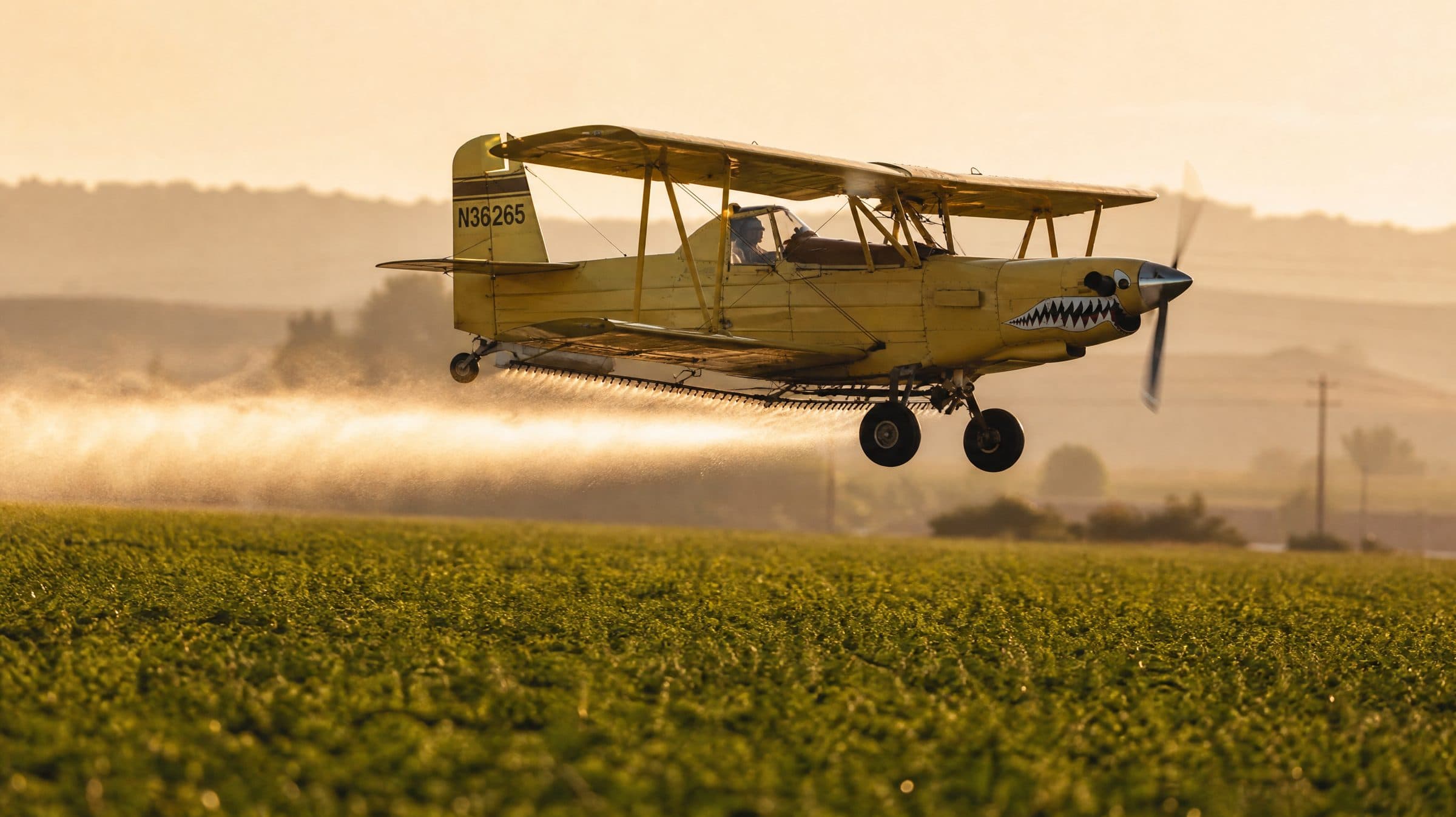
What do crop dusters spray? In one season, the same airplane can carry herbicide, fungicide, insecticide, fertilizer, seed and sulfur dust. This post explains each material, the crops that get it, the months it flies, and who decides what goes into the plane.
What do crop dusters spray? The six main materials
A crop duster is an agricultural airplane built for aerial application (crop dusting): the job of putting a material on a field from the air. The FAA rule for these flights, 14 CFR Part 137, covers pest control products, plant nutrients, soil treatments and seed. The table shows the six materials.
| Material | What it does | Liquid or dry | Common crops in our area |
|---|---|---|---|
| Herbicide | Kills weeds that take water, light and nitrogen from the crop | Liquid, or dry granules | Rice, row crops |
| Fungicide | Protects the crop from diseases such as rice blast | Liquid | Rice, orchards, row crops |
| Insecticide | Controls insects such as armyworms after they pass a damage threshold | Liquid | Rice, orchards, row crops |
| Fertilizer | Feeds the crop during the season (top-dressing) | Liquid or dry | Rice, grain, row crops |
| Seed | Plants the crop or a cover crop | Dry | Rice, cover crops |
| Sulfur | Helps control some plant diseases and mites | Dry dust | Orchards, row crops |
The National Agricultural Aviation Association reports that aerial applicators treat about 127 million acres of cropland each year. That figure comes from its 2019 industry survey and counts fields treated more than once. It equals about 28 percent of the cropland in production. Herbicide, fungicide and insecticide are all pesticides, and we group them under crop protection by air.
Are crop dusting chemicals mostly poison? What the tank holds
Most of a liquid load is water. The water is the carrier: the liquid that holds the product and spreads it over the leaves. The loader mixes the pesticide or fertilizer into the water at the rate on the product label. For example, the UC IPM rice herbicide table lists one common herbicide for ground or air in 10 to 15 gallons of water per acre.
The label is the legal rule for each product. It gives the amount of product per acre and the minimum amount of carrier. It also says whether the product can go on by air at all. Some loads also contain an adjuvant, which is an additive that helps the spray stick to leaves or reduces fine droplets. A dry load has no water; it leaves the hopper through a spreader under the fuselage.
So the term "crop dusting chemicals" covers many different things. Some are synthetic pesticides, some are fertilizers, and seed is not a chemical at all. Organic growers also hire planes for products that organic rules allow, such as sulfur and Bt (Bacillus thuringiensis), a biological insecticide. The UC IPM armyworm guidelines for rice list a Bt product as acceptable on certified organic crops.
Older articles also name rotenone as an organic product for aerial use. That is out of date. EPA records show that the registrants ended all rotenone uses except fish control, and EPA issued the final cancellation order in 2010.
What do crop dusters spray on fields in the Sacramento Valley?
The answer depends on the crop. Rice is the main crop that we fly, and orchards and row crops come next.
Rice
A rice field can get four or five different flights in one season. The plane seeds the flooded checks in spring. Then it applies herbicide at a set rice leaf stage or a set number of days after seeding, as the UC IPM herbicide table shows. Fertilizer top-dressing follows during the season, without wheel tracks in the crop. Our guides on rice herbicide application and rice fertilizer top-dressing give more detail.
Insecticide and fungicide flights happen only when scouting shows a need. The trigger is the economic threshold: the pest level at which treatment costs less than the crop damage. UC IPM suggests an armyworm treatment at more than 25 percent defoliation where armyworms are present. After the panicles emerge, the threshold is 10 percent damaged panicles. For rice blast, UC IPM says a fungicide at early heading may protect the panicles when leaf blast is present. Our post on rice pests and diseases covers the main problems.
Orchards and row crops
Walnut, almond, prune and peach growers use aerial application for fungicide, insecticide and sulfur. Row crops such as tomatoes, wheat, safflower and beans get crop protection and fertilizer flights. Our post on orchard spraying by air explains how a flight covers tree rows.
What do crop dusters drop?
People often say a crop duster "drops" something when the material is dry. The name "crop duster" comes from the early ag airplanes, which applied dusts. Dry products are still a large part of the job in our area:
- Seed. Airplanes seed most California rice onto flooded checks. Cover-crop seed goes on after harvest, as our post on aerial cover-crop seeding explains.
- Granular fertilizer. Our aerial fertilizer page describes both dry and liquid jobs.
- Granular herbicide. Some rice herbicides are granules that fall into the floodwater. The UC IPM table lists water-holding periods after many of them, often 5 days or longer.
Not every load is for a farm. NAAA lists other aerial work such as firefighting, mosquito and fly control, and oil spill cleanup.
When do crop dusters spray? A season timeline
Most of our flights happen from April to August. Weather and crop stage move these typical dates every year.
| Job | Typical months |
|---|---|
| Rice seeding | April to May |
| Fertilizer | April to July |
| Herbicide | May to June |
| Fungicide and insecticide | June to August |
| Cover-crop seeding | After harvest |
Our crop dusting season calendar shows the full year month by month.
What do crop dusters spray in the fall?
The fall is a quiet time for crop protection in our area. Rice and walnut harvest fill those months, and seed is the main fall job. Growers use the plane to put cover-crop seed on fields after harvest, so the cover crop can grow through the winter and protect the soil. A plane can also seed into a crop that is still standing, so the cover crop starts before harvest.
Some insect work continues to the end of summer. In walnuts, UC IPM reports that husk fly adults emerge from early June until early September. Growers time those treatments with traps and egg checks, not with a fixed date. Our post on walnut husk fly explains the timing. In other regions, fall jobs also include cotton defoliation and winter wheat seeding.
Why do growers use a plane instead of a ground sprayer?
A plane does not drive on the field. A tractor or self-propelled sprayer compacts wet soil and can get stuck in it. Tall crops need a high-clearance rig with narrow wheels, and not every farm owns one. In flooded rice, a ground rig is not practical at all.
A plane also covers many acres in a short window. That speed matters when a pest outbreak passes its threshold or a fertilizer window is only a few days long. Our comparison of aerial spraying and ground rigs gives the full list of trade-offs.
Not every farm hires a plane. The cost per acre can be higher than a ground pass. Power lines, homes or odd field shapes can also limit a safe flight. Our guide to crop dusting cost per acre explains the price factors.
Who decides what goes into the plane?
The pilot does not choose the product. In California, a licensed pest control adviser (PCA) usually writes a recommendation for the pesticide, the rate and the timing. The grower orders the product, and the applicator applies it as the label and the recommendation say. For restricted materials, the grower also needs a permit from the county agricultural commissioner.
Several agencies set the rules. EPA registers each pesticide and approves its label, and DPR registers it for use in California. The FAA certifies the aircraft operator under Part 137. In California, the Department of Pesticide Regulation (DPR) issues pest control aircraft pilot certificates, and county agricultural commissioners enforce the use rules.
Before an aerial pesticide job, the process usually goes like this:
- The grower or PCA scouts the field for weeds, insects or disease.
- The PCA writes a recommendation that names the product, rate and timing.
- The grower confirms that the label allows aerial application on that crop.
- The permit holder files a notice of intent for any restricted material.
- The grower sends us the field location, crop, acres, product and rate.
- We map the field and mark homes, power lines, water and sensitive crops.
- The pilot checks the wind before the flight and during the job.
- The pilot flies the field and records the application.
A notice of intent (NOI) tells the county about a planned restricted-material application. Our guide to pesticide application rules in California covers the permits in more detail. For the steps on your side, read how to hire a crop duster.
Is crop dusting safe for people who live nearby?
The label and the state rules set buffer zones, wind limits and the time before workers can enter the field. Our pilots fly low, level passes and plan around homes, schools, water and neighboring crops. If the wind is wrong, we wait.
The low flight has a purpose. A lower release point gives the spray less time to drift off the field. The pilot also shuts off the spray at the end of each pass, before the plane climbs to turn. Our post on why crop dusters fly so low explains the reasons.
People who live near farm fields can sign up for SprayDays California, the state's free notice system. It shows the product, the acres and the application method for planned restricted-material jobs nearby. Notices come 24 hours ahead, or 48 hours ahead for soil fumigants. Our posts on spray drift, crop dusting near homes and bees and pesticides answer the common questions.
What we fly in the northern Sacramento Valley
Sutter Butte Dusters flies from 4080 Clark Rd in Live Oak, with five Ag Cats and one Air Tractor 602. We apply herbicide, fungicide, insecticide, fertilizer and seed across Sutter, Yuba, Butte, Glenn and Colusa counties. Tell us the field, crop, acres, product and rate from your PCA's recommendation, and we will plan the flight. Get a quote for your field.
Questions
Yes. Organic growers can hire a plane to apply products that organic rules allow, such as sulfur and Bt, a biological insecticide. UC IPM lists a Bt product as acceptable for certified organic rice. The product label must still allow aerial application on that crop, and the grower should check with the certifier.
On corn, planes mostly apply fungicide and insecticide after the crop grows tall and the leaf canopy closes. Planes also seed cover crops into standing corn late in the season. NAAA lists corn as one of the crops that aerial applicators treat most often.
Each product has a label that sets wind limits, buffer zones and field re-entry times to protect people. Pilots fly low and wait when the wind blows toward homes or other sensitive areas. Stay away from a field during an application and follow any posted signs.
The name comes from the early agricultural airplanes, which applied dry dusts. Today most loads are liquid sprays, but planes still apply dry products such as sulfur dust, seed and granular fertilizer. The industry term for all of this work is aerial application.
