
Plane vs drone vs ground
Aerial spraying vs ground rigs: when the airplane wins
By the Sutter Butte Dusters team · · 8 min read
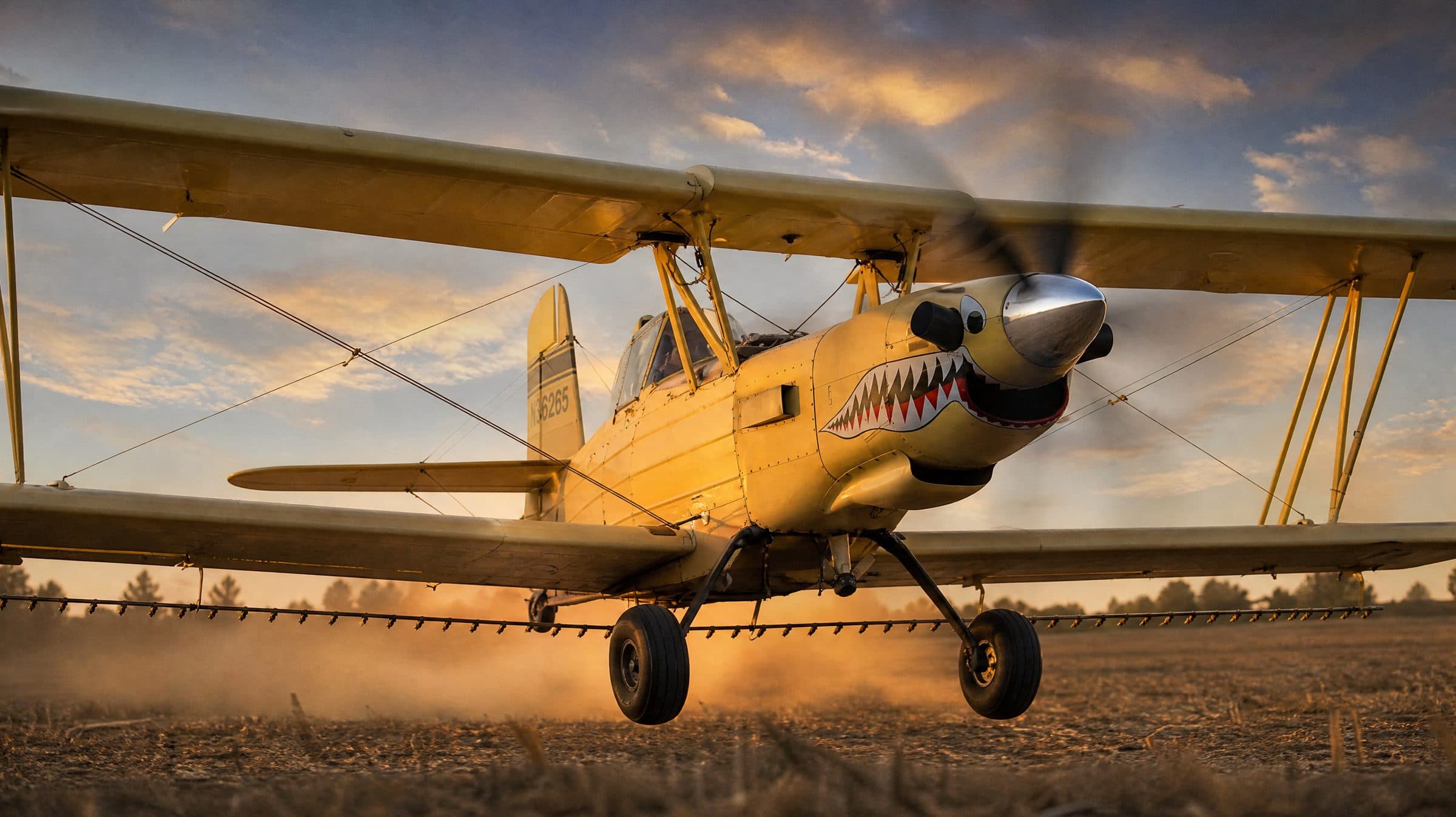
A ground rig and an airplane can apply the same product to the same field. The difference is what each one does to the soil, the crop and your schedule. This guide compares aerial spraying with ground rigs, uses published numbers that you can check, and shows how to choose for each field.
Aerial spraying or a ground rig: what is the real difference?
A ground rig is a sprayer that drives through the field, either pulled by a tractor or self-propelled. An agricultural airplane (crop duster) flies a few feet above the crop and treats one swath per pass. The table compares the two for crop spraying on a typical farm.
| Question | Airplane | Ground rig |
|---|---|---|
| Does it touch the field? | No | Yes, the wheels run on the soil and the crop |
| Can it work on wet or flooded ground? | Yes | Often no, or it leaves ruts |
| Can it treat a tall, closed crop? | Yes, it flies above it | The wheels and boom damage some plants |
| How many acres per day? | About four times a ground rig, in one NAAA example | Fewer |
| Which labels allow it? | Only labels that allow aerial application | Most labels allow ground application |
| Small or odd-shaped fields? | Less efficient | Often the better fit |
| Power lines, trees and buildings? | They limit the passes | It can work beside or under them |
| How far is the spray from the target? | A few feet, so wind matters more | The boom is close to the target |
Neither method wins every job. The label, the soil, the crop stage and the deadline decide.
What happens when a sprayer drives on wet ground?
Wet soil is where the airplane gains the most. Soil compaction is the loss of pore space when a heavy load presses soil particles together. Compacted soil holds less air and water, and roots grow through it more slowly.
Iowa State University agronomists estimate that wheel-traffic compaction cuts yield by 10 to 20 percent, depending on severity (Iowa State Integrated Crop Management). They also state that compaction gets worse as the soil gets wetter. Their advice is to wait until the soil water drops below field capacity. Field capacity is the amount of water that the soil holds after the excess drains away.
Harvest can often wait a few days, but a spray job often cannot. A fungicide may need to go on before a disease period, or weeds may outgrow the label stage. An airplane puts no load on the soil, so a wet field does not force a late application.
How much yield do sprayer wheel tracks take?
A sprayer crushes the plants under its wheels, and some of those plants do not recover. Purdue Extension measured this loss in soybean at three Indiana locations in 2005 and 2006 (Purdue Extension, Managing Fungicide Applications in Soybean). A wider boom means fewer passes, so the loss fell as boom width increased.
| Boom width | Average yield loss from wheel tracks |
|---|---|
| 30 feet | 4.9% |
| 60 feet | 2.5% |
| 90 feet | 1.9% |
| 120 feet | 1.3% |
The Purdue trials give three more details that most comparisons leave out:
- Crop stage matters. A full stand planted on time recovered from tracks made at first flower. No stand recovered from tracks made at early pod or early seed development.
- Row width matters. Rows of 15 inches or less always lost yield. Rows of 30 inches lost yield in half of the trials, because wheels at 10 to 15 mph still hit some plants.
- Repeat trips in the same tracks did not add loss. A grower who reuses the same tracks pays the loss on the first trip only.
These results come from Indiana soybean, not California crops. The principle still applies: the first trip through a standing crop costs some plants. An airplane makes no wheel tracks.
How much faster is an airplane than a ground sprayer?
An airplane covers far more acres in a day than a large self-propelled sprayer. The National Agricultural Aviation Association (NAAA) gives an example from Mississippi row crops (NAAA industry facts). An Air Tractor AT-502B with a 60-foot swath treated 1,800 acres in a 12-hour day. A John Deere R4030 with a 90-foot boom treated 450 acres in the same day.
The table converts that example into hours for jobs of three sizes. The rates are 150 acres per hour by air and 37.5 acres per hour by ground.
| Job size | Airplane (NAAA example rate) | Ground rig (NAAA example rate) |
|---|---|---|
| 300 acres | 2 hours | 8 hours |
| 900 acres | 6 hours | 24 hours, or two 12-hour days |
| 1,800 acres | 12 hours | 48 hours, or four 12-hour days |
Field size, ferry distance, product rate and reload time change these totals. The gap matters most when the treatment window is two or three days long.
Which products can you apply by air?
The product label decides first. The label is the law, and it lists the allowed application methods. If a label says ground application only, no aircraft or drone can apply that product. Many labels allow both methods, but the aerial directions often add limits.
The most common limit is the carrier volume. The carrier is the water or other liquid that carries the product, measured in gallons per acre. Every load an aircraft carries covers fewer acres when the gallons per acre go up. Penn State Extension reviewed herbicide spraying with drones in January 2026. The aerial-labeled herbicides in its table had minimum carrier volumes from 2 to 10 gallons per acre. Two Group 4 herbicide products in that table had no aerial label at all.
Some labels also set a spray height, a droplet size or a nozzle type for aerial work. Your licensed pest control adviser (PCA) writes the recommendation, and the label sets the legal limits. We apply what the label and the PCA's written recommendation allow. For the California rules behind that system, see our guide to pesticide application in California.
Crop dusting vs sprayer: which costs less per acre?
A custom ground application usually costs a little less per acre than an aerial one. The 2026 Iowa Farm Custom Rate Survey from Iowa State University gives these average charges, without the product (Iowa State Ag Decision Maker, File A3-10).
| Method (2026 Iowa survey) | Average charge per acre |
|---|---|
| Ground, broadcast, tractor | $8.50 |
| Ground, broadcast, self-propelled | $9.35 |
| Ground, self-propelled, tall crop | $11.15 |
| Aerial | $12.00 |
| Drone | $12.50 |
These are Iowa averages, not California prices and not our prices. Here, the price depends on acres, product, rate, ferry distance and field shape. Only a quote for the specific field gives the real number. Our post on crop dusting cost per acre explains what moves it.
The rate per acre is only part of the cost. The gap between aerial and self-propelled ground work is $2.65 per acre. Purdue measured a 1.9 percent loss with a 90-foot boom. That loss costs more than $2.65 once the crop is worth about $140 per acre. Against the tall-crop ground rate, the gap is only $0.85 per acre. Compaction and a late application add more cost to the ground side.
When should you keep the ground rig?
A fair comparison of crop dusting vs sprayer must include the jobs where the ground rig is the better tool.
- The label allows ground application only. No aircraft can legally apply that product.
- The label requires a high carrier volume. The airplane can do the job, but many reloads make it slow and costly.
- The field is small or irregular. Short passes and many turns waste flight time.
- Obstacles surround the field. Power lines, tall trees, wind machines and buildings limit where the pilot can fly. A ground rig can work right beside them.
- The job needs a banded or directed spray. A ground rig can put the spray in a band over the row or under the canopy.
- Sensitive sites are close. Next to homes, schools or a crop that the product can injure, a boom near the target can be the safer choice. Our post on spray drift explains how wind, height and droplet size affect each method.
Many orchard growers use ground sprayers for routine sprays and call an airplane when the ground is wet or the window is short. Our guide to orchard spraying by air covers those jobs.
Where do drones and helicopters fit?
Spray drones and helicopters are also aerial application. The FAA regulates spray drones under Part 137, the rule for crop dusters, and drone operators also need an FAA exemption. A drone must follow the aerial directions on the label.
A drone does not compact the soil, but its small tank means frequent landings to refill and change batteries. It fits small blocks, field corners and spot treatments. Our post on drone spraying cost per acre shows how the carrier volume changes a drone's price. A helicopter turns fast and can reload beside the field, as our comparison of a crop duster helicopter vs airplane explains.
How do you choose the method for each field?
Use this procedure for each field and each application. Get the PCA's written recommendation before you start.
Caution: if the label says ground application only, stop after step 1 and use a ground rig.
- Read the label for the allowed application methods.
- Write down the minimum carrier volume for aerial application.
- Check the soil moisture in the wettest part of the field.
- Note the crop height and the growth stage.
- Count the days left in the treatment window.
- Mark power lines, trees, wind machines and buildings on a field map.
- List the homes, schools, water and sensitive crops near the field.
- Get quotes for the same product, rate, gallons per acre and date.
Aerial spraying usually wins when the label allows air and the field has one of three problems. The soil is wet, the crop has closed the rows, or the window is short. On flooded rice, the airplane is often the only practical choice. See our guides to herbicide application in rice and rice fertilizer by air.
Aerial spraying in the northern Sacramento Valley
We fly herbicide, fungicide and insecticide applications for rice, orchards and row crops from our airstrip at 4080 Clark Rd in Live Oak. Our fleet has five Ag Cats and one Air Tractor 602, and we serve Sutter, Yuba, Butte, Glenn and Colusa counties. Most of our crop protection flights are from May to August. Send us the field location, crop, acres and product, and we will tell you if the job fits the airplane. Get a quote for your field.
Questions
Usually it costs a little more per acre. The 2026 Iowa State custom rate survey averaged $12.00 per acre for aerial work and $8.50 to $11.15 for ground work, without the product. Those are Iowa averages, not California prices. A quote for your field gives the real cost.
Yes, if the product label allows aerial application on that crop. Many rice herbicides in California go on by air. Some labels allow ground application only, or set a minimum carrier volume for air. Your pest control adviser writes the recommendation, and the label sets the legal limits.
For a ground rig, wait until the soil carries the weight without ruts. Iowa State advises waiting until soil water is below field capacity to limit compaction. An airplane does not touch the soil, so it can fly as soon as the wind and the label conditions allow.
No. A crop duster flies above the field, so it puts no weight on the soil and leaves no wheel tracks in the crop. Compaction comes from heavy wheels, and it is worst on wet soil. That is one of the main reasons growers hire a plane after rain.
