Crop dusting basics
Why do crop dusters fly so low? Height, drift and turns
By the Sutter Butte Dusters team · · 8 min read
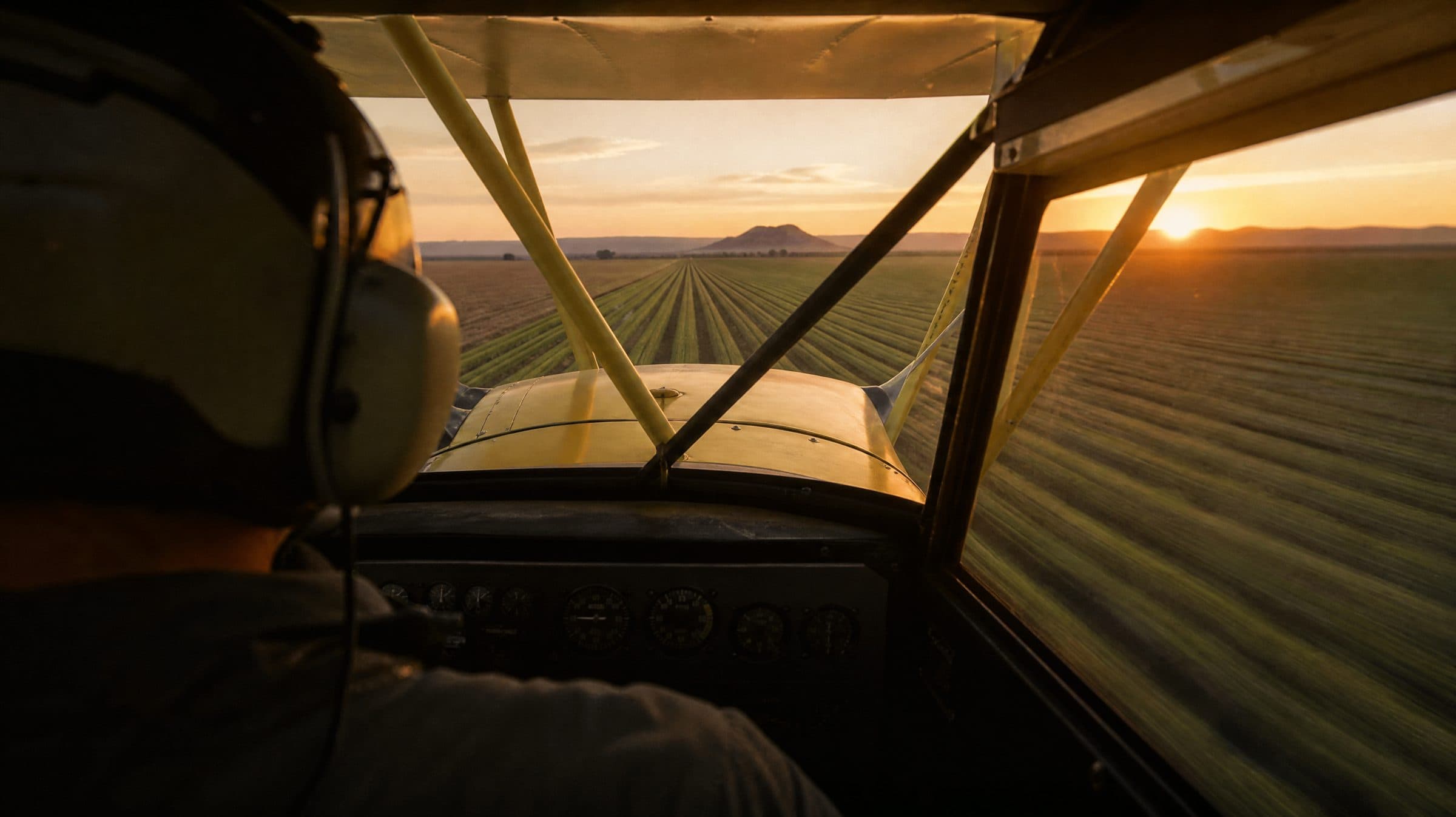
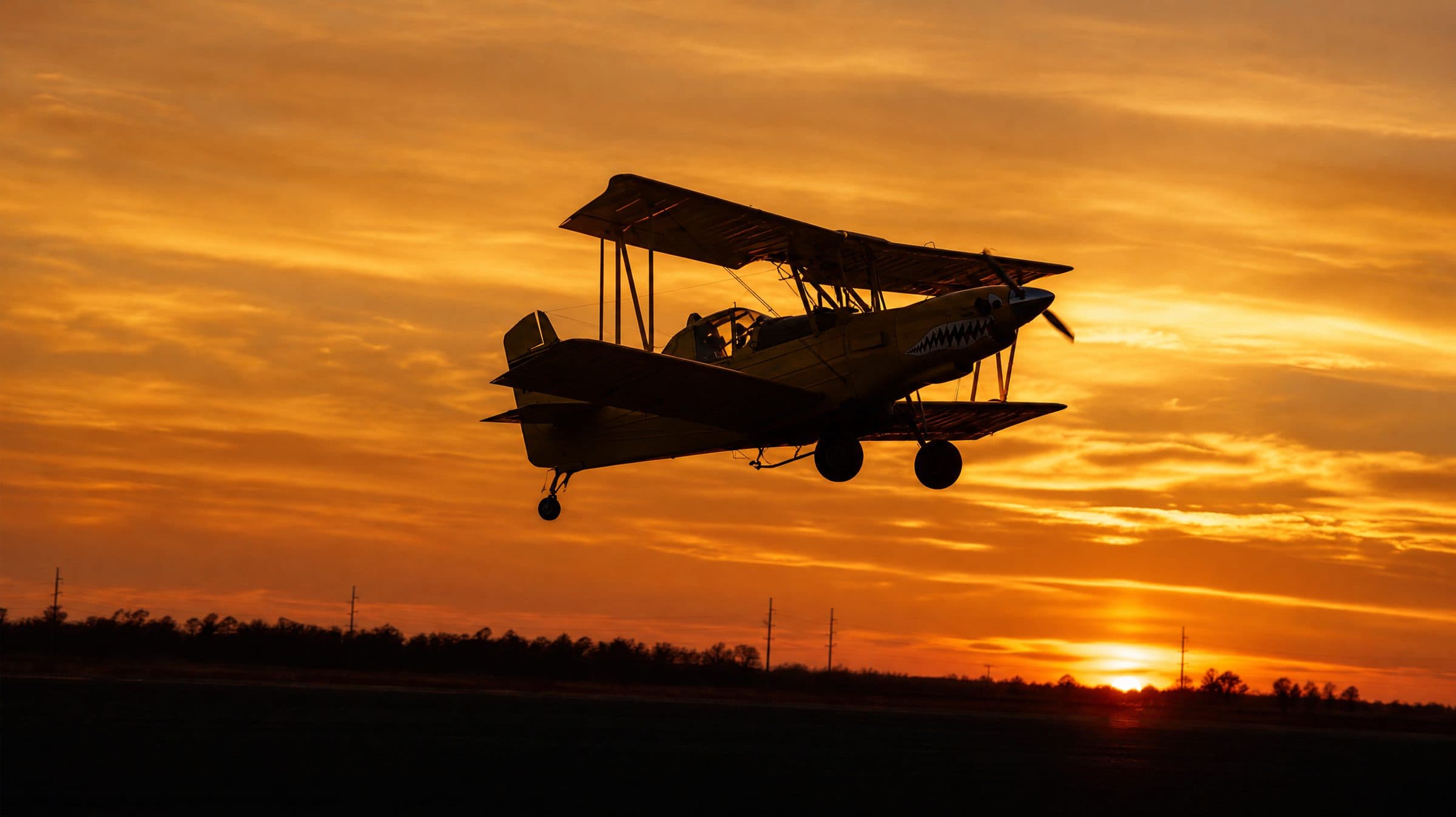
A crop duster flying low, with its wheels just over the crop, looks like a stunt. It is a measured choice. So why do crop dusters fly so low? A short fall puts the product on the crop and keeps it off the neighbors.
Why do crop dusters fly so low?
Aerial application (crop dusting) is the work of putting seed, fertilizer or crop protection products on a field from an aircraft. The pilot flies low because each extra foot of fall gives a droplet more time in the air. Wind moves it, and heat shrinks it. A smaller droplet is lighter, and a lighter droplet travels farther off the field.
A low pass gives a grower three results:
- Less drift. The droplets reach the crop before the wind can carry them away.
- Even coverage. The pilot holds one height, so each pass covers the same width at the same rate.
- Less waste. Product that lands on the target does the job that the label intends.
Our guide to spray drift in aerial application covers the drift rules.
How low do crop dusters fly?
For liquid sprays, the usual application height is 8 to 12 feet above the crop or tree canopy. Application height is the distance from the nozzle tips to the top of the crop, not to the ground. The National Aerial Applicator's Manual, a 2014 study guide published with U.S. EPA support, gives that range. It also says 8 to 10 feet is usually the maximum for sprays with fine droplets.
The product label often sets a maximum height or a height range, and the pilot must follow it. The manual also notes that pilots commonly fly higher in calm air and lower when the wind is stronger.
The height also changes through each part of a job:
| Part of the flight | Typical height | Reason |
|---|---|---|
| Spray pass, liquid product | 8 to 12 feet above the crop | Short fall time, less drift |
| Spray pass, fine droplets | 8 to 10 feet at most | Fine droplets drift farther |
| Pass with dry granules | Higher than a spray pass | The spreader throws granules sideways before they fall |
| Turnaround at the field end | High enough to clear wires and trees | Room for a safe turn |
| Ferry between airstrip and field | At least 500 feet above the surface | Manual guidance and FAA minimums |
How much difference does a few feet make?
A few feet make a large difference because small droplets fall very slowly. Researchers measure droplet size in microns, and one micron is one millionth of a meter. A human hair is about 100 microns thick. In still air, a 400-micron droplet falls 10 feet in about 2 seconds, and a 20-micron droplet takes about 4 minutes.
Wind turns that fall time into distance. The manual shows how far droplets move sideways as they fall 10 feet in a 3 mph wind:
| Droplet diameter | Sideways movement in a 3 mph wind |
|---|---|
| 400 microns | 8 feet |
| 150 microns | 22 feet |
| 100 microns | 45 feet |
| 50 microns | 178 feet |
| 20 microns | 1,056 feet |
Drift researchers call droplets of about 150 to 200 microns or smaller driftable fines. For this reason, the pilot pairs a low release height with nozzles that make large droplets.
Is it legal for a crop duster to fly that low?
Yes, under a specific FAA rule. The normal rule, 14 CFR 91.119, keeps aircraft at least 500 feet above the surface outside congested areas. Over a city, town or crowd, the minimum is 1,000 feet above the highest obstacle within 2,000 feet.
Agricultural aircraft operators hold a certificate under 14 CFR Part 137. Section 137.49 lets them fly below 500 feet over areas that are not congested. The exception covers only the actual dispensing operation, with its approaches, departures and turnarounds. The condition is strict: the flight must not create a hazard to persons or property on the surface.
Flights over congested areas need more. Under Section 137.51, the operator must get written approval from the local government and give public notice. The FAA must also approve a plan for each operation. Our post on FAA Part 137 for agricultural aircraft explains the certificate.
Why not fly even lower?
A pass that is too low causes its own problems. The manual describes "ground effect," which starts when the aircraft is less than three quarters of its wingspan above the ground. For a plane with a 40-foot wingspan, that is under 30 feet. Air that the wing pushes down hits the ground and moves back up. Over bare ground or short crops, that rising air can lift spray and carry it off target.
A very low pass also leaves streaks. The spray from each nozzle needs room to spread out and join the spray from the next nozzle. Without that room, the crop gets bands of heavy and light coverage.
How do pilots stay on line so close to the crop?
The swath is the width of crop that one pass covers. The effective swath includes the overlap between passes that gives an even rate. Operators find it by pattern testing. The aircraft sprays a dye over a string line on the ground, and an analyst measures the deposit across the swath. The manual says to repeat the test after any change to the boom or the application height.
GPS guidance keeps the passes parallel. A light bar in the cockpit shows the pilot how far the aircraft is left or right of the planned line. Before GPS, human flaggers at the field ends marked each swath. The manual notes that GPS systems removed the need for flaggers. In the 2019 NAAA survey, 99 percent of operators used GPS for swath guidance.
Swath and speed together set the work rate. At 120 mph, the speed in a worked example in the manual, a plane covers 10,560 feet each minute. With a 60-foot swath, that is about 14.5 acres each minute. The NAAA industry facts page estimates that an Air Tractor AT-502B with a 60-foot swath treats about 1,800 acres in a 12-hour day. A ground rig with a 90-foot boom treats about 450 acres. The aircraft also leaves no wheel tracks on wet or planted ground.
Why do crop duster turns look so steep?
Crop duster turns look dramatic because the pilot must climb out of the field, reverse direction and drop back in at the next swath.
Caution: A pull-up followed by a turn puts the plane in a low-speed, high-drag condition. The manual states that poorly executed turnarounds cause many aerial application accidents.
The manual describes each stage of a correct turnaround:
| Stage | What the pilot does |
|---|---|
| Field edge | Shuts off the spray in level flight |
| Pull-up | Climbs over the wires or trees at the field end |
| Level-off | Levels the wings before the turn starts |
| First turn | Makes a wide initial turn downwind |
| Straight segment | Flies level for several seconds to line up |
| Final turn | Turns back toward the field |
| Let-down | Descends to application height before the field edge |
| Next pass | Turns the spray on in level flight |
The pilot sprays only in level flight, because a turn or a climb distorts the pattern. The manual also tells pilots to avoid turnarounds over homes, livestock and ponds where possible.
What makes a crop duster flying low dangerous?
Wires and towers are the main hazard when a crop duster flies low. NAAA reports that from 2009 to 2018, collisions with towers caused 9 percent of aerial application fatalities. Collisions with power lines caused another 13 percent of accidents and 12 percent of fatalities.
Before a job, the pilot and the ground crew examine the field for hazards:
- Power lines and poles at the field edges and across the field
- Towers, guy wires and weather masts
- Trees, buildings and irrigation equipment
- Homes, roads, schools and water near the field
- Bee hives and nearby crops that the product could harm
For a pole or tree inside a field, the pilot stops the spray one or two swaths early and pulls up over it. Later, the pilot sprays one or two swaths on each side of it, across the earlier passes.
Why do crop dusters fly at night or at dawn?
Some applications happen at dawn, in the evening or after dark for two main reasons. First, cool, humid air slows evaporation, and wind is often lighter. The manual calls early morning usually ideal for that reason. Second, some products carry bee rules. UC IPM's bee precaution ratings list products that must not go on flowering plants, except between sunset and midnight if the label allows it.
Calm air near sunrise and sunset also brings a risk: a temperature inversion. In an inversion, a warm layer of air sits over cool air near the ground, sometimes 20 to 100 feet up. Fine droplets stay trapped under that layer and move slowly as a cloud. The manual tells pilots to stop if the wind falls below about 2 mph. Dead calm can signal an inversion.
Night work adds its own hazard, because wires are harder to see in the dark. Our article on bees and pesticides covers how growers and applicators protect hives.
What should neighbors do when a plane sprays nearby?
Neighbors who wonder why do crop dusters fly so low near a house usually see a turnaround or the first pass at a field edge. On the way to and from the airstrip, the manual tells pilots to fly at least 500 feet above the surface. It also tells them to stay 500 feet from people and property.
Warning: If spray or drift reaches you and you have trouble breathing, leave the area and call 911 first.
For other concerns, use these steps:
- Note the time, the location and the wind direction.
- Go indoors and close the windows if spray or odor reaches you.
- Call the grower or the applicator and ask what they applied.
- Call your county agricultural commissioner's office with your notes.
Our guide to crop dusting near homes explains what to expect and how notice works in California.
Low, level passes in the northern Sacramento Valley
We fly five Ag Cats and one Air Tractor 602 out of Live Oak, in Sutter County. You can see the aircraft on our fleet page. Our pilots fly low, level passes, check the wind before and during each job, and plan around homes, schools, water and neighboring crops. If the wind is wrong, we wait. We work rice, orchards and row crops in Sutter, Yuba, Butte, Glenn and Colusa counties. To plan an application, get a quote for your field.
Questions
Speed depends on the aircraft and the product. The National Aerial Applicator's Manual uses 120 mph in a worked example. It gives 100 to 120 mph or faster for granules in some fixed-wing aircraft. The pilot holds one constant airspeed on each pass so that the rate stays even.
Not when the wind creates a drift hazard. The pesticide label sets the wind limits, and the pilot stops the job if the wind rises. Where a label gives no limit, extension guidance suggests 3 to 8 mph, blowing away from sensitive areas. Dead calm is also a reason to wait.
During the spray pass and its turns, FAA Part 137 lets a pilot fly closer than 500 feet to people and buildings outside congested areas. The flight must create no hazard to them. Over a congested area, the operator needs local approval, public notice and an FAA-approved plan.