
Orchards
Orchard spraying by air: walnuts, almonds and prunes
By the Sutter Butte Dusters team · · 8 min read
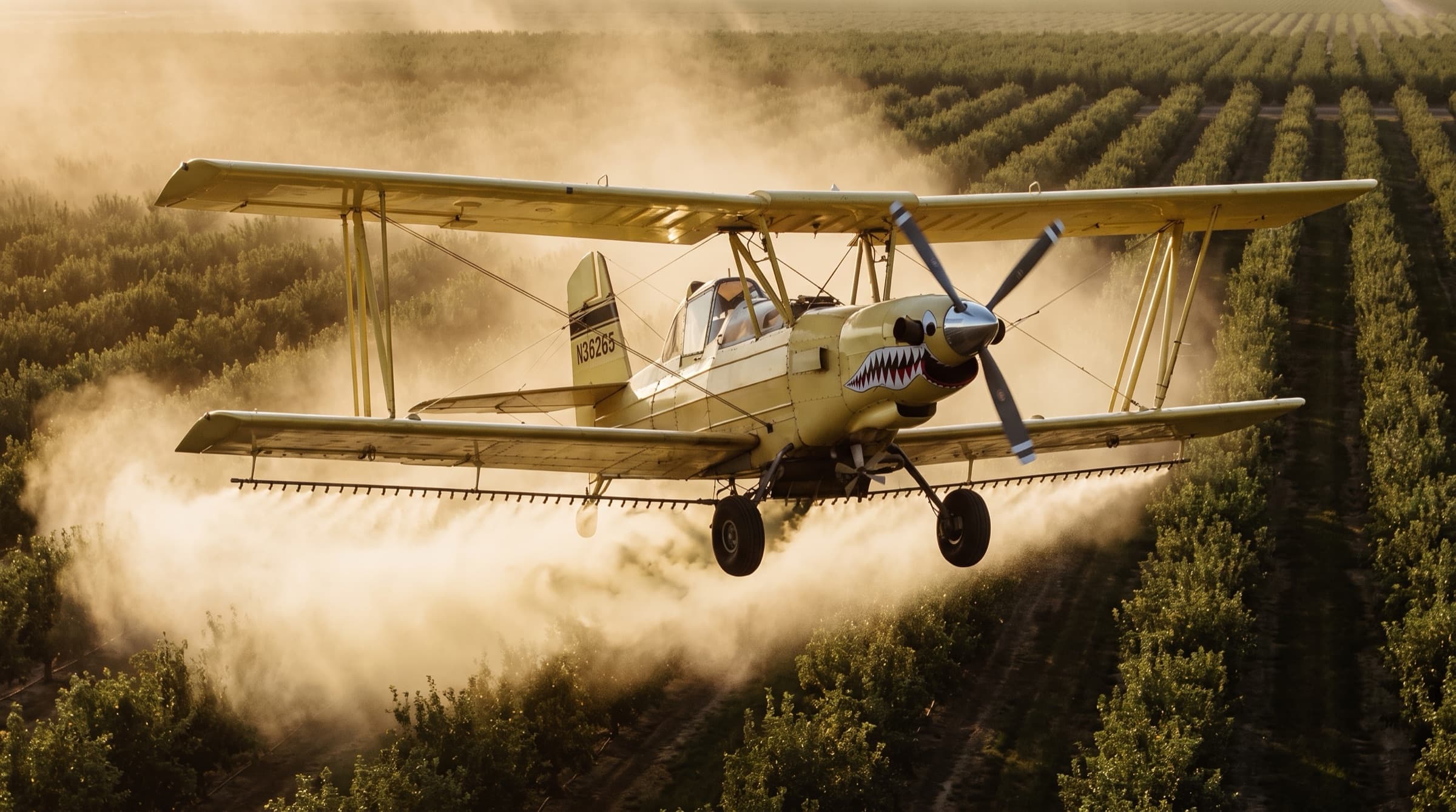
Orchard spraying by air treats a whole block when the ground is too wet for a sprayer or the bloom window is short. This post explains when an airplane fits walnuts, almonds and prunes, how the pilot calibrates it, and what the grower checks before the flight.
When does aerial orchard spraying make sense?
Aerial orchard spraying makes the most sense when timing matters more than anything else. Bloom diseases are the clearest case. Fungi and bacteria infect the flowers in wet weather, and the treatment must be on the tissue before the rain. A wet orchard floor can keep ground sprayers out of the rows for days after a storm.
An airplane never touches the ground in the block. It does not rut wet rows, compact the soil or strike low limbs full of blossoms. It also covers several blocks in one day, before the next storm.
An airblast sprayer is a ground machine that uses a large fan to push spray into the trees from each row. For dense canopies and pests deep inside the tree, it often gives better coverage when the floor is dry. Most growers use both methods. Our post on aerial spraying vs a ground rig compares the two in more detail.
How is orchard spraying by air different from an airblast sprayer?
An airplane sprays from above the trees, and an airblast sprayer sprays from the side. The ground sprayer figures in the table come from University of Georgia Extension Bulletin 979, Orchard Sprayers (2012).
| Item | Airblast ground sprayer | Airplane |
|---|---|---|
| Spray direction | From the side, carried by fan air | From above, carried down by the air behind the wing |
| Travel speed | 1 to 3 mph, most often 1.5 to 2 mph | 120 mph in the USDA example |
| Ground covered | About 0.09 acres per minute in the UGA example (60-foot rows at 1.5 mph) | 24.24 acres per minute in the USDA example (100-foot swath) |
| Spray volume | 30 to 150 gallons per acre | The label sets the aerial volume |
| Wet ground | Waits until the floor is firm | Not affected |
| How the pattern is set | Nozzles and air vanes put 2/3 to 3/4 of the spray in the top half of the tree | Nozzle type, droplet size, swath width and pass layout |
Spray from above lands first on the top of the canopy, and less reaches the inner canopy. Your licensed pest control adviser (PCA) decides whether that pattern fits the target pest or disease. The pilot controls the rest with droplet size, flight height and the spacing between passes.
How do aerial applicators calibrate the spray?
Calibration is the measurement and adjustment of the amount of spray that the equipment actually puts out. The USDA Agricultural Research Service publishes the formulas in Calibration of Aerially Applied Sprays. The procedure below follows that chapter.
- Get the airspeed, swath width, rate per acre and nozzle output.
- Multiply the airspeed in mph by the swath width in feet.
- Divide the result by 495 to get acres per minute.
- Multiply acres per minute by the rate per acre to get the output per minute.
- Divide the output per minute by the output of one nozzle.
- Correct the nozzle count for a liquid that is heavier than water.
- Run the system on the ground, or fly for 1 minute, and measure the output.
- Adjust the pressure in small steps until the output is correct.
- Make a final check with a small load in a real application.
In the USDA example, an aircraft at 120 mph with a 100-foot swath covers 24.24 acres per minute. A small output error therefore repeats across a whole block in minutes.
Nozzle wear is a common cause of that error. The UGA bulletin reports that only 0.005 inch of wear increases the flow of one disc nozzle by 36%. The same bulletin warns that output changes of 10 to 20% can easily go unnoticed. The pilot flow-checks each nozzle, replaces worn tips and repairs leaks.
Pattern testing shows how evenly the spray lands from one side of the swath to the other. The National Agricultural Aviation Association runs Operation SAFE, a pattern-testing program for aerial applicators. At a fly-in clinic, the aircraft makes test passes over sample collectors. Trained analysts measure the deposit across the swath and, for liquids, the droplet size. They then recommend equipment changes if the pattern needs them.
When you hire an applicator, ask how they set swath width and droplet size, and when they last tested their pattern. Our post on spray drift in aerial application covers wind and droplet size in more detail.
Which orchard diseases do growers treat at bloom?
Bloom is the main season for orchard spraying by air in the northern Sacramento Valley. The UC Statewide IPM Program (UC IPM) sets these bloom timings for our three main orchard crops.
| Crop | Disease | Bloom timing in the UC IPM guideline |
|---|---|---|
| Almond | Brown rot blossom blight | Pink bud (5 to 10% bloom) and full bloom |
| Prune | Brown rot blossom and twig blight | Green bud and full bloom, plus popcorn if bloom is long and wet |
| Walnut | Walnut blight (a bacterial disease) | Buds at the "prayer" stage, then 7 to 10 days later |
Sources: UC IPM guidelines for almond brown rot blossom blight, prune brown rot blossom and twig blight, and walnut blight.
Almonds. The almond guideline says flowers are most susceptible when they are fully open. Rain with temperatures in the mid-70s °F favors infection. One treatment at full bloom is enough in most orchards in a year with little rain. A long, wet bloom or a history of severe brown rot can call for a second or third treatment near full bloom.
Prunes. The prune guideline says fungicides work best when they go on before rain and dry on the tissue. It also notes that dense ground cover during bloom favors spore production from old fruit mummies. A wet, grassy floor is a disease risk and an access problem.
Walnuts. The prayer stage is the point when the leaves at the tip of the female flower bud first unfold. The walnut guideline adds an earlier treatment for catkin-first varieties such as Chandler. It applies when 30 to 40% of catkins emerge, the block had blight last season, and rain is in the forecast. The guideline also reports that copper resistance is common in Sacramento Valley orchards. Your PCA chooses the material with that resistance in mind.
What does almond spraying at bloom mean for bees?
Almond spraying at bloom takes place while rented honey bee hives are in the orchard. The Almond Board of California publishes eight tips for pesticide use at bloom. The main points for an aerial job are these:
- Notice. Tell the contracted beekeepers, and any beekeepers within 1 mile, 48 hours before the application. Notice is mandatory for products labeled "toxic to bees."
- Time of day. Apply fungicides in the late afternoon or evening.
- No insecticide mixes. Avoid insecticides at bloom, except Bacillus thuringiensis (Bt). Do not tank mix an insecticide with a bloom fungicide.
- Adjuvants. Use an adjuvant with a bloom fungicide only when the label calls for it.
- Hives, bees and water. Do not spray the hives or flying bees. Provide clean water for the bees.
- Incidents. Report a suspected bee kill to the county agricultural commissioner as soon as possible.
Our post on bees and pesticides explains bee protection in more depth.
Does the label allow a fungicide application by air?
A fungicide application by air is legal only when the product label allows it. Each label lists the methods of application, and some labels exclude aircraft. The UC IPM walnut blight guideline gives an example: the kasugamycin label says not to apply it aerially. An aerial label can also set a minimum volume, droplet size, wind limits and buffer zones.
Spray volume needs a check too. Some guidelines give a water volume that fits a ground rig. For example, the UC IPM almond guideline lists one fungicide at 400 gallons of water per acre. When a recommendation calls for a volume like that, ask your PCA whether an aerial application fits at all.
We do not choose products or rates. Follow the label and your PCA's written recommendation for each block. The pilot then confirms that the aircraft can apply the volume and droplet size that the label requires. Our posts on FAA Part 137 and pesticide application rules in California explain the federal aircraft rules and the state application rules.
How do you prepare an orchard block for an aerial application?
Complete these steps before you call for the flight.
- Get the PCA's written recommendation for the block.
- Confirm that the label allows aerial application on your crop.
- Record the bloom stage of each variety in the block.
- Mark power lines, wind machines and tall trees on the field map.
- Mark homes, schools, roads and water near the block.
Caution: The spray must not hit hives or flying bees. Confirm the hive locations before you set the date.
- Send the hive locations to the applicator.
- Agree with the beekeeper on the 48-hour notice and the water source.
- Check the forecast so the material can dry before rain.
- Plan the restricted entry interval with your field crew.
- Send the field address, APN or FSA farm and tract number.
If you do not know your parcel numbers, our guide to finding an APN or FSA farm number shows where to look.
What other orchard jobs do aircraft do after bloom?
Walnut growers often need a summer treatment for walnut husk fly, a pest that stains the hulls and shells. Many growers also use sulfur for mildew and some mites.
Most crop protection flights in our area are from May to August. Our crop dusting season calendar shows how orchard work fits around rice and row crops.
Orchard spraying in the northern Sacramento Valley
We fly orchards of walnuts, almonds, prunes and peaches from our base at 4080 Clark Rd in Live Oak. Our fleet is five Ag Cats and one Air Tractor 602. We apply fungicide and insecticide in Sutter, Yuba, Butte, Glenn and Colusa counties, including wet-ground jobs that sprayers cannot reach. We schedule each job to your PCA's recommendation and plan around the wind and sensitive areas. Send us the block and your timing, and we will give you a quote for your field.
Questions
The UC IPM almond guideline says to treat at pink bud, when 5 to 10% of the flowers are open, and again at full bloom. In a dry year, one full-bloom treatment is often enough. A long, wet bloom can call for a second or third treatment. Your PCA sets the timing for each variety.
Yes, with care. The Almond Board of California advises fungicide sprays in the late afternoon or evening, no insecticide tank mixes at bloom, and 48 hours' notice to beekeepers within 1 mile. Do not spray the hives or flying bees. Always follow the bee precautions on the label.
It depends on the target. Spray from an airplane lands first on the top of the canopy, and less reaches the inner canopy. For bloom diseases on wet ground, an airplane is often the only way to treat on time. For pests deep in dense trees, many growers use a ground rig when the floor is dry.
Only products whose label lists aerial application. Some labels exclude aircraft, and others set a minimum spray volume, droplet size or buffer zone for aerial use. We do not recommend products. Your licensed pest control adviser chooses the material, and the applicator confirms that the aircraft can meet the label.
