
Orchards
Walnut husk fly: signs, timing and control
By the Sutter Butte Dusters team · · 8 min read
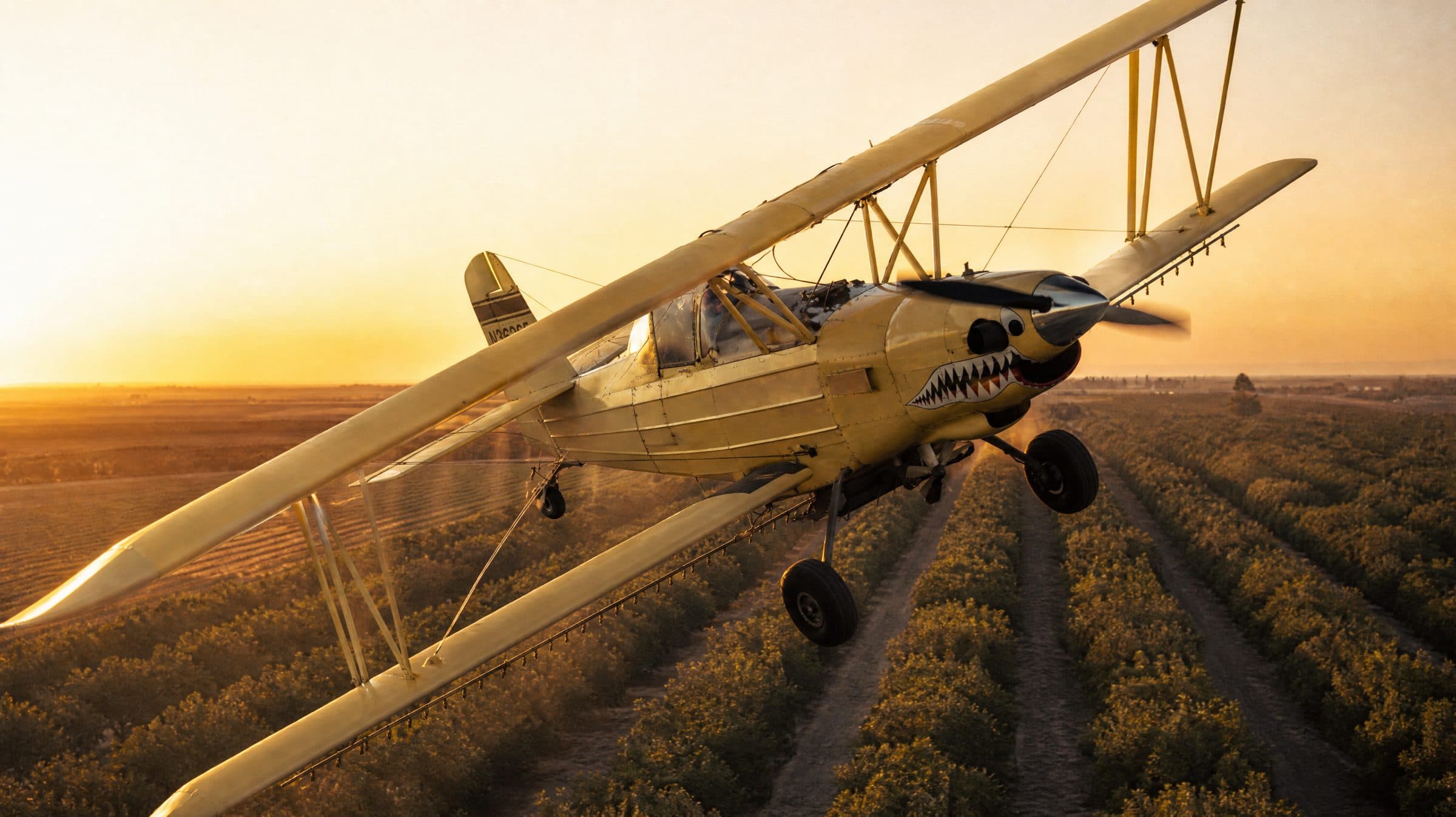
The walnut husk fly is a fruit fly that lays its eggs in the green husk of the walnut in summer. Its maggots turn the husk black and stain the shell, and an early attack also damages the kernel. This post explains how to identify the fly, how to trap it, what sets the spray date, and where an aircraft fits in the program.
What is the walnut husk fly?
This fly (Rhagoletis completa) is one of the main walnut pests in California. In this post, "husk fly" means this insect. The UC Statewide IPM Program (UC IPM) reports it in all California walnut areas (UC IPM husk fly guidelines).
The adult is about the size of a house fly. It has a yellow spot just below the point where the wings attach, and a dark triangular band at each wing tip. A 10X hand lens shows the sex. On the female, the first leg segment is straw-colored. On the male, it is brown to black. This check matters, because the female sets the treatment date.
How does the husk fly life cycle work?
The husk fly has one generation each year. The pupae (the resting stage between the maggot and the adult) spend the winter in the soil under the trees. UC IPM gives this sequence for the Central Valley:
- Adults come out of the soil from early June to early September.
- Most adults emerge between July and mid-August.
- The female lays groups of about 15 eggs just under the husk surface.
- The eggs hatch within 5 days.
- The maggots feed in the husk for 3 to 5 weeks.
- The maggots drop to the ground and burrow several inches into the soil.
- Most adults emerge the next summer. Some stay in the soil for 2 years or more.
For this reason, one untreated season can send flies into the orchard for two or more summers.
What damage does husk fly do to walnuts?
The first sign is a sting, which is a small puncture where the female put her eggs. The maggots then turn the husk soft and black. The husk tissue stains the shell, and normal bleach does not remove the stain. Stained nuts cannot go to the in-shell market.
The date of the attack decides how much the kernel suffers. UC IPM describes two cases:
| Attack date | Effect on the nut |
|---|---|
| Early (late July to mid-August) | Shriveled, dark kernels, more mold and lower yield. Early damage can cut nut value by 30 percent. |
| Late in the season | Less kernel damage, but stained shells and hulls that are hard to remove. |
Some stained nuts still go to the cracker for meats, but many leave the line at sorting. UC IPM lists Tulare, Hartley, Serr and Franquette as very susceptible, and Payne, Serr and Hartley show damage earlier than Chandler. Black walnut trees near the orchard are a preferred host and a common source of flies.
UC IPM notes that walnut blight, aphids, sunburn and water stress can cause similar damage, so check for stings and maggots.
Husk fly damage can also help another pest. UC IPM states that navel orangeworm attacks only damaged walnuts before husk split (UC IPM navel orangeworm guidelines). Codling moth causes most of that early damage. An early husk fly attack can also crack the husk and give navel orangeworm a way in.
Why is husk fly pressure higher now?
A Durham pest control adviser reported in May 2026 that trap counts have climbed for two to three seasons (AgAlert, May 20, 2026). He linked the rise to low walnut prices. Many growers cut their husk fly program, and the population built up.
The flies also start earlier than in the past. A UC Cooperative Extension (UCCE) farm advisor for Sutter, Yuba and Colusa counties reported earlier emergence in the Sacramento Valley. UCCE moved the trap date from mid-June to June 1 (Sacramento Valley Orchards, 2016).
How do you monitor for walnut husk fly?
Traps show when the flies are active and when the females are ready to lay eggs. UC IPM recommends an unbaited yellow sticky trap with an ammonium carbonate lure. Do not use the baited traps made for apple maggot.
- Hang the traps by June 1.
- Put each trap high in dense foliage on the north side of the tree.
- Use at least 2 traps for each 10 acres.
- Put traps in hot spots, such as large shaded trees and damp areas.
- Add traps near black walnut trees and near trees with damage last season.
- Check the traps 2 or 3 times a week.
- Record the catch for each orchard on its own sheet.
For the egg check, put trapped females on a dark surface and press the abdomen gently with a blunt tool. Mature eggs look pearly white, like small grains of rice.
When should walnut husk fly treatment start?
Your licensed pest control adviser (PCA) makes the call from the trap records. UC IPM describes these triggers:
| Method | Trigger for the first application |
|---|---|
| Trap catch, low to moderate pressure | The catch rises sharply |
| Trap catch, high pressure, or a ready-to-use spinosad bait | Any flies in the traps |
| Egg check in females | The first female with eggs |
| Nut check (least useful) | The first sting |
Caution: Do not wait a week after the first female with eggs. UC IPM warns that the delay gives the eggs time to develop.
The interval matters as much as the start date. A short-residual insecticide with bait kills flies for 7 to 10 days, which protects the nuts for about 3 weeks. UC IPM sets later sprays at 2- to 4-week intervals, based on how well the last spray worked.
Clean the traps the day after each treatment, and check them 3 to 4 days later. A catch near zero means the spray worked. UC IPM calls for another spray when catches rise, females carry eggs, the residual is gone and harvest is over 3 weeks away.
An orchard does not need a spray every year if the traps stay quiet.
What walnut husk fly treatment options do growers use?
Most programs use a bait spray. A bait spray mixes an insecticide with a food attractant, such as molasses, corn gluten meal or corn steep liquor. The flies feed on the droplets and die before they lay eggs.
Because the bait draws the flies, full canopy coverage is not always needed. UC IPM says that alternate-row or low-volume bait sprays can work at low to moderate pressure. Orchards with high populations and heavy past damage may need full coverage, high volume or more applications.
UCCE tested this idea in walnut orchards in 2012 and 2013, including one at Rio Oso. A spray of 10 gallons per acre on every other row controlled the fly as well as 100 gallons per acre on every row. Both used the same insecticide and bait amount per acre.
UC IPM lists several groups of active ingredients for husk fly:
- Spinosyns (spinosad and spinetoram), including a ready-to-use spinosad bait. UC IPM says not to use that bait product on black walnut.
- Pyrethroids, such as bifenthrin and lambda-cyhalothrin.
- Neonicotinoids, such as acetamiprid, imidacloprid and clothianidin.
- Organophosphates, such as phosmet and malathion. UC IPM warns that these products can increase mite problems.
UC IPM asks growers to rotate mode-of-action groups and use one group no more than 2 times a season.
California adds its own rules for four neonicotinoids: clothianidin, dinotefuran, imidacloprid and thiamethoxam. Title 3, California Code of Regulations, sections 6990 to 6990.16 apply (DPR, neonicotinoids in tree nut crops). On walnuts, the rules prohibit an application during bloom and set a combined seasonal limit. When the label and the rule differ, the strictest requirement applies.
We do not give products or rates for any pest. The label and your PCA's written recommendation set the material, the rate and the interval for each block.
Can walnut spraying for husk fly be done by air?
Yes, when the product label allows aerial application. A low-volume bait program suits an aircraft, because the bait draws the flies and full coverage is less critical. An airplane treats a whole block in one short visit, which keeps the interval on schedule. Aircraft help most on large blocks, on wet ground, and when the ground rigs are busy with codling moth or mite work.
A ground air-blast sprayer is the better tool for the high-volume, full-coverage spray that UC IPM suggests for heavy populations. Our post on orchard spraying by air compares the two methods.
Some husk fly materials are toxic to bees, and UC IPM marks acetamiprid this way. Keep these sprays off blooming weeds on the orchard floor, and read bees and pesticides.
What should you check before an aerial husk fly application?
Use this checklist before you ask for a quote.
- Get the PCA's written recommendation for the block.
- Confirm that the label allows aerial application on walnuts.
- Check for black walnut trees inside the treated area.
- Write down the last trap counts and the date of the first female with eggs.
Caution: Do not schedule a husk fly application after husk split.
- Confirm the crop stage on the day of the flight.
- Mark homes, schools, water, power lines and hives on the field map.
- Plan the restricted entry interval with your field crew.
- Compare the preharvest interval with your expected harvest date.
- Send the field address, APN or FSA farm and tract number.
For the legal side, read pesticide application rules in California and spray drift in aerial application.
How do you check the damage at harvest?
The harvest sample sets up next year's program. Before harvest, UC IPM suggests a sample of 100 nuts from each variety, each block and each high-damage area. Count the nuts with black husks or stained shells, and put next year's traps where the damage was worst. Growers with severe late damage can ask their PCA about ethephon, a plant growth regulator that brings husk split earlier.
Husk fly applications in the northern Sacramento Valley
We fly walnut and other orchards in Sutter, Yuba, Butte, Glenn and Colusa counties from our base at 4080 Clark Rd in Live Oak. Our fleet is five Ag Cats and one Air Tractor 602. Husk fly sprays are part of our crop protection work, and each flight follows your PCA's recommendation and the label. Husk fly work falls in the busy summer months of the crop dusting season calendar, so send your blocks early. Send us your field and your timing, and we will give you a quote for your field.
Questions
UC IPM prefers bait sprays, which mix an insecticide with an attractant such as molasses or corn gluten meal. The flies feed on the droplets and die before they lay eggs. Your PCA chooses the material and the rate for each block, and the label sets the limits.
In the Central Valley, adults emerge from early June to early September, with the peak from July to mid-August. A female lays eggs only after her eggs mature, so advisers press trapped females to check. UC IPM warns against a one-week wait after the first female with eggs.
Stained shells cannot go to the in-shell market, because normal bleach does not remove the stain. Late damage often leaves the kernel usable, and some nuts are cracked for meats. Early damage can shrivel kernels and, according to UC IPM, cut nut value by 30 percent.
The UC IPM walnut guidelines cover codling moth, navel orangeworm, walnut husk fly, aphids, webspinning spider mites, scales and walnut twig beetle, among others. Codling moth and early husk fly damage can both give navel orangeworm a way into the nut before husk split.