
Rice
Tadpole shrimp in rice: what they do and when to act
By the Sutter Butte Dusters team · · 9 min read
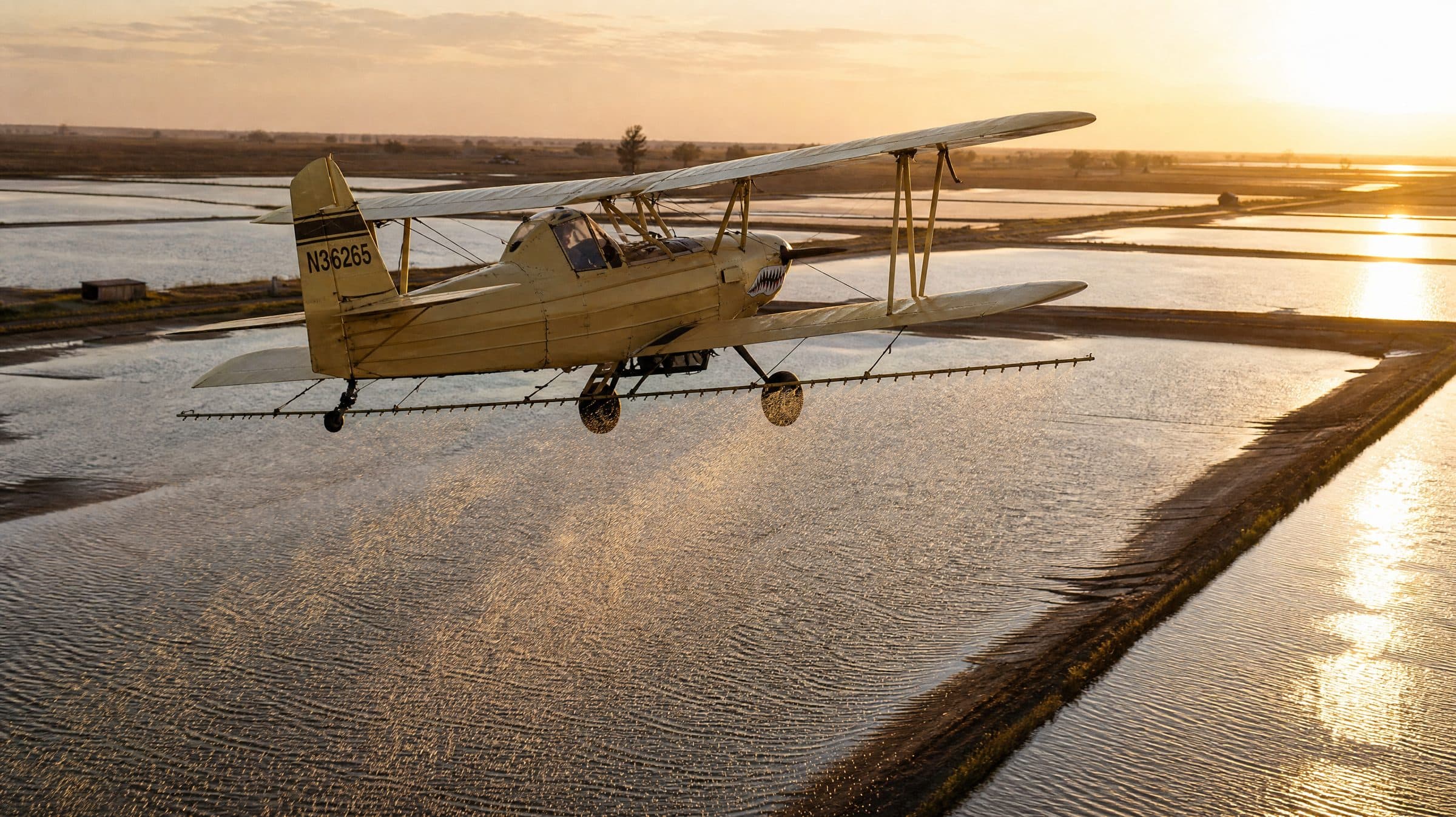
Tadpole shrimp are the first pest a water-seeded rice stand meets, and they strike before growers can see them. In the Sacramento Valley, they hatch in the new flood and can kill germinating seed before the stand starts. This guide explains how to identify the pest, scout a check and decide when to act.
What are tadpole shrimp?
The rice pest is Triops longicaudatus, a crustacean in the order Notostraca. It is not a tadpole and not a true shrimp. The UC IPM guideline for tadpole shrimp in rice describes a thin, olive-brown shield over the front of the body. Behind the shield are about 35 segments, most with leaflike legs that also act as gills, and two long tails.
The species comes from vernal pools, which fill in the wet season and then dry. A 2020 UC Davis fact sheet by Luis Espino, a UC Cooperative Extension rice adviser, says rice fields give it excellent habitat. The same fact sheet says California has recognized it as a rice pest since the 1940s.
The U.S. Fish and Wildlife Service calls these animals living fossils, because their form has changed little.
What is the tadpole shrimp life cycle?
The whole life cycle fits inside the first month of the rice flood. This timeline comes from UC IPM and the fact sheet.
| Time | What happens |
|---|---|
| 1 to 3 days after the flood starts | Most eggs in the top 0.5 inch of soil hatch. Some hatching continues for 1 to 2 weeks. |
| Less than 24 hours after a shrimp hatches | The young molt fast and look like small adults. They are translucent and hard to see. |
| About 5 days after the flood starts, in warm weather | The shell can reach about 4 mm (0.16 inch). The shrimp can now kill germinating seed. |
| 7 to 10 days after a shrimp hatches | Red-orange egg masses show in two brood pouches under the edge of the shield. |
| About 30 days after the flood starts | Most shrimp have finished their cycle, and numbers fall until they disappear. |
People often mistake the clear molt skins for dead shrimp.
How big do they get? Tadpole shrimp size and damage
Size matters more than numbers in the first week. Espino's fact sheet says a shrimp cannot injure a germinating seed until its shell is about 4 mm long. That is about half the size of a rice seed. His 2017 Rice Farming column adds that this is about when you can first detect them. An adult reaches about 1.5 inches, according to UC IPM.
The shrimp grow fast in warm weather. In the same column, Espino reports shrimp of damaging size 5 days after a late-May flood started.
What happens to tadpole shrimp eggs between seasons?
The eggs carry the population from one season to the next. Adults lay eggs one at a time on the soil or on plants at the soil surface. UC IPM reports that the eggs resist drying and stay viable for several years in unflooded soil.
A newly laid egg needs a dry period before it can hatch. For this reason, UC IPM says that no more eggs hatch until next year if the field stays flooded. The eggs also hatch in installments: some hatch at the next flood, and others wait for another dry and wet cycle. Only eggs in the top 0.5 inch of soil hatch, so cultivation can lift buried eggs into the hatch zone.
How does the pest damage rice seedlings?
The shrimp reduce a rice stand in two ways. First, they eat the white coleoptile (the first shoot) and the radicle (the first root), and the loss of either one kills the seedling. Second, they dig as they feed and lay eggs. The muddy water cuts the light that reaches submerged seedlings, so the seedlings grow more slowly.
The risk falls quickly as the seedling develops. Once a seedling has a green spike and an anchored root, the shrimp usually do not injure it. They still eat the roots of any seedling that wind or digging pulls loose. UC IPM says stand loss stops once the leaves reach the water surface and the roots are well established.
UC IPM names these signs of damage:
- Muddy water in the check.
- Masses of cut leaves and floating seedlings that the wind pushes against the levees.
When is the risk highest in the Sacramento Valley?
In our area, most rice is water-seeded. The grower floods the check, and an airplane spreads soaked seed onto the water. Our post on aerial rice seeding in the Sacramento Valley explains that flight, and our guide to the rice field explains checks and levees.
| Month | Field work in the valley | Pest risk |
|---|---|---|
| November to March | Straw breaks down; many fields hold winter water | No rice seedlings to damage |
| April | First fields flood and go to seed | Most eggs hatch 1 to 3 days after the flood; growth is slower in cool water |
| May | Most fields flood and go to seed | Highest risk; in warm water, shrimp can reach 4 mm in about 5 days |
| Early June | Late fields seeded; early stands reach the surface | Risk ends in each check once leaves reach the surface |
UC IPM gives special attention to fields with past problems and to large fields that take more than a few days to flood. Espino adds late-May and other warm-weather seedings. His fact sheet rates fields drained soon after seeding, called Leather's method, as low risk.
How do you scout a rice field for the shrimp?
Check each field often in the first 2 weeks after seeding. If a field takes a long time to flood, UC IPM says to check for shrimp after the flood and before you seed. Check all quadrants, because the shrimp can show up well beyond last year's boundaries.
You need a 1-square-foot frame with sides taller than the water, a clear jar, and a seine with 1/8-inch mesh. Our crop scouting post covers a general field walk.
- Pull the seine along the soil surface to find out whether shrimp are present.
- Compare several shrimp with a rice seed, and note whether they are over half its size.
- Set the frame gently into the water so the sample area stays clear.
- Count the healthy seedlings inside the frame.
- Note chewed shoots, chewed roots and floating seedlings.
- Take 10 samples across the check.
- Record the average seedlings per square foot and the shrimp numbers.
If wind clouds the water, wait a day or two, or push the jar open end up into the water and look through its bottom.
What are the UC treatment thresholds?
UC IPM sets its thresholds by crop stage and stand density. An average of 25 plants per square foot gives maximum yield. A stand under 12 plants per square foot can lose significant yield.
| Crop stage | What you find | UC IPM action |
|---|---|---|
| Seed germination, soon after seeding | Shrimp present | A treatment is warranted |
| Spike and anchored roots | Under 25 healthy seedlings per sq ft, with shrimp evidence | Consider a treatment |
| Spike and anchored roots | 25 or more seedlings per sq ft, with shrimp activity | Resample every 2 to 3 days until plants reach the surface |
| Leaves at the surface, roots established | Any | No stand loss expected |
Espino's fact sheet gives a simple field rule. Act if the shells are larger than 4 mm and the seedlings do not have a spike yet. If muddy water hides the stand, UC IPM says to decide from the shrimp, the molt skins, chewed tips and floating seedlings. Ask your licensed pest control adviser (PCA) for a written recommendation before you treat.
How do you control the pest without an insecticide?
Speed is the first control. Most eggs hatch 1 to 3 days after the flood, and each day before seeding lets the shrimp grow. Flood each field as fast as the water supply allows, and seed as soon as possible after the flood starts. In a large field, seed each check as it fills.
A flood and drain before seeding is the other cultural control. It kills hatched shrimp as the soil dries.
Caution: a drain can cost fertilizer, start a new weed flush, break a pesticide water-hold requirement and waste water. Talk with your PCA before you drain.
- Flood the field.
- Hold the water for 4 to 5 days so that most eggs hatch.
- Drain the field, including low spots and puddles.
- Keep the field dry for at least 24 hours after all standing water is gone.
- Do not cultivate before you reflood.
- Reflood the field and seed it at once.
Expect a smaller second hatch at the reflood. This method fits a stale seedbed program, which our post on weedy rice also covers. UC IPM says a reseeded stand is hard to establish, so prevention pays.
Which treatments does UC IPM list, and why is resistance a concern?
UC IPM lists three materials for this pest in rice. The table below summarizes the UC IPM treatment table, last updated in April 2024. The restricted entry interval (REI) is the wait before workers enter without protective equipment. The preharvest interval (PHI) is the wait from treatment to harvest.
| Material UC IPM lists | Mode-of-action group | REI | PHI | UC IPM notes |
|---|---|---|---|---|
| Copper sulfate | Not applicable | See label | See label | The only material UC IPM lists for organic rice. The rate depends on water depth. Check with your certifier. |
| Diflubenzuron, an insect growth regulator | 15 | 12 hours | 80 days | Use is permitted under a 2(ee) label. |
| Lambda-cyhalothrin, a pyrethroid | 3A | 24 hours | 21 days | Do not release floodwater within 7 days. Notify the mosquito and vector control district. Resistance reduces control in some areas. |
The district notice lets its staff monitor mosquitofish. The label is the legal source for each interval, and the label and your PCA's written recommendation set the product, the rate and the timing.
Resistance is a real concern. In his 2017 column, Espino reports that the shrimp became tolerant to parathion in the 1980s, after about 20 years of use. Pyrethroids arrived in the early 2000s. In his lab test, shrimp from two fields where a pyrethroid had failed survived 24 hours at 5 times the label rate. Copper sulfate killed all shrimp from every field within 24 hours. Our post on pesticide resistance explains how to rotate mode-of-action groups.
Tadpole shrimp vs triops: are they the same animal?
Triops is the genus of the rice pest, and the pet kits sold as "Triops" use the same genus name. The order has a second genus, Lepidurus. The 1994 federal listing rule says Lepidurus has a flat, paddle-shaped plate between its two tails. Triops has no such plate.
The vernal pool species, Lepidurus packardi, has been federally endangered since September 19, 1994. The listing rule says adults reach about 2 inches (50 mm). The Service's species page cites state records in 20 California counties, including all seven we serve. The species lives only in seasonal wetlands such as vernal pools and swales. It is not the rice pest.
For other pests, see our guide to rice pests and diseases and our post on integrated pest management.
Our work in the northern Sacramento Valley
We fly aerial seeding from 4080 Clark Rd in Live Oak, with five Ag Cats and one Air Tractor 602. An airplane can seed each check as it fills, so the seed can reach the water before the shrimp grow to 4 mm. When your PCA recommends a treatment, we apply it over the flood at the label rate through our crop protection service. Our usual time from your call to a plane over the field is 24 hours. Learn more about our rice work, or get a quote for your field.
Questions
The rice pest, Triops longicaudatus, is common in flooded California rice fields. A related species, the vernal pool tadpole shrimp (Lepidurus packardi), has been federally endangered since 1994. It lives only in seasonal wetlands such as vernal pools, and the U.S. Fish and Wildlife Service notes that it is uncommon even there.
They eat small animals and plant material that match their size. In a rice check, a shrimp with a shell of about 4 mm can eat the white shoot and first root of a germinating seed. Larger shrimp also eat the roots of seedlings that wind or digging pulls loose.
UC IPM reports that the eggs stay viable for several years in unflooded soil. A new egg needs a dry period before it hatches. The eggs hatch in installments, so one flood does not empty the soil, and only eggs in the top 0.5 inch hatch.
Not at first. Newly hatched shrimp are translucent and too small to see. They become visible at about 4 mm, which is also the size at which they can injure seed. A seine with 1/8-inch mesh pulled along the soil shows whether they are present.
