
Pest management
Integrated pest management (IPM): a grower's field guide
By the Sutter Butte Dusters team · · 9 min read
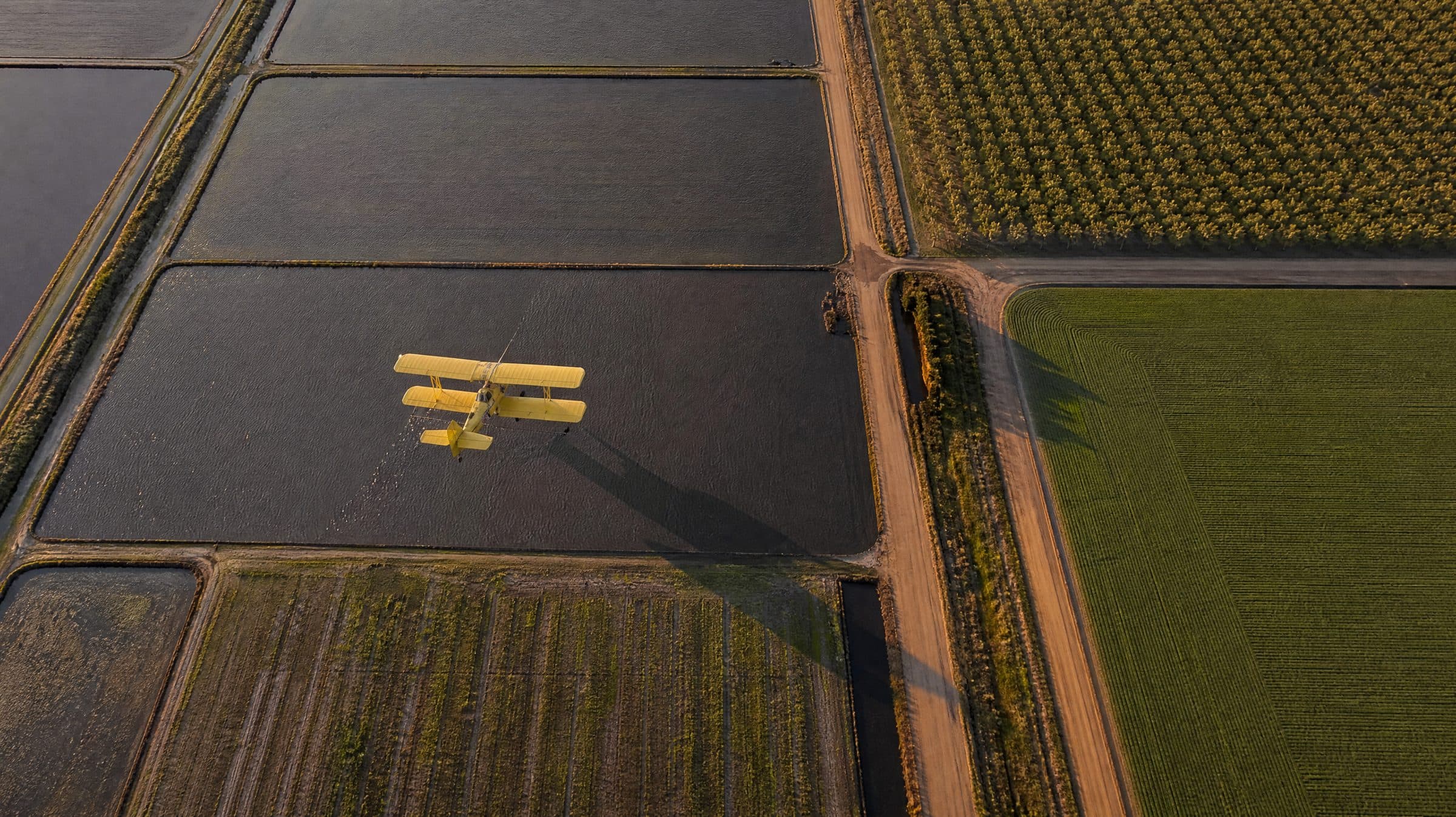
Integrated pest management (IPM) tells a Sacramento Valley grower whether a rice field needs an armyworm treatment, or an almond block a hull split spray. This guide applies the IPM steps, the pyramid and the methods to local rice, almonds and walnuts. It also shows where an aerial application (crop dusting) fits.
What is integrated pest management?
IPM is a decision process, not a single product or practice. The University of California Statewide IPM Program (UC IPM) calls it an ecosystem-based strategy that focuses on long-term prevention. Its definition of IPM has three parts:
- Prevention comes first. Biological control, habitat changes, cultural practices and resistant varieties keep pests below damaging levels.
- Pesticides follow monitoring. A grower uses a pesticide only when monitoring shows that established guidelines call for it.
- Treatments target the pest. The choice and placement of each material reduce the risk to people, beneficial insects, other organisms and the environment.
The federal integrated pest management definition, in 7 U.S.C. 136r-1, is shorter. It calls IPM a sustainable approach that combines biological, cultural, physical and chemical tools to minimize economic, health and environmental risks.
A pest is any organism that damages the crop: a weed, insect, mite, nematode, pathogen, bird or rodent. Many organisms in a field are harmless, and some are natural enemies that eat pests.
What are the steps of IPM?
Every IPM program follows the same cycle, from identification to evaluation.
| Step | What you do | Sacramento Valley example |
|---|---|---|
| 1. Identify | Name the pest to species | Tell navel orangeworm larvae from other worms in almond nuts |
| 2. Prevent | Make the field a poor home for the pest | Remove mummy nuts from almond trees in winter |
| 3. Monitor | Count pests and damage on a schedule | Check codling moth traps in walnuts every week |
| 4. Decide | Compare the count to a threshold | Treat true armyworm in rice only past the UC IPM damage level |
| 5. Act | Combine methods, and choose the most selective option | Treat only the parts of a rice field where armyworm damage passes the threshold |
| 6. Evaluate | Check the result and record it | Sample nuts after treatment, and compare harvest damage to last year |
An action threshold is the pest count or damage level at which you must act to prevent an economic loss. One insect on a leaf does not mean that you need to spray. UC IPM publishes sampling methods and thresholds for many crops in its pest management guidelines. Some pests have no numeric threshold, so field history guides the decision.
The wrong pest name leads to the wrong threshold and the wrong timing. For a field method, read our guide to crop scouting before you spray.
What is the integrated pest management pyramid?
The pyramid shows the order in which you rely on each type of control. The wide base holds methods for every acre, every year. The narrow top holds methods for use only when the lower layers fail.
- Base: prevention and cultural control. Clean seed, crop rotation, sanitation, water management and resistant varieties.
- Second layer: monitoring. Scouting, traps and degree-day models that tell you when a pest is active.
- Third layer: biological, mechanical and physical control. Natural enemies, mating disruption, traps, barriers and cultivation.
- Top: chemical control. The most selective pesticide that does the job, placed only where the pest is.
The pyramid shows priority, not a strict sequence. A walnut grower can use mating disruption and a timed insecticide in the same season. The USDA Natural Resources Conservation Service (NRCS) uses a similar model, called PAMS, in its pest management practice: prevention, avoidance, monitoring and suppression.
What are the main integrated pest management methods?
UC IPM groups the methods into four categories, and the best programs combine several.
Biological control
Biological control uses natural enemies: predators, parasites, pathogens and competitors. In almonds, UC IPM says that western predatory mites and sixspotted thrips can keep spider mites below damaging levels. Broad-spectrum insecticides such as pyrethroids kill these predators and often cause spider mite outbreaks.
Cultural control
Cultural control changes how you farm, so that the pest cannot establish, breed or survive. In rice, UC IPM reports that winter flooding can reduce rice water weevil numbers by about 50%. Spring weed control on levees removes shelter for the adult weevils.
Mechanical and physical control
Mechanical and physical controls kill the pest directly, block it out, or make the site unsuitable. In orchards, shakers, poles and flail mowers remove and destroy the mummy nuts where navel orangeworm spends the winter. Mating disruption is a related tool: dispensers release a pheromone that stops male moths from finding females.
Chemical control
Chemical control is the use of herbicides, insecticides and fungicides. Choose the most selective material, and apply it where and when the pest is vulnerable. Rotate the mode-of-action groups to slow resistance, as our guide to pesticide resistance explains.
Always follow the label and the written recommendation of your licensed pest control adviser (PCA).
Integrated pest management examples from Sacramento Valley crops
This table applies the IPM cycle to four local pests.
| Crop and pest | Prevention | Monitoring | Action point |
|---|---|---|---|
| Rice: rice water weevil | Winter flood; spring weed control on levees | Feeding scars on young leaves after the flood | No numeric threshold; decide on field history and nearby overwinter sites |
| Rice: true armyworm | Protect the parasitic wasps that kill larvae | From late June, look for leaf feeding; then examine 10 stops, 5 to 10 feet apart along a transect, in several areas of the field, twice a week | Over 25% defoliation in late June and early July, or 10% damaged panicles after panicle emergence, with larvae present |
| Almonds: navel orangeworm | Under 2 mummy nuts per tree in the Sacramento Valley | Pheromone traps in early March; egg traps by March 15 | Start of hull split, no later than 1% hull split, if traps show egg laying or the second flight |
| Walnuts: codling moth | Mating disruption in large, square, uniform blocks | Pheromone traps from early March; biofix; degree-days | 300 degree-days after biofix if last season's damage passed 3% or traps average over 2 moths per night |
Sources: UC IPM guidelines for rice water weevil, armyworms in rice, navel orangeworm in almonds and codling moth in walnuts. For other local rice pests, read our post on rice pests and diseases.
The almond example shows how prevention cuts later work. UC IPM tells growers to count mummies on 20 trees per block by January 15, and to destroy fallen mummies by March 1. Winters kill more larvae in the Sacramento Valley than farther south. Here, UC IPM says that trap catches decide whether you need an insecticide at all. For the full pest cycle, read our guide to navel orangeworm.
How do thresholds and degree days time a treatment?
Insects develop with heat, so a calendar date is a poor guide. A degree-day is a unit of heat above the lower temperature limit at which the insect grows. UC IPM models count degree-days from a biofix, which is a biological start date.
The walnut codling moth model is a clear example. UC IPM sets the biofix as the first date that moths appear consistently in traps and sunset temperatures reach 62°F. The model counts heat between 50°F and 88°F. Codling moth has two to four generations a year, so the count restarts at each new biofix.
Use this procedure for one walnut block:
- In early March, hang 1 mg pheromone traps 6 to 7 feet high in the southeast quadrant of the tree.
- Check the traps at least once a week.
- Record the biofix date for this block.
- Add the daily degree-days from a nearby weather station.
- Compare last season's damage and the trap catch to the UC IPM levels.
- Give the count and the forecast date to your PCA.
UC IPM gives two paths for the first generation. If damage last season passed 3%, or traps average more than 2 moths per trap per night, the first treatment comes at 300 degree-days. If both numbers are lower, UC IPM advises a delay until the second peak of the first flight. Our guides to growing degree days and codling moth show the steps.
What do California rules add to IPM?
California law puts parts of IPM in writing. Food and Agricultural Code section 12003 requires a PCA to put each agricultural recommendation in writing. Title 3 of the California Code of Regulations, section 6556, adds these items:
- The total acres or units to treat
- The concentration and volume per acre
- The worker re-entry interval, if one exists, and the preharvest interval
- The criteria that show the treatment is necessary
- A certification that the PCA considered alternatives and mitigation measures, and adopted them where feasible
The last two items are IPM in legal form: proof of need, and proof that the adviser weighed other options. Our post on California pesticide application rules covers permits and notices.
California also plans to go further. In January 2023, the Department of Pesticide Regulation (DPR), CalEPA and CDFA released a sustainable pest management roadmap. It builds on IPM and adds human health, social equity, environmental protection and economic vitality. Its goal is to eliminate prioritized high-risk pesticides by 2050. The roadmap is a plan, not a regulation.
Where does aerial application fit in an IPM program?
An aerial application is one tool in the chemical layer. Seeding and fertilizer flights also support prevention, because a strong, even crop resists pest attack better. Your scouting data and your PCA decide whether a field needs treatment. The plane delivers that decision on time.
Timing is where an airplane helps IPM most. Many UC IPM action points are short windows, such as the start of hull split. A late treatment can miss the egg hatch. An airplane covers a large block fast, even over wet orchard floors and flooded rice checks.
An airplane can also place a treatment where the pest is. For some rice water weevil insecticides, UC IPM says that a 30 to 50 foot band along the levees usually gives acceptable control. One water-active material must cover the whole field. For armyworm, UC IPM limits treatment to the areas with economic damage.
Read the label for bee precautions before you schedule the flight. Our guides to bees and pesticides and spray drift explain these limits.
Before you book an aerial treatment, check these items:
- Confirm the pest identification with your PCA.
- Record the count or damage level that passed the threshold.
- Get the written recommendation, with the product, rate and timing.
- Mark the field edges, power lines and sensitive areas on a map.
- Send the window, the acres and the map to the applicator.
See our crop protection service for the crops and timing we work with.
How do you know if your IPM program worked?
Evaluation improves next year's decisions. Compare the pest counts before and after treatment, and compare harvest damage with last season.
Keep a simple record for each block and each pest:
- Trap catches, scouting counts and the dates
- Biofix dates and degree-day totals
- The threshold that triggered action
- Each treatment, with the date and the mode-of-action group
These records also show resistance early. If a material now gives poor control, ask your PCA about a different mode-of-action group.
How we use IPM in the northern Sacramento Valley
We fly crop protection, seeding and fertilizer from Live Oak across Sutter, Yuba, Butte, Glenn, Colusa, Placer and Yolo counties. Most of our crop protection flights are from May to August, when many rice, orchard and row-crop pests reach their action points. With five Ag Cats and one Air Tractor 602, we usually have a plane over the field within 24 hours of your call. When your PCA's recommendation is ready, get a quote for your field.
Questions
Rice growers flood fields in winter, which UC IPM reports can cut rice water weevil numbers by about 50%. Almond growers remove mummy nuts to reduce navel orangeworm. Walnut growers use pheromone mating disruption and time codling moth treatments with degree-days.
UC IPM groups IPM methods into biological control (natural enemies), cultural control (farm practices such as rotation and water management), mechanical and physical control (traps, barriers, sanitation) and chemical control (pesticides). A good program combines several methods, because they work better together than alone.
No. Both rely on prevention, monitoring and natural enemies. Organic production limits pesticides mostly to natural materials, plus a short list of synthetic materials that the USDA National Organic Program allows. An IPM program can use a registered synthetic pesticide when monitoring shows that a pest has passed its action threshold.
The EPA states that there is no national certification for food grown with IPM, unlike the USDA organic label. In California, DPR licenses the pest control advisers who write agricultural pesticide recommendations, and those recommendations must state why treatment is needed.