Rice
What is a rice field? How California rice paddies work
By the Sutter Butte Dusters team · · 9 min read
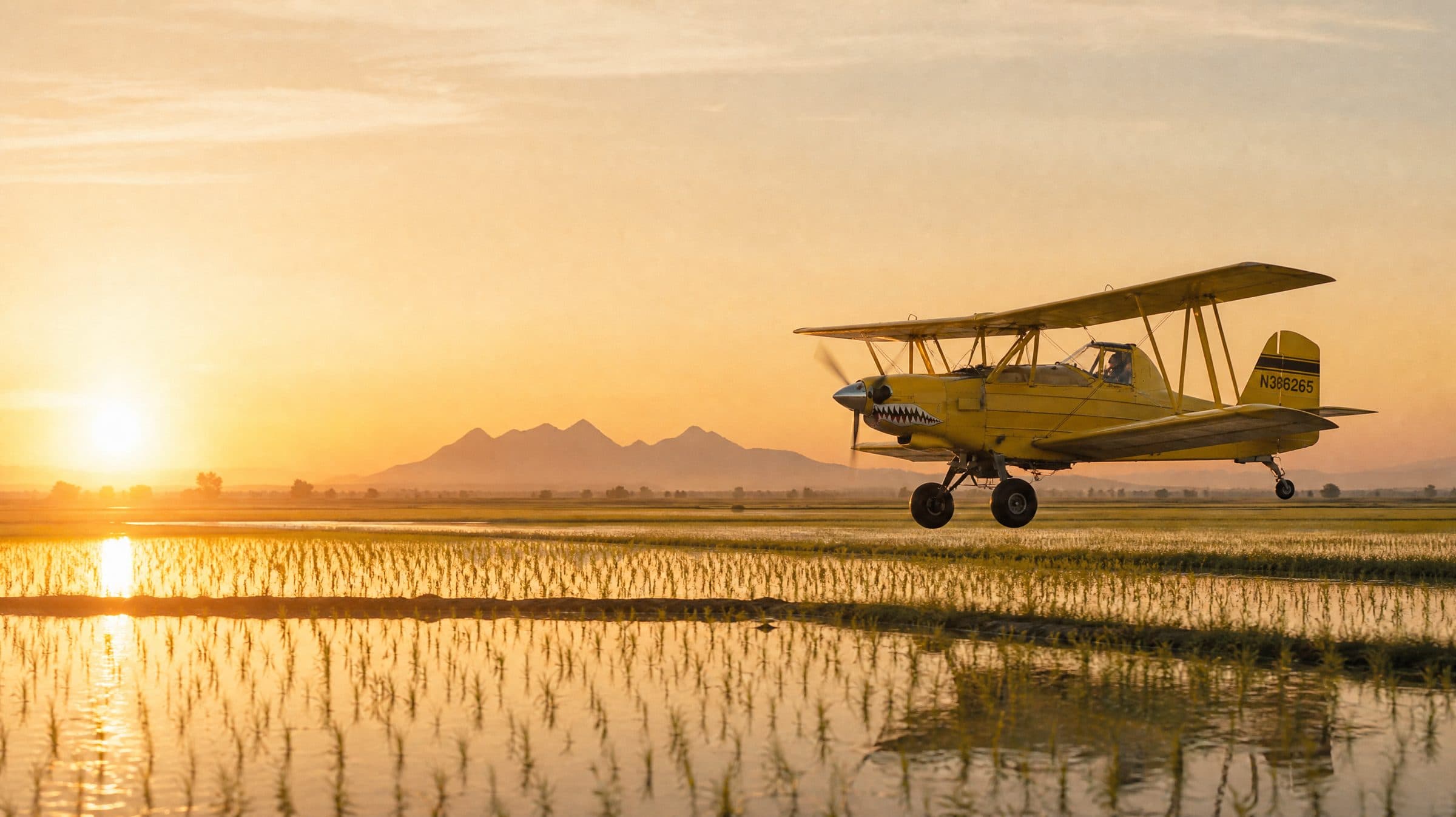
A California rice field is a built basin: flat to within a few inches, sealed by clay and fed by a canal. Growers planted 455,000 acres of California rice in 2026, mostly in the Sacramento Valley. This guide explains the parts of a paddy, how deep the water runs and why, and what happens in the field each month.
Is a paddy field the same as a rice field?
Yes. "Paddy field" and "rice paddy" both name a field that holds standing water for the rice crop. "Paddy" comes from the Malay word "padi," which means the rice plant and also the unhusked grain. In the rice trade, "paddy" still means rough rice that keeps its hull.
In California, growers seldom say "paddy." They say "field" for the whole farm unit and "check" for one basin inside it. The 2023 California Rice Production Workshop manual from UC Davis uses "basin," and it also calls the area between levees a paddy. This guide calls it "the UC manual."
How is a California paddy different from terraced rice paddies?
Terraced rice paddies climb steep hillsides in parts of Asia, such as Bali and the Philippines. A California check sits on a valley floor that naturally falls only 2 to 5 feet per mile, the UC manual says.
The USDA Economic Research Service says California producers seed primarily by air, directly into flooded fields. Most producers in the Mississippi Delta drill or broadcast seed into dry seedbeds instead.
| Feature | Terraced paddy in Asia | Check in the Sacramento Valley |
|---|---|---|
| Ground | Steep hillside, cut into steps | Flat valley floor, laser or GPS leveled |
| Size of one basin | Small steps that follow the slope | Large; some rice-only checks exceed 25 acres |
| Planting | Seedlings transplanted | Soaked seed flown onto the water |
What are the parts of a rice field in California?
Each part has one job: hold water at an even depth.
| Part | What it is | Typical numbers from the UC manual |
|---|---|---|
| Check (basin) | One level area inside levees | Some rice-only basins exceed 25 acres |
| Levee | A low earth bank around each check | 3 to 5% of a leveled field; up to 10% with contour levees |
| Rice box (weir box) | A box or pipe through a levee that sets the water level | About 18 inches high, 48 inches long, 24 to 48 inches wide |
| Flashboards | Removable boards in the box | The grower adds or removes boards to raise or lower the water |
| Roll-over | A flat spot at a levee end | Lets equipment cross from check to check |
| Borrow pit | A low strip left where a temporary levee took its soil | Often lies between two parallel temporary levees |
| Inlet and drain | The supply ditch and the outlet | Water enters the top check and leaves the bottom check |
Levees come in two types. Permanent levees stay in place for years and are common where a field grows only rice. The grower builds temporary levees each spring with a disk ridger or levee squeeze. They suit fields that rotate rice with crops such as tomatoes or safflower. About two-thirds of Sacramento Valley fields grow rice only, the manual says.
Why do rice paddies need clay soil and level ground?
A paddy must hold water without large losses. The UC manual says good rice soils have 35 to 60% clay in the topsoil or subsoil. Percolation losses in California clay soils are usually less than 4 inches in a whole season.
USDA ERS lists the needs of rice: hot days, cool nights, plenty of water, a smooth surface and a subsoil hardpan. The slow-draining soils of Colusa, Sutter, Butte, Glenn and Yuba counties fit that list.
Level ground keeps the water depth even. The UC manual says the depth in one check should vary no more than 3 to 4 inches, preferably 2.5 inches. UC IPM sets a tighter goal for weed control. It allows no more than 2 to 3 inches between the shallow and deep areas of a basin, with a maximum depth of 5 inches.
A slope of 0.1% equals a fall of 1 foot in 1,000 feet. The UC manual says growers level many fields to 0.02 to 0.05%, and many rice-only fields to zero. Rotation fields usually keep 0.05 to 0.1%. GPS leveling maps elevation with an accuracy of up to 0.1 inch.
How does water move through the checks?
Most growers use a flow-through system. Water from a canal enters the top check, then spills over the rice boxes into each lower check. A little water leaves the bottom check into a drain. Some farms use a recirculating system, which pumps the drain water back to the top. Other farms use a static system, which feeds each check from a side ditch and aims for zero drainage.
How deep is the water in a rice field?
Water depth changes during the season.
| Time or purpose | Usual water depth | Source |
|---|---|---|
| Permanent flood after seeding | 4 to 5 inches, set soon after sowing and held for the season | UC IPM |
| Control of early and late watergrass | About 7 inches, because these grasses grow through 4 inches of water | UC IPM |
| Very shallow water to avoid | 2 inches or less, which promotes all rice weeds | UC IPM |
| Cold protection before heading | As deep as the levees allow, and at least 8 inches, from 7 to 21 days before heading | UC manual |
| Before harvest | Drained about one month before harvest | UC IPM |
The UC manual sets the shallow limit a little higher: avoid 1 to 3 inches. Deep water has limits too, because wind damages levees that hold deep water.
The deep water before heading protects the crop from blanking. Blanking is pollen damage from cool temperatures of about 55 to 60 degrees F, depending on the variety. About 10 to 14 days before it emerges, the sensitive panicle sits low in the stem, partly under water. The water stays warmer than the air overnight and shields the young panicle.
How much water does a California paddy use? The UC manual gives an average delivery of 5 to 5.5 acre-feet per acre, with a range of about 4 to 8. The crop itself uses 2.75 to 3.25 acre-feet per acre. The rest leaves by seepage, percolation and drainage. The manual also says state rules have required growers since 1984 to hold pesticide-treated water on their fields. Most rice pesticides now carry a holding period, so the product breaks down before the water leaves.
What happens in a Sacramento Valley paddy each month?
The months below are typical for the northern Sacramento Valley, and weather moves them each year. The planting window and seeding details are in our post on aerial rice seeding in the Sacramento Valley.
| Months | What happens in the field | Aircraft work |
|---|---|---|
| November to February | Straw breaks down, often under a winter flood that feeds waterbirds | None in most fields |
| March and April | Tillage, leveling, levee repair, fertilizer placed 2 to 4 inches deep, seedbed rolled | None in most fields |
| April and May | Checks flooded, seed soaked, seed flown onto the water | Aerial seeding |
| May and June | Weed scouting every 3 to 4 days for 21 days after the flood | Herbicide flights |
| June and July | Tillers form; nitrogen top-dress; some fields get a short mid-season drain | Fertilizer and insect control |
| July and August | Panicles form; water raised before heading | Insect and disease control |
| August and September | Field drained about one month before harvest | None |
| September and October | Harvest | None |
For details, see herbicide application in rice and rice fertilizer top-dressing. Your licensed pest control adviser (PCA) chooses each product and timing. Every application follows the label and the PCA's written recommendation.
After harvest, growers chop the straw and work it into the soil, and many fields flood again for the winter. Our post on rice straw explains the choices and the burn limits.
Do rice paddies release methane?
Yes. A flooded soil has no oxygen, and soil microbes in those conditions make methane. The UC manual says California fields are high emitters because of water seeding and straw incorporation. The same manual notes that arsenic in California rice grain is low compared with other rice regions.
A single mid-season drain cuts methane. The UC manual reports these results from a 2018 trial at the Rice Experiment Station in Biggs (Perry and others, 2022).
| Treatment | Methane, pounds of CH4-C per acre | Grain yield, hundredweight per acre |
|---|---|---|
| Continuous flood | 136 | 93.5 |
| 5-day drain | 84 | 92.4 |
| 12-day drain | 49 | 92.7 |
The UC authors found that an 8- to 12-day drain can cut methane by 40 to 60% with no yield loss. They warn against a drain during booting or grain fill. A drain early in the season can also release nitrous oxide from fresh fertilizer.
Where are rice fields in the USA?
USDA ERS names four rice regions: the Arkansas Grand Prairie, the Mississippi Delta, the Gulf Coast and the Sacramento Valley. The June 2026 NASS Acreage report gives these planted acres.
| State | Planted acres, 2025 | Planted acres, 2026 (estimate) | Main type in 2026 |
|---|---|---|---|
| Arkansas | 1,284,000 | 851,000 | Long grain |
| California | 524,000 | 455,000 | Medium grain |
| Louisiana | 482,000 | 400,000 | Long grain |
| Missouri | 213,000 | 153,000 | Long grain |
| Texas | 145,000 | 113,000 | Long grain |
| Mississippi | 164,000 | 45,000 | Long grain |
| United States | 2,812,000 | 2,017,000 | Long grain |
NASS says the 2026 planted area is the lowest in the United States since 1972. In 2026, California planted 25,000 of the 26,000 U.S. short-grain acres and 420,000 of the 596,000 medium-grain acres.
Inside California, the NASS county estimates for 2023 list Colusa at 135,000 planted acres, Sutter at 109,000, Glenn at 75,500 and Yuba at 34,600. NASS withheld Butte, Placer, Yolo and Sacramento counties to protect single farms. Many rice fields Sacramento drivers see from Interstate 5 are in Colusa and Glenn counties. For the full crop year, see our guide to California rice farming.
How do growers get a check ready for the flood?
This spring checklist follows the UC manual and UC IPM. Your own order can differ.
Caution: Soaked seed makes its own heat, and a full seed truck holds it. A delay can weaken the seed. The UC manual advises 24 hours of soak, 24 hours of drain, then prompt seeding. Book the airplane (step 7) before the seed goes into the soak.
- Survey the grade of each check with laser or GPS equipment.
- Cut the high spots so the depth varies by no more than 2 to 3 inches.
- Repair levee holes and leaks from rodents.
- Set the rice boxes and add flashboards for the target depth.
- Place nitrogen and phosphate 2 to 4 inches deep.
- Roll the seedbed so the grooves run across the prevailing wind.
- Book the airplane for the seeding date.
- Flood each check as fast as possible to the depth on your water plan.
- Send us the field location, acres and seeding date.
To find the field numbers for step 9, see how to find an APN or FSA farm number. Weedy rice and tadpole shrimp can ruin a new stand, so read about weedy rice and tadpole shrimp before you flood.
Rice ground in the northern Sacramento Valley
Rice is the main crop we fly. Our five Ag Cats and one Air Tractor 602 work from our strip at 4080 Clark Rd in Live Oak. We seed flooded checks and fly herbicide, fertilizer and insect control in Sutter, Yuba, Butte, Glenn, Colusa, Placer and Yolo counties. Our rice page shows the jobs we do on each field. To book a flight over your checks, get a quote for your field.
Questions
Mainly to control weeds. UC IPM says California's water-seeding system began as a way to control terrestrial barnyardgrass, and 4 inches of water still controls it. Rice tolerates the flood, while many weeds do not. The water also shields the young panicle from cold nights before heading.
UC IPM gives 4 to 5 inches for a permanent flood, and about 7 inches to control early and late watergrass. Water 2 inches deep or less promotes weeds. For cold protection, the 2023 UC rice manual says to raise the water 7 to 21 days before heading, to at least 8 inches.
The 2023 UC rice production manual gives an average delivery of 5 to 5.5 acre-feet per acre each season, with a range of about 4 to 8. The crop itself uses 2.75 to 3.25 acre-feet. Seepage, percolation and drainage account for the rest.
Yes. The USDA NASS county estimates list Sacramento County as a rice county, but NASS withholds its acreage to protect the data of single farms. The large rice counties lie north of the city: Colusa, Sutter, Glenn, Butte and Yuba.