
Rice
Rice straw: what California growers do after harvest
By the Sutter Butte Dusters team · · 9 min read
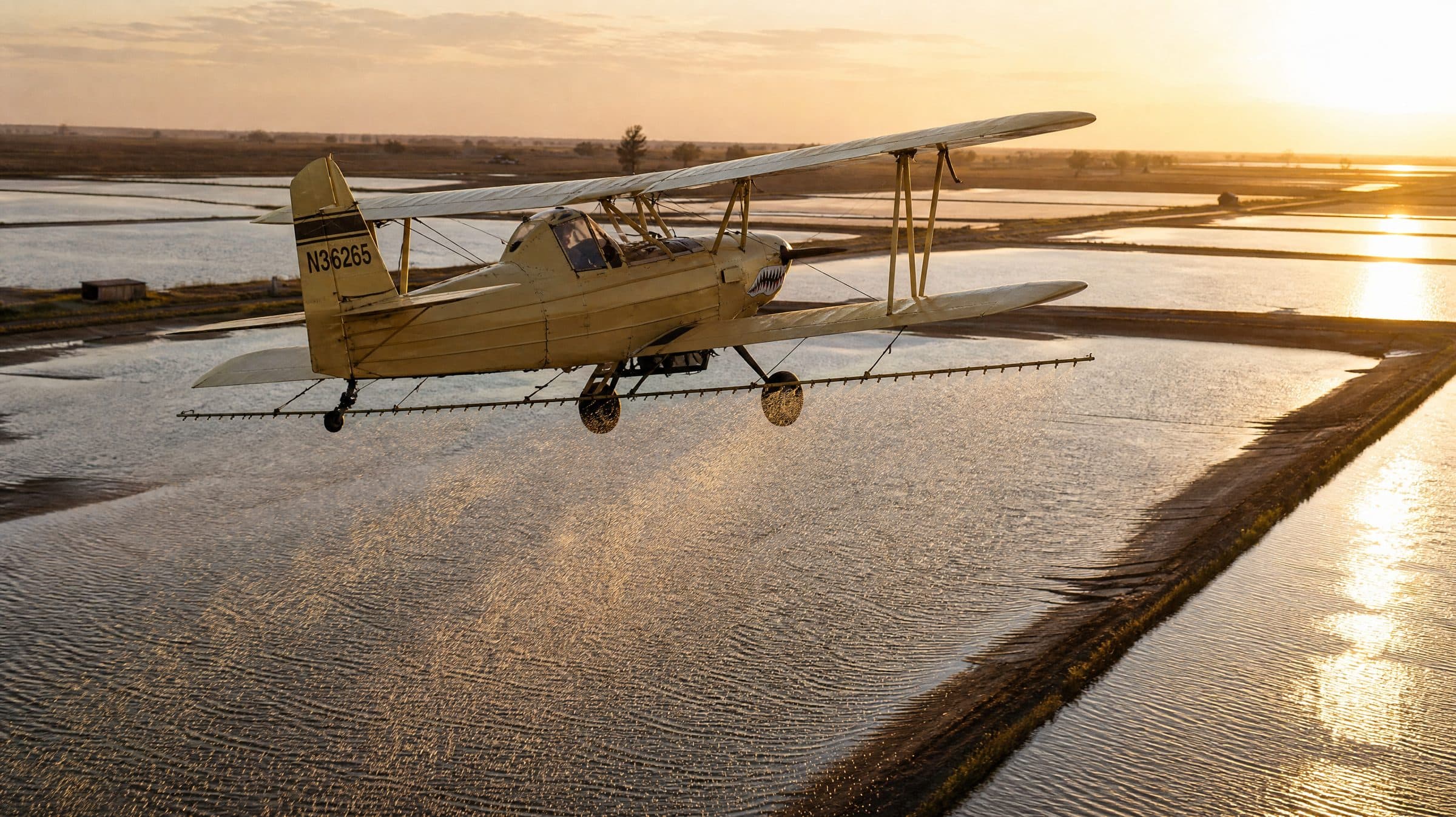
Every fall, a California rice harvest leaves several tons of rice straw on each acre. Before the next spring seeding, the grower must break it down, bale it and sell it, or, with a permit, burn it. This guide explains each choice, the state burn permit steps and the winter flood in the Sacramento Valley.
How much straw does a rice field leave after harvest?
A rice field makes about as much straw as grain. The CDFA rice fertilization guidelines use a harvest index of 0.5, which means grain is half of the dry crop weight. At the 8,500 pounds of grain per acre in the CDFA examples, the field also makes about 8,500 pounds of straw, or roughly 4 tons. California growers planted 455,000 acres of rice in 2026, the USDA NASS June Acreage report estimates. At that yield, the crop leaves close to 2 million tons of straw.
The straw breaks down slowly. Caltrans says in its erosion control guidance that a high silicate content makes rice straw last longer than other straw.
Why must growers manage the straw at all?
Straw left in the field affects the next crop in three ways:
- Disease. The stem rot fungus survives the winter as small, black resting bodies (sclerotia), mostly in the crop residue. UC IPM reports documented stem rot yield losses of 6 to 24% in California.
- Weeds. In a long UC Davis study, straw worked into the soil without a winter flood gave the most watergrass seed.
- Nitrogen. Growers worried that fresh straw would tie up soil nitrogen. In the UC Davis study, straw that stayed in the field raised the soil nitrogen supply after about 3 years.
What are the options for straw after harvest?
Growers have four basic treatments, and each can add a winter flood. From 1993 to 2001, UC Davis scientists compared all eight combinations at Maxwell in Colusa County. Their report in California Agriculture found no significant difference in grain yield among the treatments.
| Treatment | What the grower does | Main benefit | Main drawback |
|---|---|---|---|
| Burn | Burns under a conditional permit | Kills stem rot sclerotia; least watergrass with a winter flood | Permit only for disease; limited acres; smoke |
| Incorporate | Chops it and works it in with a disc or plow | Returns nutrients; builds soil nitrogen over time | More watergrass, most of all without a winter flood |
| Roll | Crushes the straw into the soil surface with a heavy roller | No disc or plow pass | Same weed concern as incorporation |
| Bale and remove | Rakes, bales and hauls the straw out | Fewer sclerotia; straw can sell | Removes potassium; only about half of the straw comes off |
| Add a winter flood | Holds 4 to 6 inches of water until early spring | Faster breakdown; fewer weeds; bird habitat | Water cost; more methane; soil stays wet longer |
UC IPM adds that a cut at ground level and removal of the straw is nearly as effective as a burn against stem rot.
How does rice straw burning work under California law?
In 1989, growers burned about 95% of the straw from roughly 400,000 acres, the UC Davis report says. The Connelly-Areias-Chandler Rice Straw Burning Reduction Act of 1991 (Health and Safety Code section 41865) phased that practice down. Since September 2001, a grower can burn only to control disease.
The statute sets these conditions for a conditional burn permit:
- During the growing season, the county agricultural commissioner must independently find enough of a pathogen, such as stem rot, to make a rice disease.
- The commissioner must also find that the disease will likely cause a significant, measurable yield loss.
- The county air pollution control officer issues the permit, and each permit allows one burn, per field, per year.
- A grower can burn up to 25% of planted acres, and the Sacramento Valley Air Basin total cannot exceed 125,000 acres.
- A grower with 400 acres or less can burn the whole acreage once every four years, inside the basin limit.
- A grower who broke the law in the previous three years cannot get a permit.
A burn also has a place in the program against weedy rice.
How do you get a rice straw burn permit?
Each county air district runs its own permit program. The steps below come from the Butte County Air Quality Management District for the 2026 to 2027 season. Ask your own county air district for its version.
- Return the permit form, the $90 registration fee and your rice burn data sheets before harvest.
- Report each field to the district's ready-to-burn list after harvest is complete.
- Let the straw dry 3 days if spread, or 10 days if in rows, unless it passes the crackle test.
- After 0.15 inch of rain or more, check that the straw passes the crackle test.
- Check the burn-day status each morning; the district posts it by 8:45 a.m.
Caution: Burn only on a burn day, and only the field and acres that the district allocates to you.
- Light the straw between 10 a.m. and 3 p.m. from September to February; have flames out by 4 p.m.
- Return any unburned acres to the district by 2 p.m. that day.
- Pay the $3.50 per acre fee when the district bills you for burned acres.
The Butte permit also requires you to follow the permit rules of your local fire agency.
What speeds up rice straw decomposition?
Water and soil contact drive the breakdown. The UC Davis study found that a winter flood slightly increased decomposition of incorporated straw. In a dry winter, surface chopping alone is unlikely to be enough, a 2021 UC Rice Blog post by Bruce Linquist says.
Ducks help too. In 2002, UC Davis reported an on-farm study of 15 winter-flooded fields along 65 miles of the Sacramento Valley. Where waterfowl could feed, the straw decomposed more than 30% faster than where fences kept the birds out. The next season, those fields also had more than 50% fewer grassy weeds, with no loss of grain yield.
Why do growers flood rice fields in winter?
Winter flooding rice fields does three jobs at once: it breaks down straw, it limits weeds and it feeds birds. Leaders of Ducks Unlimited and the California Rice Commission described the flood in a 2021 CalMatters commentary. In a normal year, they wrote, nearly 300,000 acres of rice hold a shallow winter flood. They also wrote that Central Valley rice fields provide more than 50% of the diet of ducks and geese on their fall and winter migration.
UC IPM also lists winter flooding among the practices that reduce stem rot. The UC Davis report found more methane from flooded fields with incorporated or rolled straw than from burned or baled fields. UC IPM notes that the soil stays wet longer, so growers cannot use fall tillage to dry out the tubers and roots of perennial weeds.
Dry years change the plan. In the same 2021 commentary, the Rice Commission forecast that as little as one-fourth of the normal acres would have winter water. Our guide to California rice farming explains how rice fields also feed young salmon.
What nutrients does the straw hold?
The UC Davis study measured these nutrients in the straw.
| Nutrient | Amount in the straw | If the grower bales the straw | If the grower keeps the straw |
|---|---|---|---|
| Nitrogen | 61 to 70 pounds per acre | Part of it leaves the field | Builds soil nitrogen over the years |
| Phosphorus | 13 to 14 pounds per acre | Part of it leaves the field | Returns to the soil |
| Potassium | Up to 80 pounds per acre | Large losses over time | Returns to the soil |
Baling takes only part of the straw: about 50 to 60%, the UC authors say. CDFA says winter rains can return up to 80% of the potassium to the soil from straw that lies in the field until spring.
The CDFA guidelines say the nitrogen rate may drop 10 to 20 pounds per acre after consistent incorporation and winter flooding. The UC Davis team recommended a cut of at least 25 pounds per acre after 5 years. Your farm advisor and a soil sample can set the rate for your field. For midseason nitrogen, see rice fertilizer top-dressing.
What are rice straw bales used for?
A 2000 state report found that less than 3% of the unburned straw went to uses off the farm, the UC Davis authors say. Common rice straw uses off the farm include erosion control, garden mulch and cattle feed.
- Erosion control. Caltrans names rice straw for projects that require weed-free straw. Rice is an aquatic crop, so the straw carries few weed seeds that grow on dry land. Caltrans also notes that the straw is brittle and does not punch well into soil.
- Garden mulch. Gardeners use it for the same reason.
- Cattle feed. Ranchers feed it as a low-quality forage in dry years.
Feed value changes from stack to stack. Glenn Nader, a UC Cooperative Extension farm advisor for Yuba, Sutter and Butte counties, reported a survey of more than 70 stacks. Their crude protein ranged from 2 to 7%. A beef cow that is not in milk needs a diet with 7% crude protein, so most straw needs a supplement.
How do you check straw bales before you buy them?
The UCCE feed guide gives the test method and the targets for feed straw.
Caution: A herbicide or other pesticide label can prohibit the use of treated straw as feed. Check the records before you buy.
- Ask the grower which products went on the field this season.
- Read each label for a restriction on straw for livestock.
- Take core samples from at least 25 bales in the stack.
- Send the sample to a forage laboratory for crude protein and acid detergent fiber (ADF).
- Compare the results with the UC targets in the table.
| Test | UC target for beef cattle |
|---|---|
| Crude protein | 4.5% or higher |
| ADF (fiber that lowers digestibility) | 50% or lower |
| Moisture | 12% or lower |
Our guide to the pesticide label shows where to find use restrictions.
When does straw work happen in the Sacramento Valley?
These months are typical for Sutter, Butte and Colusa counties, and weather moves them each year.
| Months | Straw work | Rule or note |
|---|---|---|
| July and August | Register rice fields with the air district | Butte asks for forms before harvest |
| September and October | Harvest; chop the straw; bale soon after harvest | Butte's fall rice burn season began September 14 in 2026 |
| October and November | Incorporate or roll; burn where permitted; start the winter flood | Burn only on burn days, on allocated acres |
| December to February | Hold 4 to 6 inches of water; birds feed on the straw | No fall tillage in flooded fields |
| February and March | Drain; let the soil dry | Dry soil is ready for spring tillage sooner |
| March to May | Tillage, leveling, fertilizer, then flood and seed by air | See our rice field guide |
A field with years of incorporated straw can carry more watergrass, so plan the spring weed program early. See herbicide application in rice, rice pests and diseases and our crop dusting season calendar.
Straw and the next rice season in the northern Sacramento Valley
We do not fly straw work, but the fall straw plan changes the weeds and nitrogen in the fields we fly next season. From our strip at 4080 Clark Rd in Live Oak, we seed flooded checks and fly herbicide, fertilizer and insect control. We work in Sutter, Yuba, Butte, Glenn, Colusa, Placer and Yolo counties. Our rice page lists each job. To book spring seeding or a summer flight, get a quote for your field.
Questions
Burning kills the resting bodies of the stem rot fungus that survive the winter in the straw. In California, a grower can burn only after the county agricultural commissioner finds a disease that will likely cut yield. The grower also needs a conditional permit from the county air district, and registers fields before harvest.
Yes, for most gardens. Rice grows in standing water, so the few weed seeds in the straw seldom sprout in a dry garden bed. For this reason, Caltrans names rice straw for erosion projects that require weed-free straw. Ask the seller whether any pesticide label limits the straw's use.
Growers aim to break down most of the straw between the fall harvest and spring tillage, a period of about five to six months. Chopping, work into the soil and a winter flood all speed the breakdown. In one UC Davis study, feeding ducks made the straw decompose more than 30% faster.
Yes, as part of a ration. A UC Cooperative Extension survey found 2 to 7% crude protein in rice straw, and a beef cow that is not in milk needs about 7%, so most straw needs a supplement. Test the bales, and check the pesticide labels for feed restrictions first.