
Rice
Watergrass in California rice: ID, timing and resistance
By the Sutter Butte Dusters team · · 8 min read
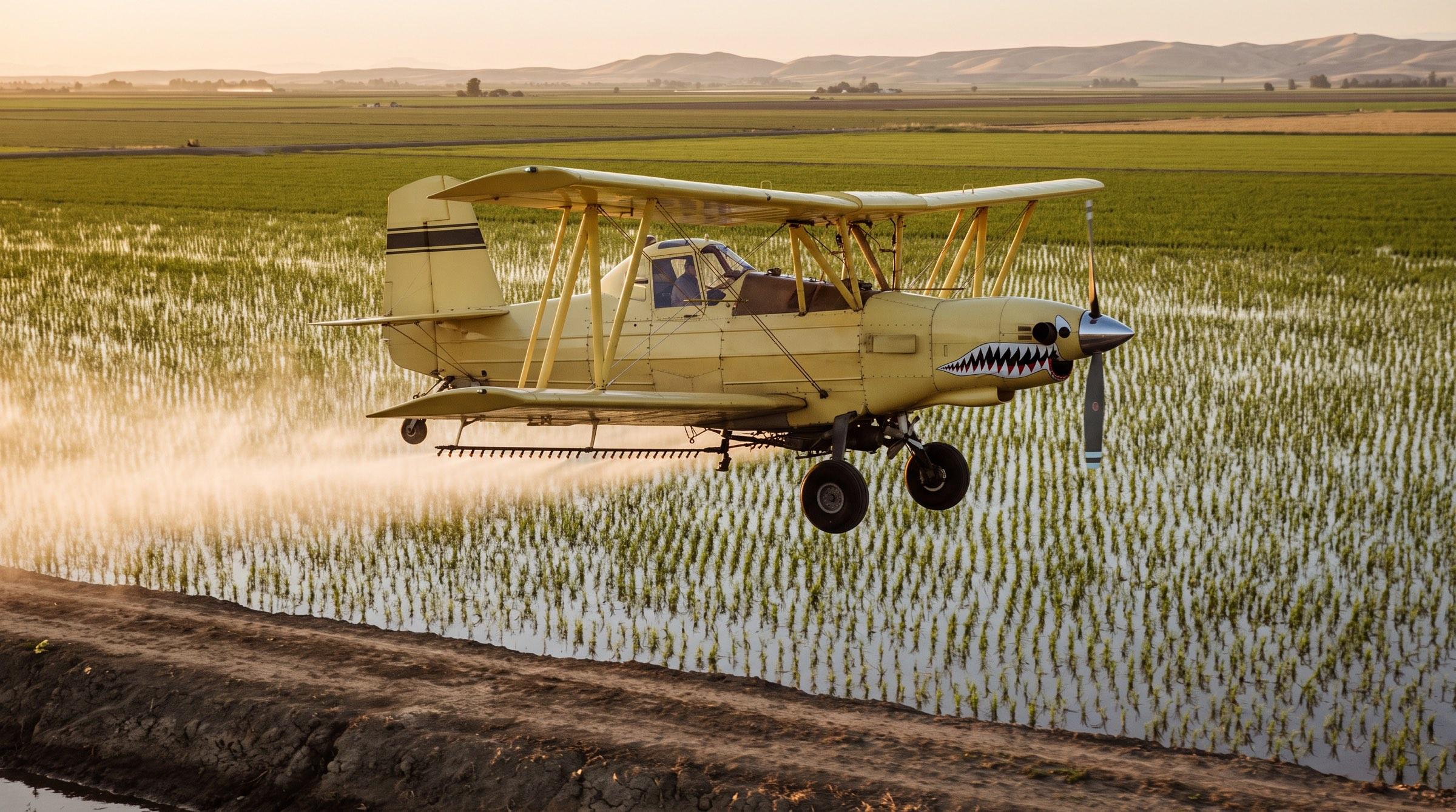
Watergrass is the most serious weed in California rice that stays flooded, according to the UC Statewide IPM Program (UC IPM). The name covers three close relatives, and one of them is the plant many growers call barnyard grass. This guide explains how to tell them apart, how water controls them, when UC says to treat, and what to do about herbicide-resistant watergrass.
What is watergrass in rice?
Watergrass is a group of annual grasses in the genus Echinochloa. An annual plant grows from seed and dies in one season. Three kinds grow in California rice, and each one answers to flood water in a different way.
| Weed | Scientific name | Response to the flood | Flowers |
|---|---|---|---|
| Barnyardgrass | Echinochloa crus-galli | 4 inches of water still gives good control | June through October |
| Early watergrass | Echinochloa oryzoides | Grows through 4 inches of water; needs about 7 inches | About 40 days after the flood, well before rice |
| Late watergrass | Echinochloa phyllopogon | Grows through 4 inches of water; needs about 7 inches | About 90 days after the flood, near the time early rice varieties flower |
Sources: UC IPM integrated weed management for rice, UC IPM names of rice weeds and the UC IPM barnyardgrass page.
UC IPM says barnyardgrass is the most widespread of the three. It also says the California water-seeded system was built to control this weed. Early and late watergrass have larger seeds, so they push up through the flood more easily. UC IPM's special weed problems page gives 7 to 8 inches as the deep flood these two need.
How do you identify barnyard grass and watergrass?
Look at the collar first. The collar is the place where the leaf blade meets the stem. UC IPM says barnyardgrass has no ligule and no auricle at the collar. A ligule is a thin flap at the base of the leaf. An auricle is a small claw that wraps the stem. UC IPM calls barnyardgrass the only common summer grass with no hairs or membranes at the collar.
Rice has both a ligule and an auricle, so this test separates the crop from the weed. Use these steps in the field:
- Pull one suspect leaf gently away from the stem.
- Look at the collar for a ligule and an auricle.
- Mark the plant as watergrass if the collar is bare.
- Check the base of the seedling for a maroon tint.
- Record the leaf count of the weed and the rice.
Older plants give other signs. Barnyardgrass can reach 5 feet tall, and its stems are flat near the base. The seed head is 2.5 to 10 inches long, with knotlike flowers packed on its branches. UC IPM shows one late type with short awns (bristles), large seeds and a drooping head.
A grass with a ligule is not watergrass. It may be sprangletop, which we cover in our guide to sprangletop in California rice. A plant with both collar parts that stands above the crop may be weedy rice.
How does water control watergrass?
Water is the most important cultural tool for many rice weeds, according to UC IPM. A cultural tool is a farm practice that does not use a chemical. Flood water limits light and oxygen, so fewer seeds sprout and fewer seedlings grow.
UC IPM gives these limits:
- Very shallow water. Water up to 2 inches deep promotes all rice weeds.
- A normal flood. UC IPM advises 4 to 5 inches of water. It adds that 6 to 7 inches suppresses certain weeds.
- Level ground. Shallow and deep areas should differ by only 2 to 3 inches, with a maximum depth of 5 inches.
- A drain. A drain lets air into the soil, and this starts watergrass seed.
The drain is the main risk. UC IPM says 3 to 5 days of exposure lets seedlings grow secondary roots. Those roots greatly reduce the effect of current watergrass herbicides. Our post on herbicide application in rice compares the water systems and their effect on each flight.
Deep water alone can also backfire. UC IPM says deep-water-tolerant watergrass can build up when follow-up herbicides fail. This happens more often in organic fields.
When does UC say to treat watergrass?
UC IPM puts grass weeds in two windows on its treatment period chart. The first runs from the 1-leaf stage of rice to tiller initiation, when the plant starts to make side shoots. The second falls in early tillering. Our guide to rice growth stages explains each stage in plain words.
Each product has its own place inside those windows. UC IPM's special weed problems page ties some products to the rice leaf stage. The range runs from the day of seeding to early tillering. It ties other products to the leaf stage of the watergrass. Some of them must go on before the watergrass has 3 leaves. Others go on after the fourth leaf and before the stem starts to lengthen.
The field decides which of these fits. Your pest control adviser (PCA) is the licensed person who picks the product and the rate for your field. The label is the law, so the product must go on at the stage, water condition and rate that the label states.
Scouting sets the date. UC IPM gives this schedule:
| Period | What to do |
|---|---|
| Flood to 21 days after the flood | Check every 3 to 4 days |
| 21 days after the flood to about 45 days after seeding | Check every week |
| Days 21 to 45 | Treat resistant weeds before they set seed |
| Panicle initiation to heading | Record the weeds that escaped control and where they grew |
Source: UC IPM integrated weed management for rice. Panicle initiation is the start of the seed head inside the stem. Heading is the time the seed head comes out of the plant.
What is herbicide-resistant watergrass?
Herbicide-resistant watergrass is a plant that survives a herbicide that kills others of its kind. UC IPM says these plants already exist in small numbers in a weed population. Repeat use of the same mode of action kills the others and leaves the resistant plants to set seed. Mode of action means the way the herbicide kills the plant, and each type has a group number.
UC IPM describes two types of resistance in California rice:
- Target-site resistance. A small change in the plant stops the herbicide from reaching its target. UC IPM reports this in groups 2 and 7.
- Metabolic resistance. The plant breaks the herbicide down before it dies. UC IPM says this type mainly affects barnyardgrass and watergrass, in groups 1, 2, 8 and 13.
UC IPM lists these signs of possible resistance:
- Healthy plants stand next to dead plants of the same weed.
- One weed survives while other weeds in the check die.
- Control of a weed gets worse over the years at the same rate.
- The same patches survive each year, and nearby fields show the same problem.
A failed treatment does not prove resistance. Poor coverage, the wrong timing, large weeds and bad weather can all cause it. A specific test confirms resistance. UC IPM still advises this rule: when in doubt, assume resistance and manage for it.
What does barnyardgrass control look like over a full season?
Good barnyardgrass control, and control of the other watergrasses, uses every tool in order. Talk through this plan with your PCA before the season starts.
| Time | What to do, based on UC IPM |
|---|---|
| Winter and early spring | Level the field, and plan a rotation or a change of water system |
| March through early May | Use a stale seedbed where it fits |
| At seeding | Use certified seed, flood fast and hold the depth |
| Early season | Scout, and avoid a long drain |
| Before the weeds set seed | Treat escapes, and stop resistant plants from making seed |
| Harvest | Clean the equipment, and work infested fields last |
A stale seedbed starts the weeds early, so you can kill them before you plant. UC IPM lists it as a way to manage resistance.
Caution: cool weather can delay planting by a few weeks with this method.
- Flush the field with water.
- Wait 1 to 2 weeks for the weeds to emerge.
- Flood the field to 4 to 6 inches.
- Board the drain boxes and let the water fall.
- Kill the weeds at the 1- to 2-leaf stage or later.
Your PCA picks the nonselective herbicide for step 5, or you can use shallow tillage. A nonselective herbicide kills most green plants.
UC IPM also gives these herbicide rules for resistance:
- Do not use group 1 or group 2 alone or again and again in one season.
- Use different groups as alternates, in mixes or in a sequence.
- Do not use a tank mix of groups 1, 2, 8 and 13 if you suspect resistant watergrass.
- Include groups 4, 7 and 14, which UC IPM says lack metabolic resistance.
Your PCA turns these rules into a program for each field. Very severe infestations may need rotation to another crop. Our rice spray guide shows how these treatment windows fit into the full rice season.
Where does an airplane fit in watergrass control?
An airplane treats a whole check without wheels in the water. This matters when a foliar herbicide needs the field drained, because UC IPM says the field must then flood again quickly. A long drain promotes weeds, and a slow reflood lowers herbicide performance. An airplane can treat many checks inside that short gap. Read our post on spray drift in aerial application for the steps that keep product on the target.
Watergrass work from Live Oak
Sutter Butte Dusters flies rice herbicide jobs across Sutter, Yuba, Butte, Glenn and Colusa counties from 4080 Clark Rd in Live Oak. Our fleet has five Ag Cats and one Air Tractor 602. We apply the product your PCA recommends, at the label rate, inside your treatment window. Learn more about our rice work, or get a quote for your field.
Questions
They are close relatives in the genus Echinochloa. UC IPM uses watergrass as the group name for three rice weeds: barnyardgrass, early watergrass and late watergrass. Barnyardgrass is the easiest of the three to control with flood water, because 4 inches of water still gives good control.
UC IPM says 4 inches still gives good control of barnyardgrass. Early and late watergrass grow through 4 inches, and they need about 7 to 8 inches. Water up to 2 inches deep promotes all rice weeds. A drain of 3 to 5 days greatly reduces the effect of current watergrass herbicides.
Look for healthy plants beside dead plants of the same weed, or patches that survive each year. Poor coverage, wrong timing and large weeds can also cause a failed treatment. A specific test confirms resistance. UC IPM says that if you are in doubt, assume resistance and change your program with your PCA.
UC IPM says to check every 3 to 4 days for 21 days after the flood, then every week until about 45 days after seeding. Record the weed, its location and the rice stage. Days 21 to 45 are critical for treating resistant weeds before they set seed.