
Rice
Rice water weevil: field edges, timing and what UC says
By the Sutter Butte Dusters team · · 7 min read
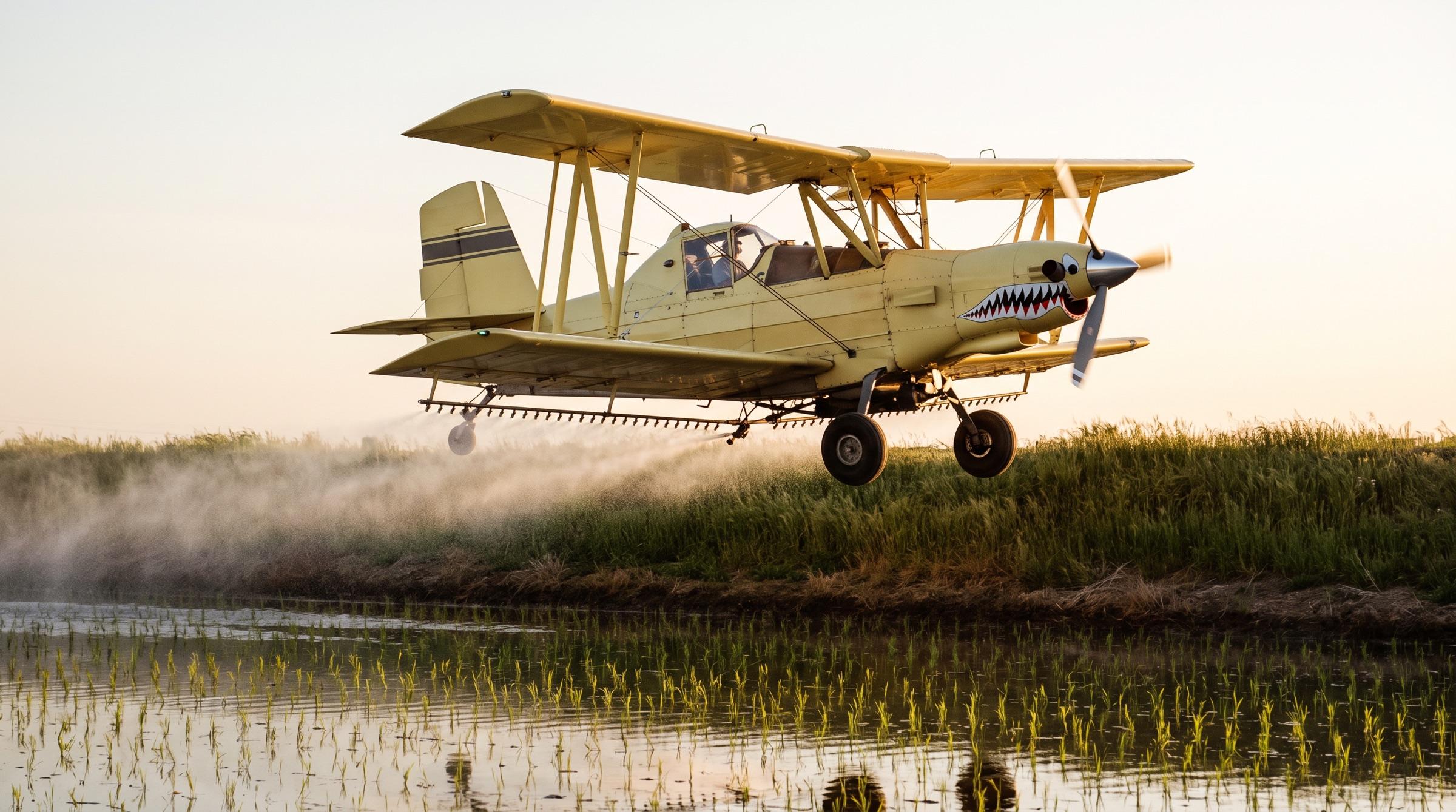
The rice water weevil is a small gray beetle, and its young cause the damage under the water. The young feed on rice roots, so the field can lose yield before you see much on the leaves. This guide explains where the weevil hits, when a treatment can work, and how to decide. It follows the UC IPM guideline for rice water weevil. UC IPM is the pest management program of the University of California.
What does the rice water weevil look like?
The adult is about 1/8 inch (4 mm) long, with a clear beak. It is gray, with a dark mark on its back. That mark runs from the base of the head to the middle of the wing covers. California has no males of this pest, and the females reproduce without mating.
The larva is the young form of the weevil. It has no legs, its body is milky white, and its head is light brown. It has spines on its back, and it uses them to pierce roots and get oxygen. The weevil lives in the Sacramento Valley, the upper San Joaquin Valley and Merced County.
What is the rice water weevil life cycle?
The weevil has one generation per year, so timing is critical. Adults spend the winter at the base of grass clumps, in weedy debris, on levees, on ditch banks and in soil cracks. A levee is the low earth bank around a part of a rice field. A check is the part of a field inside the levees.
| Stage | What happens | Time |
|---|---|---|
| Adult in spring | Feeds on grasses after daytime temperatures pass 70°F | Late winter or early spring |
| Adult flight | Flies to flooded fields on calm, warm evenings | Sunset to midnight |
| Egg | Laid one at a time under water, in the leaf sheath | Hatches in about 7 days |
| Young larva | Tunnels in the leaf sheath, then moves to the soil | About 1 day in the sheath |
| Larva on roots | Feeds on roots | About 50 days |
| Pupa | Rests in a mud-coated cocoon on the roots | About 21 days |
| New adult | Comes out of the cocoon | Early July to late September |
The leaf sheath is the part of the leaf that wraps around the stem. One female may lay over 200 eggs over several weeks. In the field, UC IPM gives a minimum time of about 60 to 65 days from egg to adult.
What damage does the rice water weevil do?
Root loss is the damage that costs yield. The larvae prune the roots, and the plants may stay short, make fewer tillers and panicles, or mature late. A tiller is a side shoot of the rice plant, and a panicle is the head that holds the grain. Slow, thin plants also give weeds room to grow.
Adults do little harm by themselves. Adult feeding makes thin slits along the upper leaf surface. UC IPM says this feeding generally causes no economic loss. Large numbers of adults may kill some seedlings in shallow water, but this is uncommon.
The field edge takes the worst of the damage, because the weevils arrive from the levees and ditch banks. UC IPM gives these distances:
| Distance from the levee or field edge | Damage |
|---|---|
| Within 15 to 20 feet | Heaviest damage, from late May through July |
| 20 to 35 feet | Moderate damage |
What is the UC threshold for rice water weevil?
UC IPM gives no number for this pest. A treatment decision comes mainly from field history, from how close the field is to winter shelter, and from the economics. Feeding scars prove that the weevil is present, but they do not measure the risk. Females can lay eggs before the plants come out of the water, so significant injury can happen with only a few scars.
Use this checklist with your PCA. A PCA is a licensed pest control adviser, who writes the recommendation for your field.
- Did this field have weevil damage in past seasons?
- Is the field next to a ditch bank, a river area or a weedy canal bank?
- Does the field have many levees and much edge for its size?
- Do you see feeding scars on the upper leaves after the flood?
- Will the cost of a treatment be less than the yield you expect to save?
UC IPM says a preventive treatment may be advisable in fields with chronic, damaging weevil numbers. A preventive treatment goes on before you see damage. UC IPM says to limit that treatment to the field edges.
When is rice water weevil treatment timed?
The treatment window is short and comes early. UC IPM says timing is critical. If the treatment goes on too late, eggs and larvae may already be in the plant. If it goes on too early, the material breaks down before the adults arrive.
The right window depends on the material. These are the windows that UC IPM describes.
| Crop stage | UC IPM note |
|---|---|
| Before the flood | Some materials can go on before the flood. Check the current label first. |
| 1 to 3 leaves, with most plants at the second leaf | A common timing for some sprays after the flood |
| 2 to 5 days after the rice comes above the water, at 2 to 3 leaves | The window for one material. It must not go on while the field floods. |
| 5 leaves | A rescue treatment gives only partial control |
Know what the material kills before you pay for it. UC IPM says some sprays do not kill larvae, and larvae do the most damage. The plants gain protection when larval numbers fall. Ask your PCA how each choice protects the roots.
Your PCA picks the product and the rate. The label is the law. UC IPM also notes extra rules for some materials, such as a notice to the mosquito control district. California rules for one insecticide group took effect on January 1, 2024. Ask your PCA which rules apply to your field. Our post on REI and PHI explains the waits before entry and before harvest.
Do you need to treat the whole field?
Often you do not. UC IPM says that treatment of the 30 to 50 feet next to the levees can give acceptable control in most conditions. That band holds the most significant infestation.
A band treatment fits an airplane well. The pilot can fly the levee edges and leave the center of the check alone. Our rice spray guide shows where this job falls in the season. Your PCA still decides whether a band or a full field is right for your rice.
What can you do before the weevil arrives?
Cultural control lowers the number of weevils before any spray. Cultural control means a change in how you farm the field. UC IPM names these steps:
- Winter flooding. Flooding for straw breakdown and waterfowl can cut weevil numbers by about 50%.
- Spring weed control. Remove weeds from the levees near seeding time.
- Early control of aquatic weeds. A clean field helps the rice recover from root injury.
- Larger, laser-leveled fields. These fields have less levee and edge per acre.
- Dry or drill seeding. Seed the dry field, irrigate to germinate, keep the soil moist for 4 to 6 weeks, then flood.
Plants are more tolerant of injury by the time of a late flood. This method needs a different weed program. It also carries a cost, because the UC IPM guideline for rice blast says drill seeding has a higher blast risk. The same guideline says to avoid field drainage, so talk with your PCA before you change your water plan. Organic fields rely on weed control, field size and the other cultural steps.
Our post on the rice field explains checks and levees. Our guide to rice pests and diseases puts this pest next to the other main problems. Our post on integrated pest management explains how to combine these steps.
Rice water weevil work from Live Oak
We fly from 4080 Clark Rd in Live Oak, with five Ag Cats and one Air Tractor 602. When your PCA recommends a treatment, we apply that product at the label rate, in the band or field that your PCA marks. Learn more about our rice work, or get a quote for your field.
Questions
UC IPM gives no numeric threshold. Decisions come mainly from field history, nearness to winter shelter such as ditch banks and weedy canal banks, and economics. Feeding scars prove that the weevil is present, but significant injury can occur with only a few scars.
UC IPM says the heaviest damage occurs within 15 to 20 feet of field and levee margins, from late May through July. Moderate damage can occur 20 to 35 feet from the levees. A treatment of the 30 to 50 feet next to the levees can give acceptable control.
Yes. UC IPM says winter flooding for straw breakdown and waterfowl habitat can cut weevil numbers by about 50%. Spring weed control on levees and larger, laser-leveled fields also help. Talk with your PCA about how these steps fit your field.
It has one generation per year. Adults emerge from early July to late September and spend the winter in grass and weedy debris on levees and ditch banks. With only one generation, the timing of any treatment is critical.
