Plane vs drone vs ground
Drone spraying vs crop dusting: which fits your field?
By the Sutter Butte Dusters team · · Updated · 8 min read
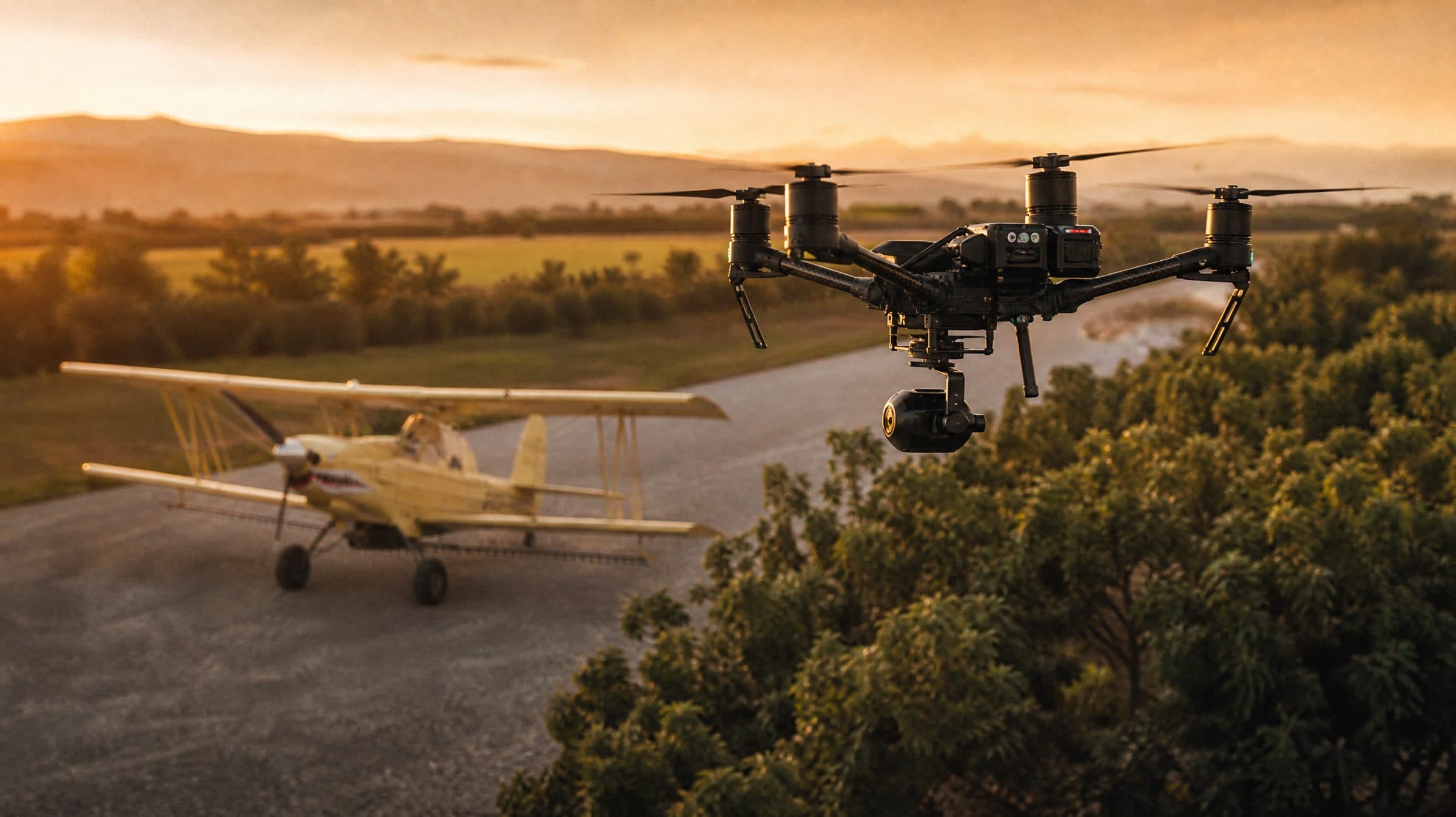
In drone spraying vs crop dusting, the drone suits spot work and small blocks near obstacles; the airplane suits large fields. Purdue Extension reports that the largest spray drones carry about 18 gallons, which covers 3.6 acres at 5 gallons per acre, a common label minimum. The Air Tractor 602 in our fleet carries 630 gallons, so it treats a 200-acre rice field at that rate in two loads.
What is the real difference in drone spraying vs crop dusting?
The rules are the same for both aircraft. Federal rule 14 CFR Part 137 covers any aircraft that dispenses crop products, drones included. A drone must follow the aerial directions on the product label, the same as an airplane. In California, both pilots need a state pilot certificate.
The machines are very different. A spray drone carries a small tank, flies slowly a few feet above the crop and lands every few acres. An ag airplane carries a much larger hopper and treats a large block in one or two loads. The drone vs crop duster choice comes down to these differences and the size of your job.
The table compares a large spray drone with an ag airplane on the points that change how a job runs.
| Point | Spray drone | Ag airplane |
|---|---|---|
| Load per trip | Up to about 18 gallons on the largest models | 630 gallons in the Air Tractor 602 hopper |
| Acres per load at 5 gallons per acre | About 3.6 acres | About 126 acres |
| Flight time per battery | About 7 to 12 minutes for heavy spray drones | Not limited by a battery |
| Working speed | About 10 to 15 mph in extension examples | About 145 mph typical for the Air Tractor 602 |
| Where it mixes and loads | At your field edge, from a trailer with water, tanks and a generator | At the operator's airstrip |
| Pilot position | On the ground, with the drone in sight | In the aircraft |
Sources: drone figures from Purdue Extension, The Evolution of Spray Drones, PPP-154 (2025); airplane figures from Air Tractor AT-602 specifications. Acres per load are our arithmetic from those tank sizes.
How many acres can a drone spray compared with a crop duster?
Load size sets the pace of every job. The 630-gallon hopper of the Air Tractor 602, one of the six airplanes we fly, holds 35 times the largest drone load.
The label spray volume makes the gap larger. Drones usually apply 2 to 3 gallons per acre, but many labels require at least 5 to 10. At 10 gallons per acre, a full drone tank treats only 1.8 acres.
Each drone load also uses most of a battery. Purdue says that a full load drains a battery fast, and a crew needs 3 to 12 batteries for continuous flight. In drone spraying vs plane spraying, these stops decide how many acres one crew finishes in a day.
This table shows how many full loads each aircraft needs for one field, at two spray volumes.
| Field size | Spray volume | Total mix | Drone loads at 18 gallons | Airplane loads at 630 gallons |
|---|---|---|---|---|
| 20 acres | 2 gallons per acre | 40 gallons | 3 | 1 |
| 160 acres | 2 gallons per acre | 320 gallons | 18 | 1 |
| 160 acres | 5 gallons per acre | 800 gallons | 45 | 2 |
| 640 acres | 5 gallons per acre | 3,200 gallons | 178 | 6 |
Tank sizes come from the sources under the first table. Load counts round up and assume a full tank on each trip.
Can a spray drone meet the label's spray volume?
Check the label before you choose the aircraft, because the label is the law. The product must allow aerial application, and the drone must meet every aerial direction on it. Purdue Extension notes that those directions were written for airplanes and helicopters. Some labels say that if you cannot meet all aerial directions, you must not apply the product by air.
Spray volume is the most common conflict. A drone can meet a 5 to 10 gallon minimum, but it then treats fewer acres per day. At 2 gallons per acre, the drone mix is very concentrated. Purdue warns that some products that mix well in 10 to 20 gallons per acre can separate at drone concentrations.
Most spray drones have no tank agitation. A good drone crew mixes in a nurse tank (a larger support tank) with an agitation pump, then fills the drone from it. That work happens at your field edge, and 200 acres at 2 gallons per acre needs at least 400 gallons of water. An airplane loads at its airstrip, so the mixing and rinse work stay off your field.
The label and your licensed pest control adviser (PCA) set the product and rate for either aircraft. Ask your PCA to confirm that the written recommendation fits the method.
Which drifts more: a spray drone or a crop duster?
In drone spraying vs crop dusting, neither aircraft is free of drift, and the same weather rules apply to both. Drift depends on droplet size, release height, speed, wind and air stability. The label sets the wind limits for each product. No one should spray during a temperature inversion, when cool air sits under warm air near the ground. Warning signs include ground fog, and smoke or dust that hangs low and moves sideways.
Drift data for drones is still limited. Purdue Extension reports early studies where drones that fly more than 10 feet above the crop cause more drift. Rotor downwash pushes droplets down, but researchers do not yet know how much spray it moves sideways.
An airplane pilot controls drift with nozzle choice, low passes and the direction of each pass relative to the wind. Our pilots check the wind before and during the job and plan around homes, schools, water and nearby crops. If the wind is wrong, we wait. Our spray drift guide explains each factor.
How do you know the drone or plane covers the field evenly?
Even coverage depends on the effective swath, not the advertised one. The effective swath is the distance between passes that gives an even rate when the spray patterns overlap. Purdue Extension says a drone's effective swath is usually 65 to 75 percent of the advertised width. A 30-foot advertised swath gives about 20 to 22 feet.
Applicators find the effective swath with a pattern test. The pilot flies across a line of water-sensitive cards or a collector, and the crew reads where the droplets land. Small setup changes alter the pattern, so the crew tests again after equipment changes. Ag airplanes need the same kind of test.
A wrong swath leaves streaks: strips with too little product beside strips with too much. Ask the applicator for the date of the last pattern test and the swath for your field.
Who can legally spray your field by drone or airplane in California?
Both aircraft need federal approval. The operator must hold an FAA agricultural aircraft operator certificate under Part 137. A drone operator also needs an FAA exemption, a registered drone and a remote pilot certificate. The drone pilot must keep the drone in sight.
The state adds its own pilot certificate. The California Department of Pesticide Regulation requires a Pest Control Aircraft Pilot Certificate for anyone who flies an airplane or a drone for pest control. The experience bar differs. A journeyman airplane pilot needs 1 year as an apprentice and 150 hours of fixed-wing operation in the past 2 years. A journeyman drone pilot needs 1 year as an apprentice and 50 hours of drone application under a journeyman. See our guides to FAA Part 137 and California pesticide application rules.
When does a drone make more sense than a crop duster?
In the crop duster vs drone choice, a drone wins on small and awkward work:
- Spot treatments on part of a field
- Small blocks, because some airplane and large ground-rig operators set a minimum acreage
- Field corners near power lines, trees or buildings, where the drone's obstacle sensors help
- Test plots and research strips
A drone has limits even on small work. The pilot must keep it in sight, so tree lines and orchard canopy can split a job into short flights. A drone that hovers to avoid an obstacle also drains its battery fast.
When does an airplane make more sense in the Sacramento Valley?
An airplane wins when the job is large or the window is short. In most drone vs airplane crop spraying decisions in this valley, the acres and the timing point to the airplane:
- Rice seeding onto flooded checks in April and May (see our rice seeding guide)
- Herbicide, fungicide and insecticide programs from May to August, when pest pressure will not wait
- Fertilizer top-dressing on rice and other crops, with many fields in one day
- Dry products such as granular fertilizer and granular rice herbicide, which suit the Ag Cat hopper
- Fields too wet for a ground rig (see aerial spraying vs ground rigs)
Distance adds little time for an airplane. In a straight line from our Live Oak strip, Yuba City is 7 miles, Colusa is 17 miles and Willows is 34 miles. A drone crew must drive its trailer to each field and set up again.
What should you ask before you book a drone or an airplane?
Ask each operator for these items. If one is missing, book another operator.
| Ask for | A good answer |
|---|---|
| FAA approval | A Part 137 operator certificate, plus an FAA exemption that covers its drones. |
| State license | A DPR Pest Control Business License, registered this year with your county agricultural commissioner. |
| Pilot certificate | A DPR Pest Control Aircraft Pilot Certificate for each pilot. An apprentice flies only under journeyman supervision. |
| Spray volume | At or above the label minimum. Purdue Extension notes that many labels require 5 to 10 gallons per acre, which a drone may not reach. |
| Effective swath | A pattern-test width, not the advertised one. NAAREF, an aerial application research foundation, advises a test every 2 years and after major setup changes. |
| Records | A copy of the application record, which the business reports to the county. |
Sutter Butte Dusters flies aerial application from our airstrip at 4080 Clark Rd in Live Oak, with five Ag Cats and one Air Tractor 602. We do not fly spray drones; our drone data service maps fields and images crop health. We serve growers in Sutter, Yuba, Butte, Glenn and Colusa counties. If you are not sure which aircraft fits your field, send the location, crop, acres, product and timing. Get a quote for your field, or call (530) 695-2294, Monday to Friday, 8am to 3pm.
Questions
It depends on the acres, the spray volume and the field. A drone can cost less on a small block. On a large field, many refill stops add crew time. Get quotes for the same field and product, and read our drone spraying cost per acre guide.
A drone with a spreader can seed a small area. Most California rice is seeded by airplane onto flooded checks in April and May, because a whole field must go in fast. One airplane load covers far more ground than one drone load.
Yes. Neither aircraft touches the ground in the field, so neither leaves wheel tracks or compacts wet soil. That makes both useful after rain or on flooded rice. The choice then depends on the acres, the label volume and the spray window.
No. We fly all applications with our five Ag Cats and one Air Tractor 602. Our drone service is for data: field mapping, topography and multispectral crop health images. Those maps can help you and your PCA decide where a treatment is needed.