
From the hangar
Crop duster planes: types, parts and why they are yellow
By the Sutter Butte Dusters team · · 8 min read
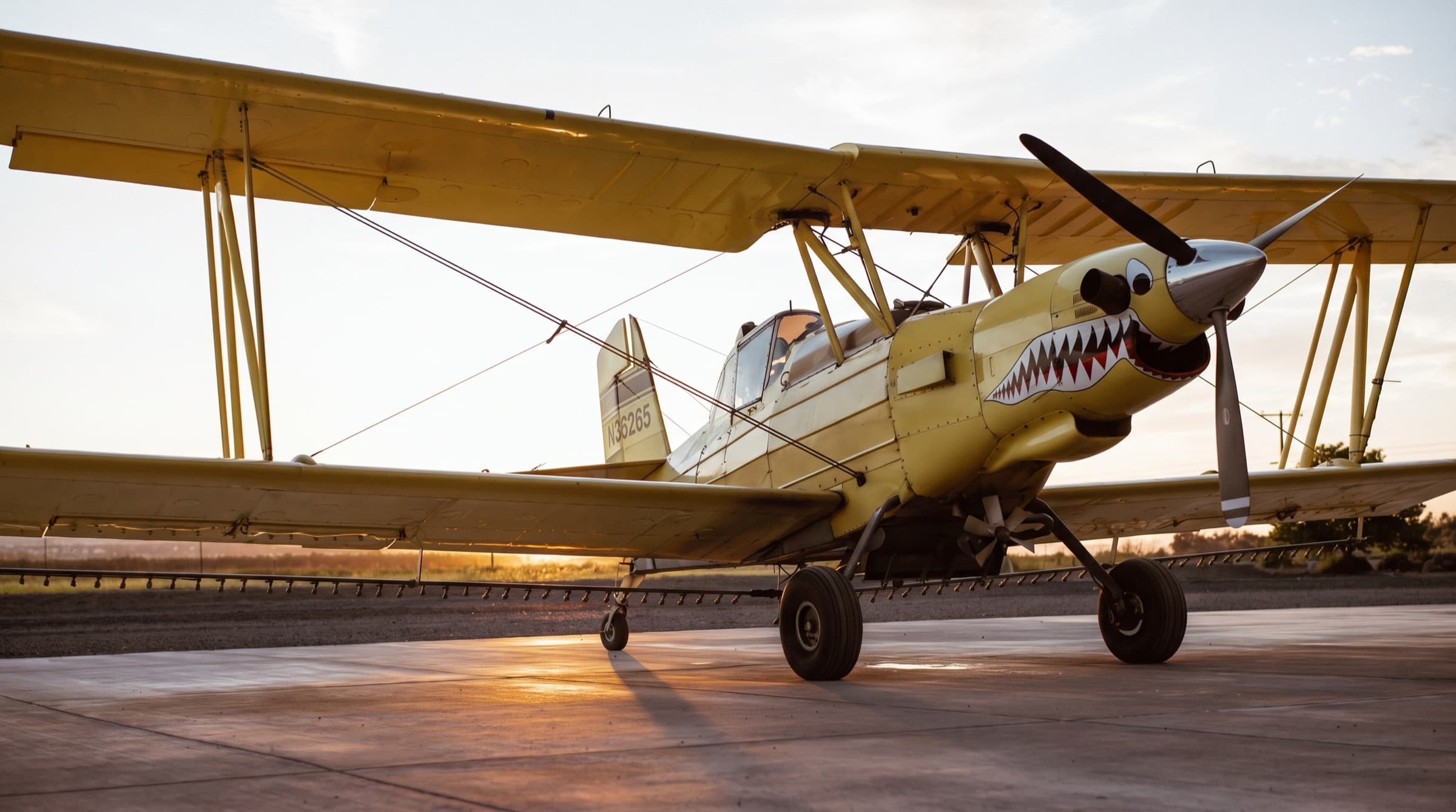
A crop duster is an airplane that carries seed, fertilizer or crop protection products and releases them a few feet above a field. The job itself is aerial application (crop dusting). This guide explains the types of agricultural aircraft, the parts that do the work, how the design developed, and why so many are yellow.
What is an agricultural aircraft?
An agricultural aircraft (ag aircraft) is any aircraft that an operator uses to dispense material for farming, forestry or pest control. The FAA rules for this work are in 14 CFR Part 137. Part 137 covers pesticides, plant food, soil treatments and seed. Our guide to FAA Part 137 for agricultural aircraft explains the operator certificate.
The National Agricultural Aviation Association (NAAA) counts about 1,560 aerial application businesses and 3,400 ag pilots in the United States. Its 2019 survey found that 84 percent of ag aircraft are airplanes and 16 percent are helicopters. It also found that 83 percent of the fixed-wing aircraft and 71 percent of the helicopters have turbine engines. In this post, "ag airplane" means a fixed-wing agricultural plane.
What types of ag airplanes fly today?
Two designs do most of the work: the radial-engine biplane and the turboprop monoplane. A biplane has two sets of wings, and a monoplane has one. A radial engine is a piston engine with its cylinders in a ring. A turboprop is a turbine engine that turns a propeller.
| Model | Layout | Engine | Hopper |
|---|---|---|---|
| Ag Cat G-164A | Biplane | Pratt and Whitney R-985 (450 hp) or R-1340 (600 hp) radial | 300 gallons |
| Ag Cat G-164B (Super B) | Biplane | Pratt and Whitney R-985 or R-1340 radial | 400 gallons from serial 660B |
| Air Tractor AT-502B | Monoplane | Pratt and Whitney PT6A-34AG, 750 shp | 500 gallons |
| Air Tractor AT-602 | Monoplane | Pratt and Whitney PT6A-60AG, 1,050 shp | 630 gallons |
| Air Tractor AT-802A | Monoplane | Pratt and Whitney PT6A-65AG, 1,295 shp | 800 gallons |
The Air Tractor figures come from the maker's published specifications. Air Tractor lists typical working speeds from 120 mph on the AT-502B to 160 mph on the AT-802A. Our history of the Grumman Ag Cat gives the type data for every Ag Cat model.
Helicopters can work small, odd-shaped fields, as our comparison of helicopters and airplanes for crop work explains. Spray drones carry much smaller loads, and our post on drone spraying cost per acre compares them with an airplane.
How did the crop duster plane develop?
Operators first converted military airplanes for farm work. These dates come from the FAA historian's account of 100 years of crop dusting and the Smithsonian's Air and Space Quarterly.
- 1921: Army pilot John Macready flew a modified Curtiss JN-4 over 6,000 catalpa trees in Troy, Ohio. The makeshift hopper held 100 pounds of dust.
- 1925: The Huff-Daland Duster, a converted biplane with a large hopper, started work on southern farmland. The company later became Delta Air Lines.
- Late 1940s: Operators converted surplus Stearman biplanes and Piper Cubs for farm work. Some surplus trainers sold for as little as $250.
- 1950: The AG-1 flew. Fred Weick designed it at Texas A&M under a federal contract, with a seat built for a 40 G shock and a shoulder harness.
- 1953: Leland Snow flew his S-1 monoplane. His S-2 became the first purpose-built ag plane made for commercial sale.
- 1957: The Grumman Ag Cat prototype flew. Schweizer Aircraft built the production airplanes from 1959.
- 1959: Piper started to sell the PA-25 Pawnee, which grew out of Weick's AG-3 design.
- 1966: Snow's Thrush prototype flew, with the cockpit behind the hopper and the engine.
- 1977: The Air Tractor AT-302 became the first ag plane with a factory-installed turbine engine.
The converted airplanes did the work, but they had a high accident rate. By the early 1950s, the federal government listed over 5,000 aircraft in farm use. The FAA historian reports that they sprayed 60 to 70 acres an hour. A tractor-drawn sprayer covered about 100 acres a day.
In 2022, the Smithsonian article counted 3,773 ag aircraft in the United States. Of these, 1,658 are Air Tractors and 576 are Thrush models. Most of the rest are models that are no longer in production, such as the Piper Pawnee, the Cessna AGwagon and the Ag Cat. About 1,800 of the more than 2,600 Ag Cats built are still in use worldwide.
What is a crop duster plane made of?
Most ag airplanes use the same layout. The engine sits in front, the hopper sits behind it, and the pilot sits behind the hopper. The hopper is the tank that holds the load, liquid or dry.
| Part | What it does |
|---|---|
| Engine and propeller | Pulls a heavy load off a short strip and climbs over trees and wires |
| Hopper | Holds liquid or dry material in front of the cockpit, near the center of gravity |
| Pump | Pushes liquid from the hopper to the boom; a small wind-driven propeller or a hydraulic motor turns it |
| Spray boom and nozzles | A pipe under or behind the wing that releases the liquid as droplets |
| Dry spreader | A wide duct under the hopper gate that uses ram air to spread seed, granules and sulfur |
| Dump system | Releases the load fast in an emergency |
| GPS guidance and flow control | Keeps each pass parallel to the last and holds the rate per acre |
| Smoke generator | Puts a puff of smoke in the air so the pilot can see the wind at the field |
| Cockpit and harness | Protects the pilot; Part 137 requires a shoulder harness for each pilot |
Part 137 also sets a dump rule for work over a congested area. There, an airplane must be able to dump at least half of its maximum load within 45 seconds. Grumman designed the original Ag Cat cockpit to withstand a 40 g impact, according to the Smithsonian's record of the Ag Cat in its collection.
The liquid in the hopper is mostly water, which carries the product across the leaves. Our post on what goes in the hopper explains each material. Dry jobs such as rice seeding use the spreader instead of the boom.
How does a crop duster airplane control drift?
Drift is spray that moves off the target field. An ag airplane controls drift mostly through its boom and nozzle setup. Each wingtip makes a vortex, a spinning column of air that can carry fine droplets away. A shorter boom keeps the outer nozzles inboard, away from the vortices.
The California Department of Pesticide Regulation (CDPR) publishes recommended permit conditions for drift. They apply to restricted materials, and CDPR encourages them for other pesticides. The main aircraft conditions are:
- The functional boom, from outboard nozzle to outboard nozzle, is no more than 75 percent of the wingspan.
- Boom pressure is no more than 40 psi for the nozzles in use.
- Each nozzle has a positive shutoff and points backward with the airstream.
- The wind at the field is no more than 10 mph, measured 4 feet above the ground.
- The release height is no more than 10 feet above the crop.
- The pilot starts the spray after the airplane enters the field and stops it before the airplane leaves.
For example, Air Tractor lists the AT-602 wingspan as 56 feet, so a 75 percent limit gives a 42-foot functional boom. The product label can set stricter limits, and the label always comes first. Our guide to spray drift in aerial application covers droplet size and buffer zones. Our post on why ag pilots fly so low explains the low pass.
Why are crop dusters yellow?
No FAA rule requires an ag airplane to be yellow, and Part 137 does not mention paint. The yellow is a tradition with a practical side.
The tradition goes back to World War II trainers. The Navy painted its Stearman N2S trainers yellow so that other pilots could see them in busy training patterns. Pilots called them "yellow perils," according to the San Diego Air and Space Museum. After the war, many surplus Stearmans went to work on farms. Bright paint still helps other pilots, ground crews and people near a field see an airplane that works low.
Many operators now fly other colors. Our Ag Cats wear yellow with shark-mouth nose art, so people in the valley can spot them.
Biplane or monoplane: which ag airplane fits the job?
A biplane gets a lot of wing area from a short span. That gives strong lift at low speed and a tight turn at the end of each pass. The original Ag Cat stalled at 67 mph, according to the Smithsonian. Its welded steel-tube fuselage has removable aluminum panels for cleaning. Our post on why we fly the Ag Cat describes it from the cockpit.
A turbine monoplane carries a bigger load and works faster. Air Tractor calls the AT-502B the most popular ag plane in the world, with more than 1,000 of the 502 series built since 1987. It also needs more runway: Air Tractor lists a 1,830-foot takeoff at its 12,500 lb gross weight. Large fields with long, straight passes suit it well. Our comparison of the Air Tractor 602 and the Ag Cat explains why we fly both.
How do you know which aircraft your field needs?
The applicator chooses the aircraft, but your details drive that choice. Hopper size and the volume per acre set the acres in each load. For example, at 10 gallons of total spray per acre, a 400-gallon hopper treats up to 40 acres per load. On a hot day, weight limits can reduce that load.
Caution: the product rate and the volume per acre come from the label and your licensed pest control adviser (PCA). Do not ask the pilot to change them.
- Write down the field location and the acres.
- Mark power lines, towers, trees and homes on a map.
- Get the written recommendation from your PCA.
- Note whether the product is liquid or dry.
- Write down the start and end of the treatment window.
- Send these details to the applicator.
Our guide on how to hire an aerial applicator lists the questions to ask before the job.
Our fleet in the northern Sacramento Valley
We fly five Ag Cat biplanes and one Air Tractor 602 from our base at 4080 Clark Rd in Live Oak. We seed rice, apply dry and liquid fertilizer and fly crop protection jobs. We work across Sutter, Yuba, Butte, Glenn and Colusa counties. Our fleet page shows the airplanes. For your next application, get a quote for your field.
Questions
The National Agricultural Aviation Association reports that agricultural aircraft range in price from about $100,000 to nearly $2 million. Hopper size, engine type and engine power drive most of that range. For a used airplane, the condition, engine time and installed equipment also change the value.
Air Tractor lists a working speed of 145 mph for the AT-602 and 120 to 145 mph for the smaller AT-502B. The larger AT-802A works at 130 to 160 mph. These figures come from the maker's published specifications.
FAA Part 137 lets an ag airplane fly below 500 feet over areas that are not congested during the application, if it creates no hazard on the ground. California's recommended drift permit conditions for restricted materials limit the release height to 10 feet above the crop.
Hopper sizes run from 300 gallons on the Ag Cat G-164A to 800 gallons on the Air Tractor AT-802A. The Ag Cat G-164B holds 400 gallons and the AT-602 holds 630 gallons. On hot days, weight limits can keep the pilot from filling the hopper.
