From the hangar
Are biplanes still used? Why we still fly the Ag Cat
By the Sutter Butte Dusters team · · Updated · 8 min read
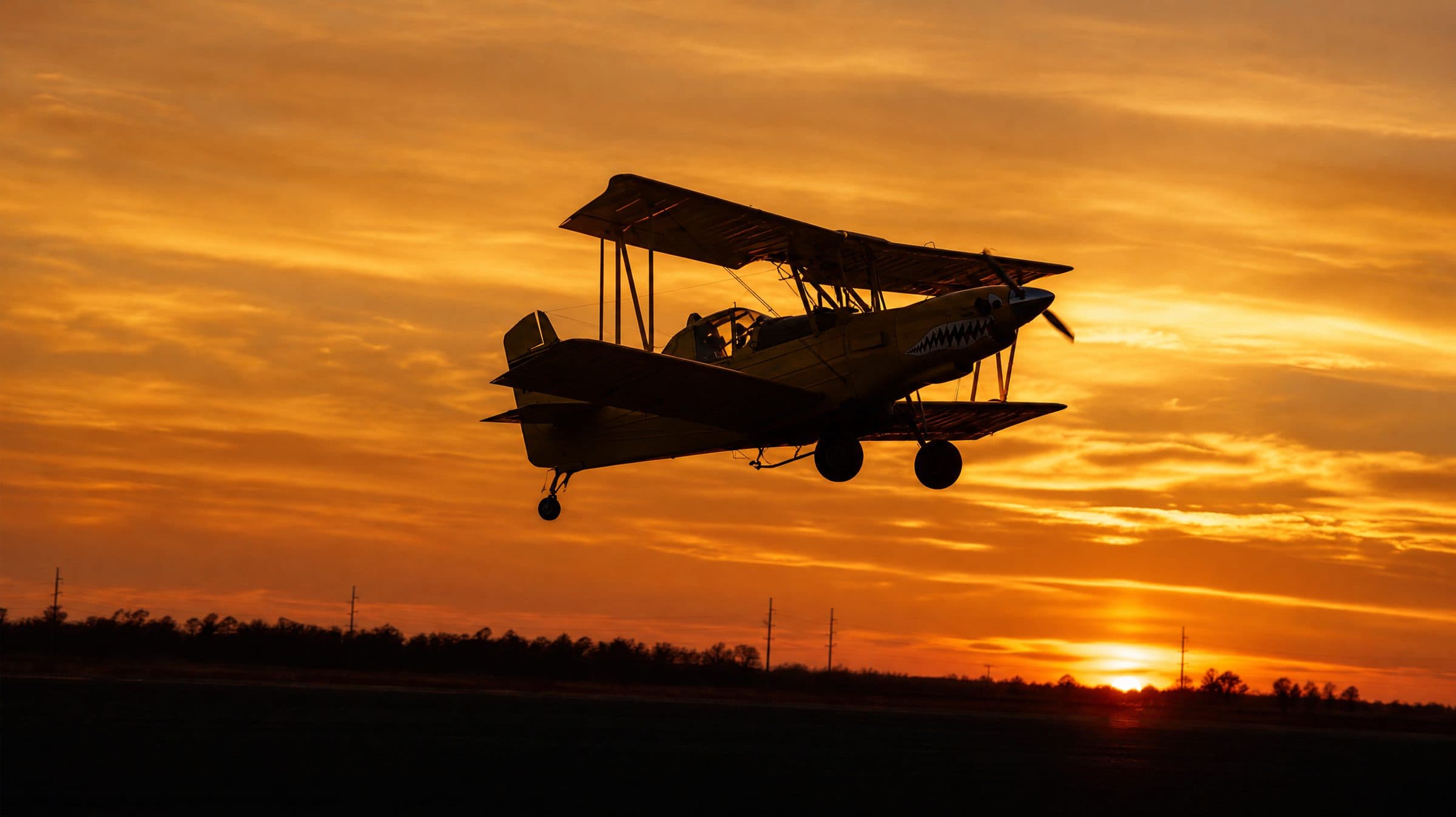
Are biplanes still used? Yes, and the place where they still work hardest is over farm fields. Most aircraft today fly on one wing. A few jobs still need what two wings give, and aerial application (crop dusting) is the main one. We fly five Super B Ag Cat biplanes from our strip in Live Oak, California, and our neighbors ask us this question every season.
Are biplanes still used today, and for what?
Biplanes still fly every day, but in a small number of special roles. Airlines, cargo companies and front-line air forces do not use them. Each remaining role needs something that a fast single-wing aircraft does not give. That can be control at low speed, quick rolls, a strong and simple structure, or open-cockpit history.
Farm work is the only one of these roles where a biplane is a daily tool and not a hobby aircraft. After World War II, many surplus Stearman trainers became crop dusters, with a hopper in place of the front seat. In the late 1950s, Grumman designed the Ag Cat, a biplane made for farm work from the start.
Aerial application is still a large industry. The 2019 National Agricultural Aviation Association industry survey counted 1,560 U.S. aerial application businesses. These businesses treat about 28 percent of the cropland in production, and 84 percent of their aircraft have fixed wings. The survey does not count biplanes on their own. The Ag Cat is still at work in that fleet, including over the northern Sacramento Valley.
This table shows where biplanes still work today and what the job asks of the aircraft.
| Role | Typical biplanes | What two wings give the job |
|---|---|---|
| Aerial application (crop dusting) | Grumman and Schweizer Ag Cat; Stearman in the past | Steady control at low speed, tight turns, a strong airframe |
| Aerobatic competition and air shows | Pitts Special | A short span, quick rolls and strong wings |
| Aerobatic and tailwheel training | Two-seat Pitts S-2C | A demanding aircraft that teaches precise control |
| Scenic rides and vintage flying | Boeing Stearman, older WACO and Great Lakes | An open cockpit and a 1930s or 1940s design |
| New-build classic aircraft | WACO YMF-5 (built until 2026) | A 1930s design with a modern engine and modern avionics |
Why are biplanes no longer used for most flying?
Biplanes lost their place because engines and materials improved. Early aircraft had wood frames and fabric skins. A single wing of that type could not carry the load alone, so designers stacked two wings and braced them with struts and wires. The result was a light, stiff box that made a lot of lift at low speed.
By the late 1930s, metal wings were strong enough to stand alone without outside bracing. Engines also gave much more power, so aircraft flew faster. At high speed, the struts, the wires and the second wing cause a large amount of drag. The two wings also disturb the airflow over each other, so each wing makes less lift than it would alone.
For an airliner or a fighter, speed and fuel economy are the main goals. A single wing wins on both, so the biplane disappeared from those jobs. The same features that cost speed are still useful in work that happens at low speed, close to the ground. That is the reason for the next section.
Why are biplanes still used for crop dusting?
Crop dusting happens at low speed, at low height, with a heavy load and many turns. A biplane does well in exactly those conditions. To learn more about the low passes, read why crop dusters fly so low.
The Ag Cat has a large wing area in a short span. More wing area per pound of aircraft lets the pilot fly slower and turn tighter with a full hopper. The Smithsonian's National Air and Space Museum describes the Ag Cat as a strut-braced biplane with a 35 percent wing stagger. The museum says that this stagger gives excellent low-speed stall characteristics. In plain words, the aircraft stays easy to control near its slowest flying speed.
Northern Sacramento Valley fields test these qualities. A rice check is a flooded field section that levees divide. Power lines run along many roads, and orchard rows end at canals, houses and trees. At the end of each pass, the pilot pulls up, turns around and lines up for the next pass. A plane that turns tightly at low speed spends less time in each turn and gives the pilot more margin near obstacles.
A biplane's wing cell is also strong and simple. The struts and wires carry loads in a direct path, and the pilot can see many of the parts in a walk-around inspection. That matters for an aircraft that takes off and lands many times in a day from a farm strip.
This table compares what field work asks of an aircraft with what the Ag Cat design gives and where we see it in the valley.
| What field work needs | What the Ag Cat design gives | Where we see it in the valley |
|---|---|---|
| Steady control at low speed | Two wings with 35 percent stagger for gentle stall behavior | Low, level passes over flooded rice checks |
| Tight turns at the end of each pass | A large wing area in a short span | Turns over levees, canals and orchard row ends |
| A strong airframe | A strut-braced wing cell | Repeat loads from the Clark Rd strip |
| A hopper for dry and liquid products | A hopper ahead of the cockpit | Rice seed in April and May, dry fertilizer from April to July |
Source for the wing stagger: Smithsonian National Air and Space Museum. Season months are typical timing from our service pages.
Why can you not buy a ride in a crop-dusting biplane?
An Ag Cat is a working aircraft, not a sightseeing aircraft, and federal rules keep it that way. Many agricultural aircraft, the Ag Cat among them, have a restricted category certificate. Under 14 CFR 21.25, the restricted category covers special purpose operations, and agricultural use includes "spraying, dusting, and seeding."
Section 91.313 of the same rules limits a restricted category aircraft to its special purpose. It also prohibits the carriage of persons or property for compensation or hire in that aircraft. The rule makes an exception for the material that the job needs, such as crop dusting, seeding and spraying loads. So a biplane ride at an air show is a different aircraft with a different certificate. One of our Ag Cats carries the registration N36265.
The operator of the aircraft also needs an FAA agricultural aircraft operator certificate. Our post on FAA Part 137 and the rules for agricultural aircraft explains that certificate and the operating rules.
Do they still make biplanes?
Yes, but in small numbers, and the builders do most of the work by hand. WACO Aircraft built the WACO YMF-5, a three-seat open-cockpit biplane that uses a 1930s design and a radial engine. It built the aircraft in Battle Creek, Michigan, until the company ceased operations there, as Aviation International News reported on April 30, 2026. Aviat Aircraft in Afton, Wyoming, builds the two-seat Pitts S-2C for aerobatic flying. Other companies sell biplane kits that pilots build themselves, but no factory builds biplanes in large numbers.
The Ag Cat has a longer production story. The National Air and Space Museum says that Grumman engineers proposed it in 1955, and it first flew on May 27, 1957. The museum calls it the first aircraft that a major aircraft company designed for agricultural aviation. The museum says that Schweizer Aircraft built 2,646 of the nearly 2,700 Ag Cats. From 1981, Schweizer added models with longer wings, a longer fuselage and more engine choices, which include the Super B.
So nearly every Ag Cat that flies today came from the Schweizer production line. Operators keep these aircraft in service through inspection, repair and rebuild. We maintain our five Super B Ag Cats in our own hangar in Live Oak. For the full story of the type, read the history of the Grumman Ag Cat.
What is the shark mouth nose art on our Ag Cats?
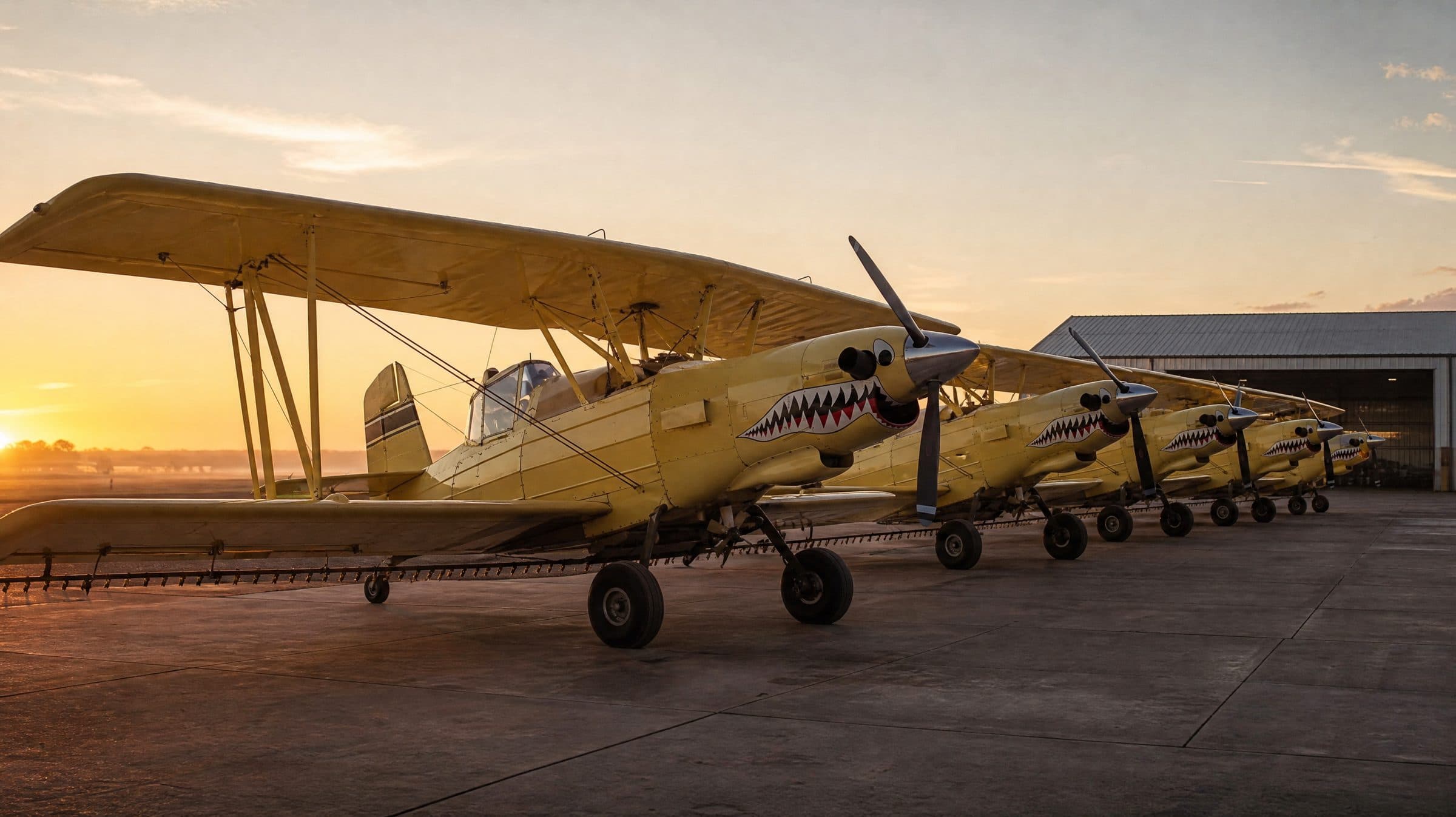
The shark mouth nose art on our Ag Cats is our livery and a salute to aviation history. The design became famous in World War II on Curtiss P-40 fighters. Shark mouths go back to World War I aircraft. The classic P-40 design came from a Royal Air Force squadron that painted it on its P-40s in North Africa. The American Volunteer Group in China, the Flying Tigers, copied the design and made it known around the world.
The paint has no aerodynamic purpose. It does make our aircraft easy to recognize from the ground. If you see a yellow biplane with a shark mouth low over a field near Live Oak, it is one of ours. Our post on crop duster planes explains the yellow paint and the other aircraft types in ag aviation.
Is a biplane the right aircraft for your field?
The aircraft type is only one part of a good application. A biplane has real limits. It flies slower than a large turbine monoplane, so long ferry flights take more time. In the 2019 NAAA survey, 83 percent of fixed-wing ag aircraft and 71 percent of ag helicopters had turbine engines. The Air Tractor 602 in our fleet is one of them.
For that reason, we fly a single-wing turbine aircraft next to our five Ag Cats. Our comparison of the Air Tractor 602 and the Ag Cat explains when each aircraft fits a job.
For the grower, three things matter more than the number of wings:
- The pilot flies calibrated equipment and puts the product on the target at the label rate.
- The pilot plans the job around wind, nearby homes, water and sensitive crops.
- The operator flies inside your treatment window.
Your licensed pest control adviser (PCA) writes the product and the rate. We apply only what the label and the PCA recommendation allow. To compare operators before you hire one, read how to hire a crop duster.
Are biplanes still used in the northern Sacramento Valley? Yes, every season. Sutter Butte Dusters flies five Super B Ag Cats and one Air Tractor 602 from 4080 Clark Rd in Live Oak. We seed rice and apply crop protection and fertilizer in Sutter, Yuba, Butte, Glenn and Colusa counties. Each county seat that we serve is 34 miles or less from our strip in a straight line. To see the aircraft up close, see the fleet, or request an application for your field.
Questions
For most purposes, biplanes became obsolete by the late 1930s. Stronger metal wings, better materials and higher speeds made the single-wing design better for fighters, bombers and airliners. A few biplanes still served in World War II, mainly as trainers and in other special roles.
A biplane has a short wingspan and a large wing area for its weight. The short span lets it roll quickly, and the large area lets it turn tightly at low speed. For this reason, aerobatic pilots fly the Pitts and ag pilots fly the Ag Cat.
The Boeing Stearman, a World War II trainer, is one of the most common vintage biplanes in the air today. Owners fly it for rides, air shows and history. After the war, many surplus Stearmans worked as crop dusters before purpose-built ag aircraft replaced them.