
Pest management
Jar test for tank mix compatibility: step by step
By the Sutter Butte Dusters team · · 8 min read
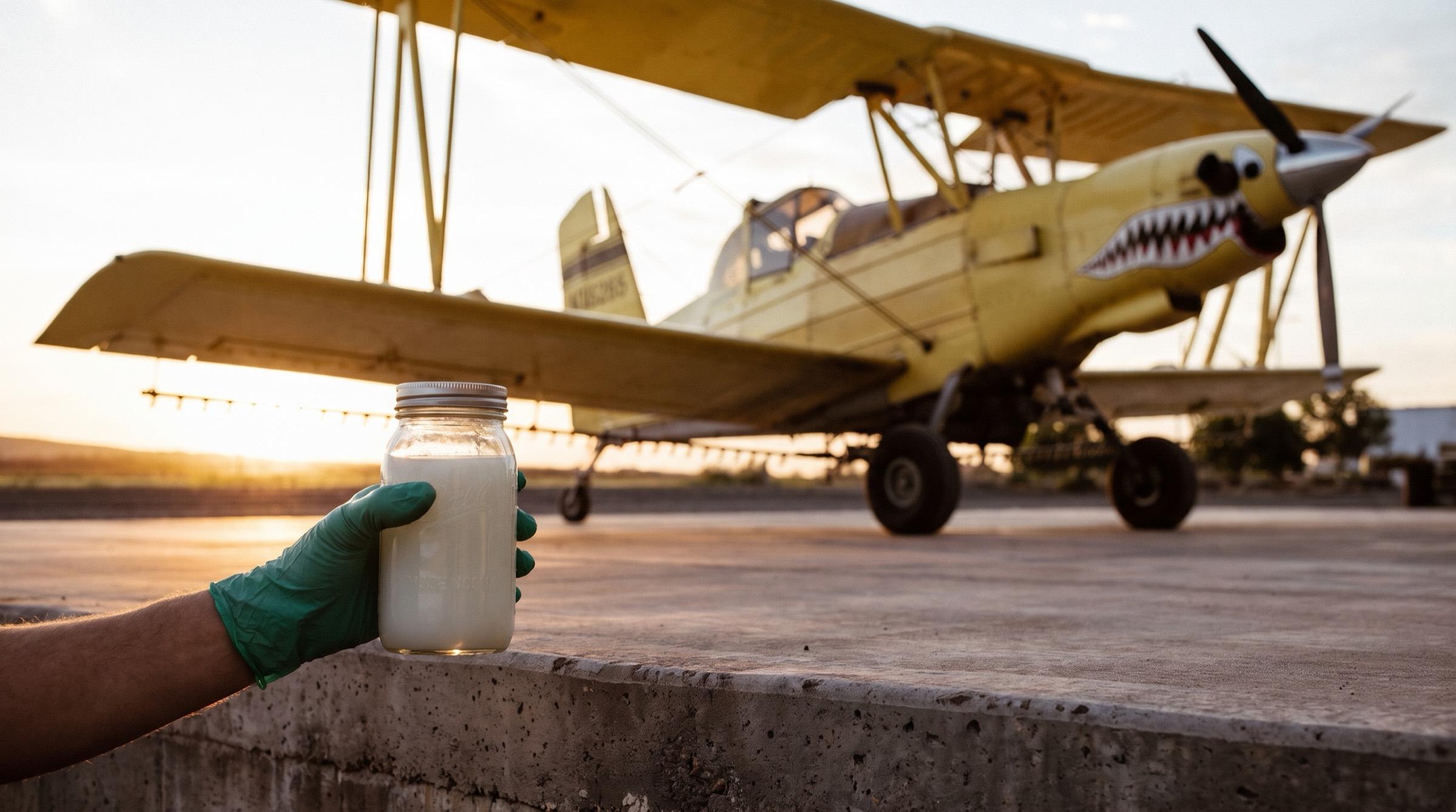
A jar test for a pesticide tank mix is a small trial in a clear quart jar. It shows if the products in a planned spray stay mixed in your own carrier water. This guide covers the spray mix test, not the coagulant test that water treatment plants use.
Why do a jar test before you fill the tank?
A jar test checks tank mix compatibility at a small scale before you commit a full load. An aircraft hopper holds a large volume, so a bad mix wastes product, time and a full cleanout. A bad mix can also plug screens and nozzles while the aircraft is in the air.
Two kinds of problems can occur. Physical incompatibility means that the products do not stay mixed. They form flakes, gels, sludge or separate layers. Chemical incompatibility means that the products react, which can reduce control or injure the crop.
The University of Arkansas extension guide states that this test finds only physical problems, not chemical ones. Source: Assessing Pesticide-Fertilizer Compatibility (Jar Test), FSA2166, University of Arkansas Division of Agriculture, 2024.
Many labels give specific mixing instructions or name tested tank mix partners. Read every label in the mix first. The label directions override any general order in this guide.
What do you need for the test?
- Two clear glass quart jars with tight lids. The first jar holds the mix as planned. The second jar holds the same mix with a compatibility agent.
- Carrier from the same source as the load: the same well, ditch or liquid fertilizer. Hardness, pH and temperature change how products mix.
- Measuring spoons and a syringe marked in milliliters (1 mL is 1 cc).
- A small scale for dry products.
- The label of every product, and the written recommendation from your pest control adviser (PCA).
- The rates and the gallons per acre (GPA) from the work order.
- The personal protective equipment (PPE) for mixers and loaders. Use the most protective PPE that any label in the mix requires.
- A container to hold the test mix until you discard it as the labels direct.
How do you scale the products to a quart jar?
The jar must hold the same ratio of product to carrier as the real spray. Published charts assume a set spray volume. The Arkansas chart uses 2.5 mL for each pint per acre in 1 pint of carrier. By our math, that ratio matches about 24 GPA.
An aerial job often uses a lower GPA than that, so the spray is more concentrated. Scale the test to the GPA on your work order, not to a general chart.
Use 1 pint (16 fluid ounces) of carrier in the quart jar. The empty space lets you shake the jar. Then calculate the jar factor and the amount of each product:
- Jar factor = 16 fluid ounces ÷ (GPA × 128 fluid ounces per gallon)
- Product per jar = label rate per acre × jar factor
Here is an example only, not a rate recommendation. The work order says 10 GPA and a liquid product at 1 pint per acre.
- Calculate the jar factor: 16 ÷ (10 × 128) = 16 ÷ 1,280 = 1/80.
- Calculate the product: 16 fluid ounces ÷ 80 = 0.2 fluid ounce.
- Convert the result: 0.2 fluid ounce is about 5.9 mL, or about 1.2 teaspoons.
A dry product at 1 pound per acre and 10 GPA needs 453.6 grams ÷ 80, or about 5.7 grams. Weigh dry products, because the volume of a spoonful changes from product to product.
| Spray volume | Jar factor | Liquid, for each 1 pint per acre | Dry, for each 1 pound per acre |
|---|---|---|---|
| 5 GPA | 1/40 | 11.8 mL | 11.3 g |
| 10 GPA | 1/80 | 5.9 mL | 5.7 g |
| 20 GPA | 1/160 | 3.0 mL | 2.8 g |
The finished spray volume includes the volume of the products. For a test this small, the difference does not change the result. Our gallons per acre calculator guide shows the math for the real load.
What is the WALES mixing order?
WALES is a common pesticide mixing order for products that have no label order. The Arkansas guide gives the WALES mixing order as follows:
- W: wettable powders and water-dispersible granules.
- A: agitate, then add adjuvants such as antifoam agents and buffers.
- L: liquid flowables.
- E: emulsifiable concentrates.
- S: surfactants.
Purdue University gives the same order. It also says to fill the tank about half full of water before the first product goes in. Purdue puts compatibility agents and antifoam agents in before the pesticides. Source: Tank mixes, Purdue Facts for Fancy Fruit.
Other memory aids exist, such as APPLES. Their letters change from source to source, so we do not list one here. Use the same order in the jar and in the tank. The test proves only the order that you tested.
How do you run a jar test step by step?
Caution: Put on the label PPE before you open any container. Do not smell the jar or hold your face over it. Keep the test away from food, drink and children.
- Pour 1 pint of carrier into each jar.
- Add the compatibility agent to the second jar at its label rate.
- Cap the second jar and shake it gently.
- Add the first product to both jars, in the planned tank order.
- Cap both jars and shake them gently for 10 seconds.
- Rinse the measuring device, or use a new one.
- Repeat steps 4 to 6 for each product, in order.
- Cap both jars and shake them gently for 30 seconds.
- Let the jars stand for 30 minutes.
- Examine each jar at 15 minutes and again at 30 minutes.
- Turn each jar over a few times to see if the mix comes back together.
The shake times and the 30-minute wait come from the Arkansas guide.
What do you look for after 15 to 30 minutes?
Hold each jar up to the light. Compare it with a jar of plain carrier. Then use this table.
| What you see | What it means | What to do |
|---|---|---|
| A uniform mix with no layers or particles | The mix is physically compatible | Use the same order in the tank, with full agitation |
| Light settling that mixes again when you turn the jar | Mild separation | Spray only with continuous agitation |
| Flakes, specks or grainy solids | Physical incompatibility | Do not load the mix; try the fixes below |
| Gel, paste or sludge | Severe physical incompatibility | Do not load the mix; call your PCA |
| An oil or cream layer that does not mix again | The emulsion broke | Do not load the mix; test a compatibility agent or a new order |
| Thick foam that stays | The mix traps air | Ask your PCA about an antifoam agent |
| The jar feels warm | A chemical reaction may occur | Do not load the mix; discard it as the labels direct |
| Only the jar with the compatibility agent stays mixed | The agent solves the problem | Add the agent to the load at its label rate |
The Arkansas guide says that you can spray a mix that separates but mixes again easily, with good agitation. Some products, such as wettable powders and dry flowables, need constant agitation in any mix.
What do you do if the jar test fails?
Do not put a failed combination in the hopper. Try one fix at a time, each in new jars:
- Check the order against each label, and correct it.
- Mix each dry product into a small amount of carrier first, to make a slurry.
- Test the mix with a compatibility agent.
- Put half of the compatibility agent in the carrier.
- Mix the other half into the flowable or emulsifiable concentrate before you add it.
- Ask your PCA if you should change a product or apply the products separately.
The Arkansas guide describes the slurry method and the split compatibility agent method. It also warns that a mix that stands for a long time has more chance to react. Mix each load close to the time of the flight.
How is physical incompatibility different from chemical incompatibility?
You can see physical incompatibility in the jar. You usually cannot see chemical incompatibility. A mix can look perfect and still lose activity or burn the crop.
Some sources call chemical incompatibility "biological incompatibility," because the result shows on the pest or the crop. It can come from a reaction between products, or from a carrier pH that breaks a product down. The Arkansas guide says the best check is a spray on a small area, then an inspection for crop injury or poor control. Ask your PCA before you do that.
The best information comes from the labels. A label can list tested tank mix partners, mixes to avoid and a technical support phone number. Our guide on how to read a pesticide label shows where these statements appear. Our guide to spray adjuvants explains buffers, defoamers and compatibility agents.
Where does the test fit in spray planning?
A good mix still needs the right timing. For navel orangeworm, codling moth and peach twig borer, our NorCal spray timing tracker shows degree days since biofix and the UC IPM treatment window. Run the test when the PCA writes the recommendation, not on the morning of the flight. Then you have time to fix a problem.
Sutter Butte Dusters flies aerial application jobs from Live Oak with five Ag Cats and one Air Tractor 602. We serve Sutter, Yuba, Butte, Glenn, Colusa, Placer and Yolo counties in the northern Sacramento Valley. Send us every product, every adjuvant and the GPA before the flight, with the order that passed your test. Get a quote for your field.
Questions
Follow the label first. If no label gives an order, many extension guides use WALES: wettable powders and dry granules, agitate and add buffers or antifoam agents, liquid flowables, emulsifiable concentrates, then surfactants. Fill the tank about half full of water before the first product.
No. A jar test shows only physical incompatibility, such as flakes, gels or separation. A mix can look perfect and still lose activity or injure the crop. Labels that list tested tank mix partners, and your PCA, are the best guide to chemical compatibility.
Add one when the plain jar fails and the jar with the compatibility agent stays mixed. Use the rate on the agent's label. Many guides put the compatibility agent in the carrier before any pesticide. Ask your PCA if a label in the mix restricts adjuvants.
Let the jar stand for about 30 minutes after the final shake. Examine it at 15 minutes and again at 30 minutes. Then turn it over a few times. A mix that separates but mixes again easily can go out with constant agitation.