
Cost and planning
Gallons per acre calculator: spray volume and tank mix math
By the Sutter Butte Dusters team · · 7 min read
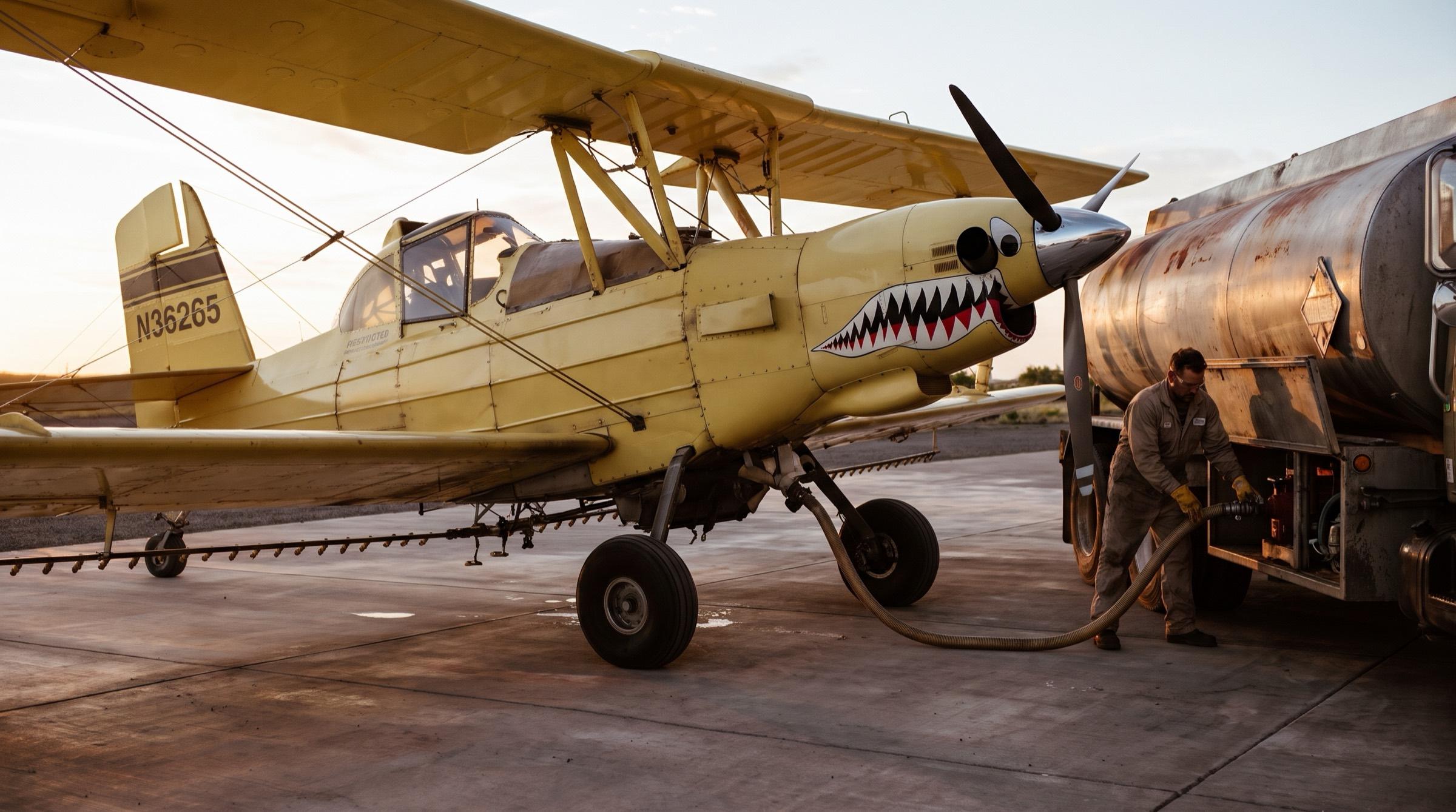
A gallons per acre calculator answers two questions before a spray job. How many acres does one load cover, and how much product goes in each load? This post gives the formulas, worked examples for an airplane load and a ground boom, and a unit check table.
All rates in this post are example numbers for the arithmetic. The product, the rate and the spray volume come from the pesticide label and your pest control adviser's (PCA) written recommendation. Never use a number from this page in place of the label.
What does gallons per acre mean on a pesticide label?
Gallons per acre (GPA) is the total volume of spray mix that goes on one acre. The mix is the water or other carrier plus all the products in the tank. The label rate is different. It is the amount of one product per acre, such as 16 fluid ounces or 2 pounds.
Many labels give a minimum spray volume, and some give separate minimums for ground and aerial work. Purdue Extension noted in January 2025 that some labels require 10 to 20 GPA for ground rigs and 5 GPA by air. In January 2026, Penn State Extension listed aerial minimums of 2 to 10 GPA for common corn and soybean herbicides. Two products in that table had no aerial label at all.
Our post on how to read a pesticide label shows where these limits appear. Read the label for your product, because the volume differs from product to product.
How many acres does one load cover?
Every gallons per acre calculator starts with acres per load. Divide the gallons in the load by the gallons per acre.
Acres per load = load gallons / GPA
Then divide the field acres by the acres per load, and round up.
Number of loads = field acres / acres per load
Example 1: a 630-gallon load at 10 GPA
Our Air Tractor 602 has a 630-gallon hopper. Suppose the label and the PCA call for 10 GPA.
630 / 10 = 63 acres per load
A 200-acre field needs 200 / 63 = 3.2 loads. So the job takes 3 full loads and a fourth, smaller load. The 3 full loads cover 189 acres. The last 11 acres need 11 x 10 = 110 gallons of mix.
The real load can be less than a full hopper. Air temperature, runway length and the weight of the mix can limit it on the day. Our post on how many acres a crop duster can spray explains these limits.
How much chemical per tank or per load?
Multiply the label rate per acre by the acres that the load covers. This is the core of every tank mix calculator and pesticide calculator.
Product per load = label rate per acre x acres per load
Water per load = load gallons - product gallons
Example 2: product for the 630-gallon load
Use an example label rate of 16 fluid ounces per acre. The load covers 63 acres, from Example 1.
63 x 16 = 1,008 fluid ounces
1,008 / 128 = 7.875 gallons of product
630 - 7.875 = 622.1 gallons of water and other tank partners
For the small fourth load, the math is the same. 11 acres x 16 = 176 fluid ounces, or 1.375 gallons of product, in 110 gallons of mix.
A dry product works the same way. At an example rate of 2 pounds per acre, the full load takes 63 x 2 = 126 pounds. A herbicide mix calculator follows the same steps for each product in the tank. Before you mix two or more products, test them in a jar test for tank mix compatibility.
How do you convert ounces, pints, quarts and pounds?
Labels give liquid rates in fluid ounces, pints or quarts per acre. They give dry rates in ounces or pounds per acre. Convert everything to one unit before you multiply.
| Unit | Equals |
|---|---|
| 1 US gallon | 4 quarts, 8 pints, or 128 fluid ounces |
| 1 quart | 2 pints, or 32 fluid ounces |
| 1 pint | 16 fluid ounces |
| 1 pound (dry weight) | 16 ounces (dry weight) |
| 1 imperial gallon | 1.20 US gallons |
A fluid ounce measures volume, and a dry ounce measures weight. Do not mix them up. Purdue Extension also warns that some spray drones use imperial gallons, so check which gallon your equipment shows.
The next table is a check table for the 63-acre load in Example 1. Use it to test your own spray calculator or spreadsheet.
| Example label rate per acre | Product per 63-acre load | Same amount in gallons or pounds |
|---|---|---|
| 8 fluid ounces | 504 fluid ounces | 3.94 gallons |
| 1 pint | 63 pints | 7.88 gallons |
| 1 quart | 63 quarts | 15.75 gallons |
| 4 ounces (dry) | 252 ounces | 15.75 pounds |
| 1 pound | 63 pounds | 63 pounds |
How do you calibrate a ground boom for gallons per acre?
A ground boom uses the 5,940 formula. The University of Kentucky Extension gives it in a 2019 calibration guide.
GPA = (GPM x 5,940) / (MPH x W)
GPM is the average flow of one nozzle in gallons per minute. MPH is the ground speed. W is the nozzle spacing in inches. The number 5,940 is a constant that converts the units.
To measure the speed, time the rig over a known distance. The same guide gives this formula:
MPH = (distance in feet x 60) / (time in seconds x 88)
Example 3: a boom with 20-inch nozzle spacing
Caution: wear the gloves and other protective equipment that the label requires before you catch output from a boom that has held pesticide. Calibrate with clean water.
- Fill the tank half full of clean water.
- Measure a course of 176 feet.
- Drive the course at a steady engine speed, and record the time.
- Repeat the run three times, and average the times.
- Catch the output of each nozzle for 1 minute.
- Average the nozzle catches in fluid ounces.
- Divide the average catch by 128 to get GPM.
- Calculate GPA with the 5,940 formula.
- Compare the result with the GPA on the PCA's recommendation.
Suppose the average time is 20 seconds. Speed = (176 x 60) / (20 x 88) = 10,560 / 1,760 = 6.0 mph.
Suppose the average catch is 38.4 fluid ounces. Flow = 38.4 / 128 = 0.30 GPM.
GPA = (0.30 x 5,940) / (6.0 x 20) = 1,782 / 120 = 14.85 GPA
To reach a target GPA, solve for the nozzle flow instead. For 15 GPA at 6.0 mph and 20 inches, GPM = (15 x 6.0 x 20) / 5,940 = 0.30. Change speed or nozzle tips for large changes. The Kentucky guide says to use pressure only for small adjustments.
A 300-gallon tank at 14.85 GPA covers 300 / 14.85 = 20.2 acres. At an example rate of 1 quart per acre, the tank takes 20.2 quarts, or 5.05 gallons, of product.
Gallons per acre calculator: the steps for any job
Use these steps for an aircraft load, a ground tank or a nurse tank.
- Get the PCA's written recommendation for the field.
- Read the label for the product rate and the minimum GPA.
- Write down the GPA for the job.
- Divide the load or tank gallons by the GPA for acres per load.
- Divide the field acres by the acres per load, and round up.
- Convert each label rate to one unit.
- Multiply each label rate by the acres per load.
- Subtract the product gallons from the load gallons for the water.
- Check each result against the check table.
- Write the numbers on the mix sheet before you load.
How Sutter Butte Dusters plans a spray load
We fly crop protection jobs in Sutter, Yuba, Butte, Glenn, Colusa, Placer and Yolo counties with five Ag Cats and one Air Tractor 602. See our aerial crop protection page for the work we do. Send us the PCA's recommendation with the product, the rate, the GPA and the acres, and we plan the loads. To time orchard sprays for navel orangeworm, codling moth or peach twig borer, use our free NorCal spray timing tracker. When the plan is ready, get a quote for your field.
Questions
Divide the tank gallons by the gallons per acre to get the acres one tank covers. Multiply that number by the label rate per acre. For example, a 300-gallon tank at 15 GPA covers 20 acres, so a 1-quart rate takes 20 quarts, or 5 gallons, of product.
The label sets the volume. Penn State Extension listed aerial minimums of 2 to 10 gallons per acre for common corn and soybean herbicides in January 2026. Purdue Extension noted that some labels call for 5 gallons per acre by air and 10 to 20 for ground rigs.
GPA equals nozzle flow in gallons per minute times 5,940, divided by ground speed in mph times nozzle spacing in inches. At 0.30 GPM, 6 mph and 20-inch spacing, the boom applies 14.85 gallons per acre. The number 5,940 converts the units.
One US gallon holds 128 fluid ounces, one quart holds 32 and one pint holds 16. A fluid ounce measures volume, while a dry ounce measures weight, so do not mix the two on a mix sheet. Some drones show imperial gallons, which equal 1.20 US gallons.
