
Field crops
Wheat stripe rust in California: scout early, spray on time
By the Sutter Butte Dusters team · · 9 min read
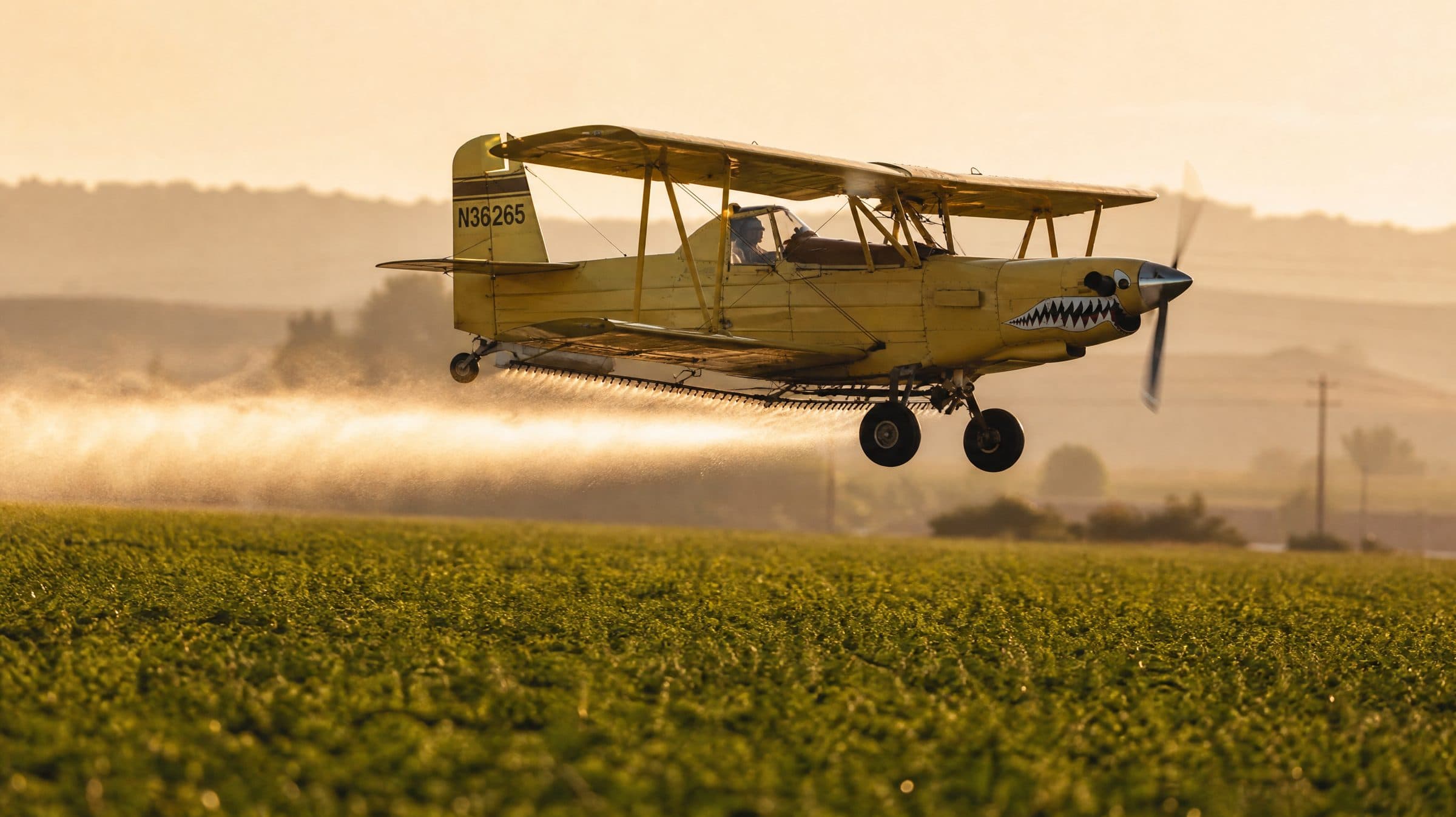
Wheat stripe rust is usually the first rust to appear in California wheat. On a susceptible variety, it can take a large share of the yield. It grows best in the cool, wet weather that the Sacramento Valley often has from February to April. This guide shows how to identify it, when to scout, and when a fungicide pays.
What is wheat stripe rust?
Wheat stripe rust is a fungal disease caused by Puccinia striiformis f. sp. tritici. Much of the world calls it wheat yellow rust. A separate strain of the fungus attacks barley. The fungus grows only on living plants, so it needs green host tissue between crops.
UC IPM states that this fungus caused some of the most damaging wheat epidemics in California (UC IPM: Stripe rusts of wheat and barley). UC farm advisors in Glenn, Colusa and Yolo counties report its return as a widespread, serious disease in 2003 (Munier, Schmierer and Brittan, 2012). The USDA ARS Cereal Disease Laboratory states that losses of 40 percent can be common.
UC IPM says the disease reduces the number and weight of kernels. The fungus also forms races. A race is a strain that can defeat some resistance genes but not others. The UC advisors report that new races overcame the resistance of new varieties within a few years of release.
How do you identify stripe rust?
Look for long, narrow lines of yellow-orange pustules between the leaf veins. A pustule is a small blister that breaks open and releases powdery spores. On older plants, the pustules form stripes. On young seedlings, they are often scattered. UC IPM notes that the fungus also infects the glumes, the papery bracts around each kernel.
Late in the season, the pustules turn dark and shiny as the fungus forms teliospores. For a quick field check, wipe a leaf with a white tissue. Fresh pustules leave a yellow-orange powder.
How is stripe rust different from leaf rust of wheat?
California wheat can carry three rusts, and they differ in timing and risk.
| Feature | Stripe rust (yellow rust) | Leaf rust (brown rust) | Stem rust (black rust) |
|---|---|---|---|
| Spore color | Yellow-orange | Reddish orange | Brick red |
| Pustule pattern | Long lines between the veins | Scattered or clustered on the upper leaf | Long pustules with ragged edges |
| Main location | Leaves and glumes | Leaves | Stems, also leaves and sheaths |
| Best temperature | 50 to 60 degrees F | 60 to 72 degrees F | Days 77 to 86 degrees F, nights 59 to 68 degrees F |
| Time of season | Early, before the other rusts | Late season | Warm weather |
| Importance in California | Major, with past epidemics | Losses in humid years with a cool late spring | Not significant, because common cultivars resist it |
Source: the UC IPM small grain guidelines for stripe rust (linked above), leaf rust and stem rust.
The UC advisors note that San Joaquin Valley growers do not treat leaf rust of wheat, because they consider it too late to cut yield. Stripe rust starts earlier and can reach the flag leaf before grain fill.
What is the stripe rust life cycle?
The stripe rust life cycle repeats many times in one spring.
- Survival. The fungus lives through summer on volunteer wheat, volunteer barley and some wild grasses.
- Spread. Wind carries the orange urediniospores between fields, and sometimes hundreds of miles.
- Infection. A spore needs free water on the leaf to infect it.
- Latent period. The USDA lab reports new spores about 11 days after infection at a mean daily 59 degrees F.
- Repeat. UC IPM reports a new cycle every 7 to 10 days under the best conditions.
UC IPM gives 50 to 60 degrees F with intermittent rain and dew as the fastest conditions. UCCE advisors in Tulare and Kings counties add fog to that list (UCCE small grains update). They also note that races now cause disease in warmer, drier weather than in the past.
With cycles of 7 to 11 days, mid-February to mid-April allows about five to eight generations. A few pustules on a volunteer plant in February can become a yellow field by April.
When does wheat stripe rust show up in the Sacramento Valley?
Most Sacramento Valley wheat goes in during the fall. Your dates move with the planting date, the variety and the weather.
| Month | Typical crop stage | What to do |
|---|---|---|
| November to December | Planting and emergence | Choose a resistant variety, and remove volunteer grain near the field |
| January to February | Tillering | Start to scout after mild, wet spells |
| March | Stem elongation to flag leaf | Scout every 7 days, and call your PCA at the trigger |
| Early April | Flag leaf to heading | Main fungicide window: protect the flag leaf |
| Mid-April | Late heading | Label cutoffs come near, and late sprays rarely pay |
| May | Grain fill and dry-down | No spray benefit; note which varieties rusted |
The April dates come from the UC spray trials below. In the 2012 drought, the wheat dried down on May 7, about three weeks earlier than normal.
How do you scout wheat for stripe rust?
Our guide to crop scouting covers general methods.
- Start in February, or in January after a mild, wet winter.
- Check the most susceptible variety on the farm first.
- Examine volunteer grain on field edges, ditch banks and roads.
- Walk a W pattern across the field, and stop at 10 or more places.
- At each stop, examine 10 plants from the lower leaves to the top leaf.
- Count the plants with one or more fresh, yellow-orange pustules.
- Record the variety, the growth stage, the date and the percent of plants infected.
- Repeat the check every 7 days while the weather stays cool and wet.
- Call your PCA when 10% of plants show rust, or at a hot spot (a patch of yellow plants).
The UCCE small grains update sets the 10% trigger and the hot-spot rule for weather that favors the disease.
When should you spray for stripe rust?
Protect the flag leaf. The flag leaf is the top leaf on the stem, and it feeds the grain during grain fill. UC IPM states that the goal of a fungicide is to protect the flag leaf and the plant through grain fill. The Munier, Schmierer and Brittan report summarizes 18 replicated UC trials from 2003 to 2012, plus two separate trials.
| Trial situation | Result |
|---|---|
| One application at the first sign of rust, at flag leaf or at heading | Same result at both timings: 132% to 140% of the untreated yield, a gain of 32% to 40% |
| Rust before flag leaf; applications at flag leaf and at heading | Yields averaged 222% of the untreated, in fields with severe rust |
| Separate trial: one application on April 16, the latest label timing, as rust started | No significant gain, although rust damaged 60% of the untreated flag leaves |
| Separate trial, 2012 drought: application on April 9, crop dry on May 7 | 15% yield gain |
| All trials | Test weight up 3 to 5 pounds per bushel |
The authors' trial slides give single-spray yields as a percent of the untreated plots, with the untreated plots set at 100. On susceptible varieties, the treatment more than paid its cost in five of six years. The exception was 2004, when heat and low humidity held the disease back.
If rust appears before the flag leaf, plan for a possible second application at heading. The April 16 result is one trial, but the authors conclude that a late enough infection does not cut yield.
Which fungicide groups does UC IPM list for stripe rust?
Fungicide choice belongs to your licensed pest control adviser (PCA). UC IPM lists four active ingredients. They come from FRAC Group 3 (DMI fungicides such as the triazoles) and Group 11 (QoI, the strobilurins). The Fungicide Resistance Action Committee (FRAC) 2026 code list rates Group 11 as high risk for resistance and Group 3 as medium risk.
| Active ingredient | FRAC group | REI | Last stage or harvest limit in the UC table |
|---|---|---|---|
| Azoxystrobin | 11 | 4 hours | Not after heading is complete (Feekes 10.5.4); no wheat grazing for 14 days; 7-day PHI for wheat hay or forage |
| Propiconazole | 3 | 24 hours | Until Feekes 10.5.4, the beginning of ripening; 7-day PHI |
| Propiconazole plus trifloxystrobin | 3 and 11 | 12 hours | Grazing and hay limits; 35-day PHI on wheat |
| Pyraclostrobin | 11 | 12 hours | Not after heading is complete (Feekes 10.5) on wheat; no hay for 14 days |
REI is the restricted-entry interval, and PHI is the preharvest interval. The table is not a recommendation. Rates come from the label and your PCA.
For California, UC IPM advises no more than one application of a high-risk group before you rotate to a different group. For other groups, it advises no more than two applications in a row. Our post on pesticide resistance explains why.
Caution: Read the label before you schedule the flight. Each label sets the last growth stage for application, and the label can change after UC updates its table. Always follow the label and your PCA's written recommendation.
Why fly fungicide on wheat in a wet spring?
Stripe rust weather is also wet-ground weather. The storms that spread spores in March and April keep many fields too soft for a ground rig. Our comparison of aerial spraying and ground rigs gives the published yield losses from wheel traffic.
Aerial application (crop dusting) puts no load on the soil and leaves no wheel tracks. With a 7 to 11 day cycle, a week of delay can mean one more generation of spores. An airplane covers many acres in one day, so a whole farm can get its flag-leaf spray inside the window. See how we work on row crops and grain.
How does wheat stripe rust resistance work?
Plant resistance is the first defense, and UC IPM lists resistant cultivars first. All-stage resistance, also called seedling resistance, works from emergence to harvest. It usually works against some races only, so a new race can defeat it. Adult-plant resistance develops as the plant grows, often by stem elongation. One form gets stronger as spring days warm, and it usually works against many races, so it lasts longer.
UC rates stripe rust in its statewide variety trials, with Yecora Rojo as the susceptible check. The 2021-22 UC variety report used three seasons of data, from 2019-20 to 2021-22.
| Multi-year rating | Entries named in the 2021-22 report |
|---|---|
| Susceptible | Yecora Rojo, WB Triple IV, WB Orita, WB Mohave, APB 510477 and UC Atrea, plus six barley entries |
| Moderately susceptible | WB 9699, Kronos, DPG FV 2808 and APB 471400 |
The same report names the top-performing Sacramento Valley varieties with no stripe rust susceptibility. In common wheat, they were WB 9215 and AP Octane, from 2020 to 2022 data. In durum, they were AS Maestrale and Tiburon, from 2022 data only. In triticale, the variety was UC Bopak.
Treat this list as a start, not as proof of resistance. Ratings change as races change, so use these rules when you choose varieties:
- Check the newest UC variety report before you order seed.
- Plant more than one variety, as UC advisors recommend, to limit the loss from a new race.
- Scout varieties rated moderately susceptible or susceptible first.
- Report heavy rust on a resistant variety to your farm advisor, because it can signal a new race.
Stripe rust and our work in the northern Sacramento Valley
We fly wheat, rye and other grain across Sutter, Yuba, Butte, Glenn, Colusa, Placer and Yolo counties from our base in Live Oak. We usually have a plane over the field within 24 hours of the call, weather permitting. We apply the product that your PCA recommends, before the label cutoff stage. Read about our crop protection flights, or get a quote for your wheat field.
Questions
Yes. Stripe rust and yellow rust are two names for the same disease, caused by the fungus Puccinia striiformis. Leaf rust, also called brown rust, and stem rust, also called black rust, are different diseases. Other Puccinia species cause them, and they have different colors, patterns and seasons.
Yes, but a different strain of the fungus attacks barley. UC IPM reports that barley stripe rust first appeared in California in 1993 and 1994, with major epidemics in 1996, 1997 and 1998. The barley strains also survive in warmer, drier climates than the wheat strains.
It can be. Some labels in the UC table stop at the completion of heading, so check the label first. In one UC trial, eight fungicide treatments at the latest label timing, April 16, gave no significant yield gain. Ask your PCA before you treat a late infection.
Leaf tissue that rust has already killed does not recover. A fungicide stops new infections and protects the flag leaf and new growth. In UC trials, one application at the first sign of rust gave 132 to 140 percent of the untreated yield. That is a gain of 32 to 40 percent.