
Crop nutrition
Foliar fertilizer: when spraying nutrients on the leaf works
By the Sutter Butte Dusters team · · 9 min read
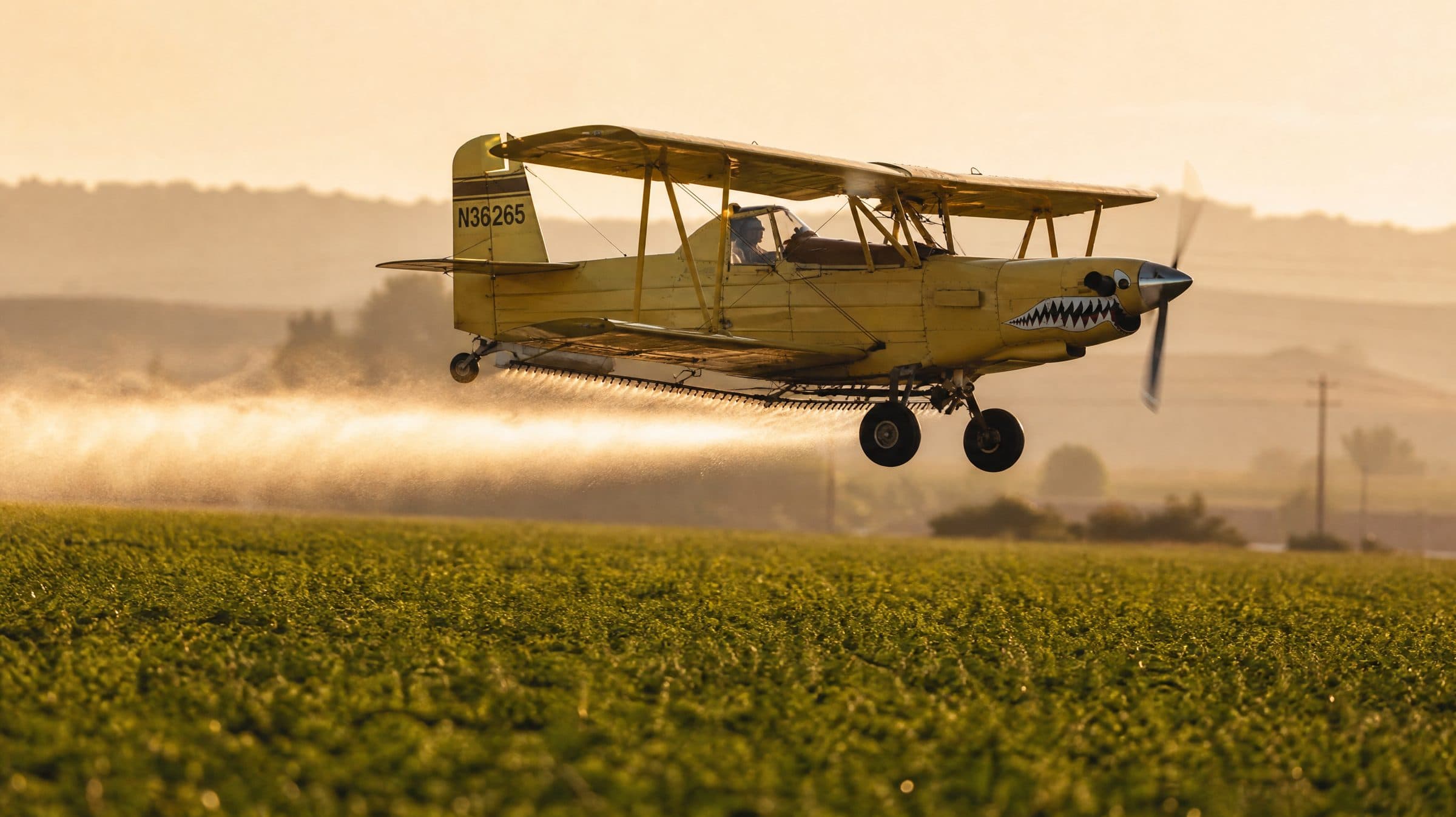
A foliar fertilizer is a nutrient solution that you spray on the leaves of a crop instead of on the soil. It corrects a few nutrients at a few crop stages, but it cannot replace a soil program. This guide gives the CDFA and UC rates for Sacramento Valley crops and shows how they change in an airplane.
How does a leaf take in nutrients?
Foliar feeding (the application of nutrients to the leaves of a plant) works through the leaf. Dissolved nutrients pass through the waxy outer layer (the cuticle) and through small pores. A leaf takes in only a small dose at one time, because the spray dries or runs off.
Uptake speed depends on the nutrient. In a study on mature Nonpareil almonds, the trees took up 85% of a urea spray within 24 hours (CDFA almond fertilization guidelines).
Movement inside the plant also matters. Boron moves inside almond trees, so a fall spray reaches the next spring's flower buds. In walnut and pistachio, boron does not move this way, per the same CDFA guidelines. A UC Cooperative Extension grape paper by Peter Christensen calls iron the hardest nutrient to correct with a spray. The iron stays where it lands.
Does foliar feeding actually work?
Yes, for micronutrients. A crop needs zinc, boron and manganese in small amounts, so a leaf can absorb enough to correct a shortage. Most soils also lock up zinc, manganese and iron, per the UC grape paper.
For the major nutrients, the answer is usually no. A crop needs nitrogen, phosphorus and potassium in large amounts, and a leaf absorbs only a little per spray. In processing tomatoes, one urea spray supplies only about 5 pounds of nitrogen per acre, per CDFA.
| Nutrient | Does a leaf spray work? | What the research shows |
|---|---|---|
| Zinc | Yes | The usual spray for a zinc shortage in prunes, peaches and grapes. |
| Boron | Yes, at the right stage | In almonds, hulls under 80 ppm boron show a shortage that a soil application corrects best. Trees with 80 to 120 ppm may benefit from a postharvest spray. |
| Manganese | Yes | The UC grape paper reports 2 to 3 pounds of manganese sulfate per 100 gallons corrects a shortage. |
| Iron | Poorly | Needs repeat sprays and often leaves green spots on yellow leaves. |
| Nitrogen (urea) | As a supplement only | Can raise wheat grain protein. Gives no consistent yield gain in well-fed almonds, prunes or processing tomatoes. |
| Potassium | Rarely, except in prunes | A north Sacramento Valley prune study matched a soil program with four sprays a year. A walnut study found no benefit. |
| Phosphorus | Rarely | Can supplement soil phosphorus in wheat, but cannot replace it. |
| Calcium | Case by case | Used for some fruit disorders, such as bitter pit in apples. UC grape trials found no effect on waterberry. |
Before you spray, our guide to nitrogen deficiency in crops shows how to tell a nitrogen shortage from other problems.
Which nutrients do Sacramento Valley growers spray, and when?
Timing decides whether a leaf spray pays. The table gives the published timing and rate per acre for the main local crops.
| Crop | Nutrient | Timing | Published rate |
|---|---|---|---|
| Walnuts | Zinc | Spring, at 6 to 10 inches of shoot growth, if last year's leaf analysis showed a shortage | No rate given; ask your adviser |
| Prunes | Potassium nitrate | Every 2 to 3 weeks, from late April or early May through July | 20 to 30 lb in 100 gal; about 100 lb a season |
| Prunes | Zinc, spring | Before leaves reach full size, no later than mid-May | 3 to 5 lb zinc oxide or basic zinc sulfate per 100 gal |
| Prunes | Zinc sulfate, fall | At the start of normal leaf drop | 10 to 15 lb in 100 gal; 20 to 25 lb maximum |
| Peaches | Zinc sulfate | Mid- to late October | 10 to 50 lb in 50 to 100 gal |
| Almonds | Boron | After harvest, well after hull split, while the leaves are still active | 0.2 to 0.4 lb boron in 100 gal |
| Wheat | Nitrogen (UAN or urea) | At flowering or in the 2 weeks after, for grain protein | 30 lb nitrogen as UAN gave the best protein in one cited study |
| Processing tomatoes | Nitrogen | Only to correct a late shortage in furrow-irrigated fields | 4 to 6 lb urea nitrogen per 100 gal |
The walnut timing comes from the UCCE Sutter-Yuba walnut newsletter (April 2026). The other rows come from the CDFA fertilization guidelines for each crop.
For almonds, the hull sample at harvest decides the boron spray. The CDFA almond guidelines say that a boron spray at early or full bloom does not work and can reduce nut set. Boron sprayed before hull split moves into the hulls and leaves the orchard with the crop. More than 0.4 to 0.6 pounds of boron per acre in 100 gallons may reduce fruit set.
Prunes are the clearest case for a potassium spray. Southwick and coworkers ran a 3-year study in a potassium-deficient north Sacramento Valley orchard. Four sprays a year of 25 pounds of potassium nitrate per acre matched a fall soil application of 600 pounds of potassium chloride. The two programs gave the same yield, fruit quality and July leaf potassium (CDFA prune fertilization guidelines).
The prune guidelines also set limits on that spray. In hot weather, use no more than 25 pounds of potassium nitrate per 100 gallons per acre. When zinc is in the same tank, use no more than 10 pounds.
Fall zinc sulfate on prunes can speed up leaf drop when the orchard is still irrigated or after rain. The CDFA prune guidelines say to keep oil sprays at least 30 days away from a zinc sulfate spray. They also say to skip a spring zinc spray if rain is forecast within 48 hours, because rewet leaves can take up too much zinc.
Which types of foliar fertilizers are there?
Foliar products fall into six groups.
| Type | Examples | What to know |
|---|---|---|
| Single-element salts | Zinc sulfate, manganese sulfate, magnesium sulfate, potassium nitrate, soluble borate | Most UC and CDFA trials use these materials. |
| Urea | Low-biuret urea | Biuret is a by-product in urea that can damage small shoots. A low-biuret grade reduces the risk. |
| Nitrogen solutions | UAN (urea ammonium nitrate) | Urea burns wheat leaves less than ammonium nitrate or ammonium sulfate. |
| Chelates | Zinc EDTA, iron chelates | The UC grape paper found no advantage for chelated zinc over neutral zinc or zinc oxide, at a higher cost. |
| Blends and NPK liquids | Mixed micronutrient products, complete liquid fertilizers | Usually only one nutrient is short, and a blend holds too little of it to correct the shortage. |
| Seaweed and biostimulants | Kelp extracts | Sold mainly as growth aids, not as a measured nutrient dose. Test them on check strips. |
The UC grape paper gives a simple rule. First find the one nutrient that is short with a tissue test. Then spray that nutrient alone, in an inorganic form. Iron is the exception, and growers usually apply it as a chelate.
What are the disadvantages of foliar fertilizer?
A leaf spray has six main limits:
- Small doses. A correction can take several trips. The prune potassium program above needs four sprays a year.
- Leaf burn. In almonds, 0.5% urea caused no visible damage, while 1% caused slight tip injury. The CDFA prune guidelines report that spring urea sprays of 1.8% or more damaged stone fruit leaves. After harvest, 4 to 5% low-biuret urea went on safely.
- Heat. The CDFA wheat guidelines say that foliar UAN above 80 degrees F is likely to cause considerable leaf burn and some yield loss.
- Short effect. A fall boron spray in almonds lasts one season, so growers repeat it each year.
- Spoiled leaf samples. Zinc stays on the leaf surface. The CDFA peach guidelines say a leaf analysis is not useful after a zinc spray earlier that season.
- Tank-mix risk. The UC grape paper reports that some pesticides caused more crop injury when growers added foliar nutrients.
Early morning is not always best. The CDFA wheat fertilization guidelines say that dew raises the risk of nitrogen burn, because the leaves stay wet longer. Fast drying in dry weather may reduce the risk. Pick mild temperatures, dry leaves and a forecast with no rain.
How does an airplane apply a foliar fertilizer spray?
An aerial foliar job is a regulated flight. Federal rules define an agricultural aircraft operation to include the release of any substance for plant nourishment (14 CFR 137.3). A fertilizer flight therefore falls under the same FAA Part 137 rules for operators as a pesticide flight.
Water volume is the main difference between air and ground. Most CDFA orchard rates assume 100 gallons of water per acre. An airplane carries far less, and the label sets the minimum aerial volume. The same pounds of nutrient in less water make a stronger mix.
A worked example shows the scale. Ten pounds of nitrogen as urea is about 22 pounds of urea. One gallon of water weighs 8.34 pounds.
| Water per acre | Urea per acre | Approximate strength |
|---|---|---|
| 100 gallons | 22 lb | 2.6% |
| 20 gallons | 22 lb | 13% |
| 10 gallons | 22 lb | 26% |
At 10 gallons, the mix is far stronger than the 4 to 5% that the prune guidelines report as safe after harvest. The fix is a lower rate per acre or more water. The UC grape paper also found more zinc uptake from dilute sprays than from concentrate sprays. Ask your adviser to set the rate for the aerial water volume, and follow the label's aerial directions.
Wheat has one published aerial limit. The CDFA wheat guidelines say aerial UAN or foliar urea can go on with MCPA or dicamba, two broadleaf herbicides. In that tank mix, the rate should not exceed 25 pounds of nitrogen per acre. The guidelines give no separate aerial limit for a protein spray at flowering. Our comparison of aerial spraying and ground rigs covers the other trade-offs.
Many growers add a nutrient to a fungicide or insecticide flight. When a pesticide is in the tank, the pesticide label and your licensed pest control adviser's (PCA) written recommendation control the job. The CDFA prune guidelines say that adjuvants increase zinc uptake and may cause leaf burn, so the zinc rate may need to drop. Our guide to spray adjuvants explains the product types.
How do you plan a foliar fertilizer application?
- Take a leaf, petiole or hull sample at the stage that UC sets for your crop.
- Check the soil, because many shortages start there. See our guide to soil sampling.
- Find the one nutrient that is short.
- Choose a single-element product for that nutrient.
- Read the label for foliar use, aerial directions and the minimum water volume.
- Get the rate from your adviser for the actual water volume per acre.
- Caution: some mixes form a sludge or injure the crop. Do a jar test before you mix a nutrient with a pesticide.
- Leave a few untreated check strips, repeated across the field.
- Schedule the flight for mild temperatures, dry leaves and no rain in the forecast.
- Record the product, rate, water volume and date.
- Keep sprayed leaves out of the next tissue sample.
- Compare the check strips with the treated rows at harvest.
Foliar nutrients in the northern Sacramento Valley
We apply dry and liquid fertilizer by air in Sutter, Yuba, Butte, Glenn, Colusa, Placer and Yolo counties. Leaf sprays fit the crops we fly, from zinc in walnuts and prunes to late nitrogen in wheat. Send us the product label, your adviser's rate per acre and the water volume, and your timing window. Read more about our aerial fertilizer application and orchard work, or get a quote for your field.
Questions
Uptake starts within hours for some nutrients. In a study cited by the CDFA almond guidelines, mature almond trees absorbed 85% of a urea spray within 24 hours. Iron is the slow case: it tends to stay where it lands on the leaf, so iron sprays often need repeats.
Not for most nutrients. The soil supplies the large amounts of nitrogen, phosphorus and potassium that a crop needs. A leaf spray is a supplement, or a fix for zinc and other micronutrients that the soil locks up. UC trials found no consistent gain from foliar nitrogen in well-fed almonds and tomatoes.
Often, but check first. The pesticide label and your PCA's written recommendation control the tank mix. Do a jar test for compatibility. A UC grape paper found that some pesticides caused more crop injury when growers added foliar nutrients, so add a nutrient only when the crop needs it.
Usually not in a crop with adequate soil fertility. In a two-year California almond study, up to three spring sprays of N, P and K combinations gave no consistent change in kernel yield or leaf nutrient levels. A leaf absorbs too little of these nutrients to matter.