
Pest management
Crop scouting: how to check a field before you spray
By the Sutter Butte Dusters team · · 9 min read
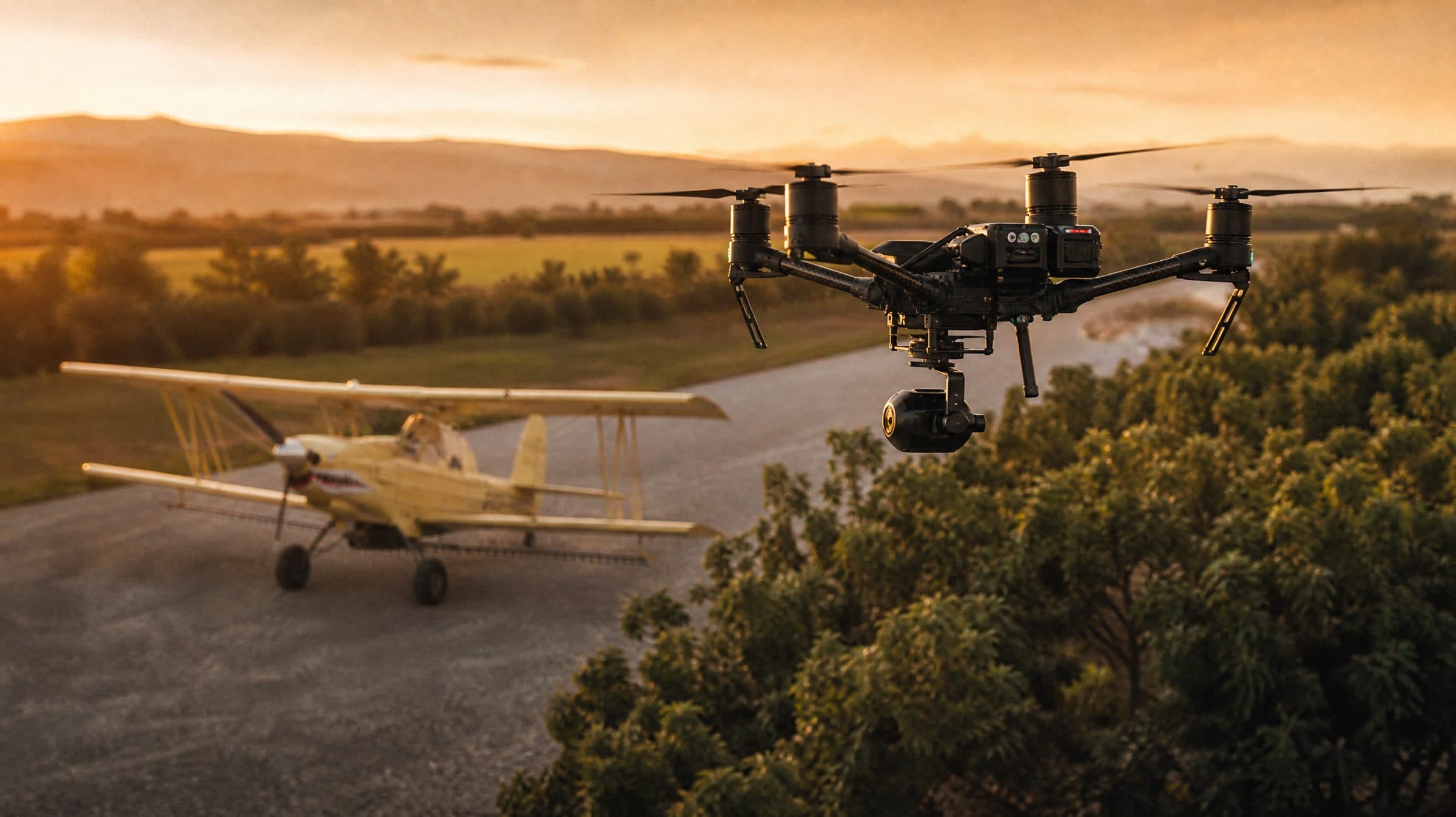
Crop scouting is a planned walk through a field to find pests, disease, weeds and crop stress, and to measure them. The counts tell you and your pest control adviser (PCA) whether a spray will pay, and when. This guide gives a procedure, sampling patterns, UC IPM thresholds, a report template and a Sacramento Valley calendar.
What does a crop scout look for?
A scout compares the field with a normal crop at the same growth stage. Signs include off-color leaves, chewed edges, stippling, wilt, stunted plants, stand gaps and odd patterns.
A scout records five groups of information on every visit:
- The crop. Growth stage, stand and general vigor.
- Insects and mites. The pest, its life stage, and the count per leaf, plant, sweep or trap.
- Natural enemies. Predators and parasites that can hold a pest under the threshold.
- Disease and weeds. The symptom, the species, and how much of the field shows it.
- Conditions. Weather, irrigation, water depth in rice checks, and recent field work.
The pattern of a problem is often the best clue. Damage in straight lines or at regular widths points to equipment, drift or fertilizer. Damage in patches that spread points to insects or disease.
Why is scouting important in agriculture?
Scouting turns a guess into a decision. An action threshold is the pest count or damage level at which control costs less than the loss it prevents.
The importance of scouting in agriculture shows in five places:
- Fewer sprays. You treat only the areas that pass a threshold.
- Better timing. Many treatments work only on one life stage, such as newly hatched larvae.
- Natural enemies survive. An unnecessary spray can kill predators and cause a mite outbreak.
- Slower resistance. Each unnecessary spray selects for pests that survive it.
- A record for the law. In California, each PCA recommendation must state the criteria used to decide that the treatment is necessary (3 CCR section 6556).
Scouting is the monitoring step of integrated pest management.
What tools does a scout need?
Most of the kit fits in a vest. Add crop-specific tools for each field.
| Tool | Use |
|---|---|
| Phone or tablet with GPS | Notes, photos and the location of each stop |
| Hand lens | Mites, eggs, small insects and disease lesions |
| Sweep net | Insects in grain, hay and other dense crops |
| Sample bags, vials and a cooler | Plants and insects for identification |
| Knife and trowel | Split stems and nuts; dig roots |
| Flagging tape | Mark hot spots for the next visit |
| 1-square-foot frame | Rice seedling counts and damaged panicle counts |
| Seine with 1/8-inch mesh | Tadpole shrimp on the soil of a flooded check |
| Pheromone and sticky traps | Moth and fly flights in orchards and tomatoes |
Take a sample of an unknown pest to your PCA or your UC Cooperative Extension farm advisor. Report a new or unusual pest to the county agricultural commissioner or the CDFA Pest Hotline.
How do you scout a field before you spray?
Plan the route before you enter the field. A fixed procedure lets you compare this week's counts with last week's.
Caution: Do not enter a treated field before the restricted-entry interval (REI) on the label ends. Our guide to reading a pesticide label shows where to find the REI.
- Read the notes and the trap counts from the last visit.
- Check the field history for pests, weeds and problem areas.
- Look at the whole field from the edge, a vehicle or a drone image.
- Mark unusual areas on the map, and add them to the route.
- Choose a sampling pattern that crosses the whole field, from a new entry point.
- Stop at the planned points and examine the plants.
- Count pests, natural enemies and damage at each stop.
- Take photos and samples of anything that you cannot identify.
- Compare the totals with the UC IPM threshold for the crop and stage.
- Send the report to your PCA on the same day.
After a treatment, scout the field again to check the result.
Which sampling pattern should you use?
The pattern must cover the whole field, or each part of the field that you could treat separately. Do not sample only the edge rows, unless the pest starts at the edge.
| Pattern | Best fit | How it works |
|---|---|---|
| W or Z walk | Wheat, row crops, tomatoes | Five or more stops on a zigzag path across the field |
| Transect with stops | Rice checks | A straight line with a stop every 5 to 10 feet |
| Tree sample | Orchards | A fixed number of trees in each sampling area |
| Hot-spot check | Mites, weeds, wet spots | Known problem areas, checked first |
| Trap line | Moths and flies | Traps at set spacing, checked on a set schedule |
What are the UC IPM thresholds for local crops?
UC IPM gives a sample size and a decision rule for many local pests. Use the exact sample size, because each threshold depends on it.
| Pest and crop | Sample | UC IPM decision rule |
|---|---|---|
| Rice armyworm, late June to early July | 10 stops, 5 to 10 feet apart, in each injured area | Over 25% defoliation, with armyworms present |
| Rice armyworm, panicle emergence to maturity | 1 square foot at each of 10 stops | 10% or more damaged panicles, with true armyworms present |
| Almond webspinning spider mites | 15 leaves on each of 5 trees per sampling area | With predators: 27 or fewer leaves with mites, no treatment; 40 or more, treat. Without predators: 12 or fewer, no treatment; 24 or more, treat |
| Processing tomato fruitworm | Leaf below the highest open flower, 30 plants | 3 or more eggs: sample 30 more leaves. 5 or more in that sample: treat at egg hatch |
| Almond navel orangeworm, winter | Mummy nuts on 20 trees per block, by January 15 | Sacramento Valley target: fewer than 2 mummies per tree |
Sources: the UC IPM guidelines for rice armyworm, almond spider mites, tomato fruitworm and almond navel orangeworm.
For mites, record only whether each leaf has pest mites or predators. A total between the two numbers means that you sample more trees, up to 20 on the UC IPM form. In rice, if you find damage but no larvae, check again in the evening, when they are more active. UC IPM says not to spray if you still find none.
In Sacramento Valley tomatoes, small wasps parasitize many fruitworm eggs in late August and September, and most parasitized eggs turn black. UC IPM gives an adjusted threshold for black and white eggs. A field can pass the plain egg count and still not need a spray.
When should you scout crops in the Sacramento Valley?
UC IPM asks for weekly or more frequent checks for many pests in season, as the table shows. Dates move with the weather, so follow traps, degree-days and crop stage.
| Month | Crop | What to check |
|---|---|---|
| By January 15 | Almonds | Mummy nuts on 20 trees per block |
| February to April | Wheat | Wheat stripe rust, weekly in cool, wet weather |
| Early March | Walnuts | Hang codling moth traps at bud break |
| By March 15 | Almonds | Navel orangeworm egg traps, 1 per 10 acres or at least 4 per orchard |
| March and April | Almonds | Leaffooted bug: dropped nutlets, gummy nuts and the bugs |
| April to May | Rice | Tadpole shrimp and stand counts after the flood; weevil feeding scars |
| May to August | Almonds | Spider mites at least weekly; hot spots first until July 1 |
| By June 1 | Walnuts | Walnut husk fly traps, 2 or more per 10 acres, checked at least twice a week |
| Late June to early July | Rice | Armyworm defoliation, twice a week once damage appears |
| July to harvest | Processing tomatoes | Tomato fruitworm moths in July traps; egg samples once moths fly and many green fruit are 1 inch across |
| Panicle emergence to maturity | Rice | Armyworm damage to panicles; weedy rice at heading |
Each pest link opens our guide, with its UC IPM source.
What goes in a crop scouting report template?
A good report lets a PCA decide without a second visit. Use the same form for every field and every week.
| Entry | What to record |
|---|---|
| Field | Grower, field name, APN or FSA farm and tract number |
| Visit | Date, start time and scout name |
| Weather | Air temperature, wind speed and direction, sky |
| Crop | Variety, growth stage, stand and water depth |
| Method | Pattern, number of stops and sample size |
| Pests | Species, life stage and count at each stop |
| Natural enemies | Species and count |
| Damage | Percent defoliation, damaged fruit or damaged panicles |
| Weeds and disease | Species, crop stage and percent of field |
| Threshold | The UC IPM value, and whether the count passed it |
| Next step | Sent to PCA, re-check date, or no action |
| Attachments | Photos, GPS points and a map of hot spots |
Print this checklist and keep it with the form:
- Last report and trap counts in hand
- Pattern chosen and route changed from the last visit
- Same sample size as the last visit
- Natural enemies counted, not only pests
- Hot spots flagged and mapped
- Report sent to the PCA on the day of the visit, even when you find no problem
Can crop scouting drones replace a field walk?
Drones find problems fast, but they do not replace the count on the ground. A multispectral camera maps plant vigor and shows weak areas, stand gaps and wet spots.
A drone cannot count mite eggs on a leaf underside or name an insect species. Use the map to choose where to walk, then confirm each weak area on foot.
Crop scouting drones fit large fields and fields that are hard to walk, such as flooded rice checks. Our drone data service gives multispectral crop health maps, plant population counts and field topography.
To fly a drone under 55 pounds for work, a pilot needs an FAA Remote Pilot Certificate under Part 107. The pilot must be at least 16 years old (FAA Part 107 guidance). A drone that sprays a pesticide needs more than that, as our guide to FAA Part 137 explains.
What happens after the scout finds a problem?
A count over the threshold starts a decision, not a spray. If a treatment is necessary, the PCA writes a recommendation. Under 3 CCR section 6556, it lists the acres, the rate per acre, the label intervals and the criteria for the treatment.
Treat only the area that needs it. UC IPM tells rice growers to limit an armyworm treatment to the parts of the field with economic damage. The scout's hot-spot map shows those parts to the applicator.
For an aerial job, our guides to hiring a crop duster and to preparing a field for aerial application list what the operator needs. Mark power lines, homes, bee yards and the treatment area on the same map.
Are there crop scouting jobs in California?
Yes. PCA firms, farm supply companies, large farms, crop consultants and research projects hire seasonal scouts and field technicians.
A scout collects data. In California, a person who advises on agricultural pesticide applications needs a Pest Control Adviser license from DPR. The license requires approved college courses and examinations (DPR licensing). Scout work builds the pest identification skills that a PCA needs.
People who apply pesticides need a different license, as our California pesticide applicator license guide explains.
How scouting connects to our work in the northern Sacramento Valley
We fly crop protection, seeding and fertilizer from Live Oak across Sutter, Yuba, Butte, Glenn, Colusa, Placer and Yolo counties. A good scouting report tells us the crop stage, the treatment area and the hazards before the plane leaves the strip. Most of our crop protection flights are from May to August. With five Ag Cats and one Air Tractor 602, we usually have a plane over the field within 24 hours of your call. When your PCA's recommendation is ready, get a quote for your field.
Questions
Many UC IPM guidelines call for weekly checks in the season, and more often near a threshold. For example, UC IPM asks almond growers to check mites at least weekly from May to August, and rice growers to check armyworm damage twice a week once it appears.
The W pattern is a zigzag walk that crosses the field in the shape of the letter W. The scout stops at five or more points along the path. The pattern samples the middle and both sides of the field, not only the edge rows near the road.
It depends on the pest. In rice, UC IPM says that if you find few armyworms, you should check again in the evening, when the larvae are more active. For routine counts, scout at the same time on each visit, so that the counts stay comparable.
A crop scout walks fields on a schedule and records the crop stage, pest counts, natural enemies, weeds, disease and damage. The scout gives this report to a pest control adviser (PCA). In California, the licensed PCA, not the scout, writes any pesticide recommendation.