Ag pilot careers
Agricultural pilot jobs: how new pilots land a first season
By the Sutter Butte Dusters team · · 9 min read
Many agricultural pilot jobs never reach a public job board. An ag operator (a business that holds an FAA agricultural aircraft operator certificate) usually fills a seat with a person it already knows. This guide shows where to find openings, what operators and insurers check, and how to judge an operator before you sign.
Where are agricultural pilot jobs posted?
Few seats open each year, because most ag operations are small. The National Agricultural Aviation Association (NAAA) found an average of 2.17 pilots and 2.3 aircraft per operation in its 2019 industry survey. So many crop duster pilot jobs go to people whom the operator already knows.
The table lists the main channels, with the most useful one first. The NAAA facts in the table come from the NAAA career page.
| Channel | What you find there | Notes |
|---|---|---|
| Ag operators near you | The owner or the chief pilot, in person | Visit in the winter. |
| NAAA Job Board | Pilots who want work and operators who want pilots | Members only |
| NAAA Online Directory | Contact details for operators and pilots | Members only |
| Ag Aviation Expo | Operators from across the country, and Compaass Rose sessions for new pilots | NAAA's annual convention |
| State ag aviation conventions | Operators in your region | In California, the California Agricultural Aircraft Association convention |
| General job boards | Some aerial applicator jobs and aerial application jobs | Call to confirm that the seat is still open. |
How do you find ag pilot jobs near me?
In California, start with the state lists of licensees. The DPR lists of licensees sort businesses and people by county, based on the address on the license. The list of people marks each journeyman pilot certificate (JPC) and apprentice pilot certificate (APC). A county with several pilot certificate holders likely has aerial work nearby.
What do operators and their insurers check?
An operator checks your papers first and your judgment second. Under 14 CFR 137.41, each pilot in command must show the operator, or its chief supervisor, the knowledge and skill that 14 CFR 137.19(e) lists. Under 14 CFR 137.71, the operator records your name, address, certificate number and the date of that check. Expect the operator to ask for these items:
- Your FAA commercial pilot certificate
- At least a second-class medical certificate, which commercial pilot privileges require (14 CFR 61.23)
- A tailwheel endorsement in your logbook (14 CFR 61.31(i)), because the Ag Cat and the Air Tractor both have a tailwheel
- Your logbook, with total, tailwheel, piston, turbine and ag time
- In California, a DPR apprentice or journeyman pilot certificate, or the date of your DPR exams
The operator's aviation insurer must also accept you, and its minimums can be higher than the FAA minimums. In a 2009 NAAA article, Insuring New Ag Pilots, an NAAA Insurance Committee member described the problem. He wrote that an underwriter will rarely insure a 250-hour commercial pilot alone in an ag plane. The same underwriter will often accept that pilot under the direct supervision of an operator with a long, safe record.
The article gives a step plan that underwriters like. Start in a lower-value aircraft with seed and fertilizer work. Then move to insecticides and fungicides, then to herbicides, and later to a turbine. The author also wrote that most underwriters insist on PAASS, the industry's yearly safety program.
At an NAAA session in 2009, an underwriter named the most important factor for a new pilot. It was the operator's relationship with the insurer, and how long the insurer had covered that operator. He also valued time at an ag flight school and the maturity of the pilot. NAAA reported the session in its 2010 article on the search for new ag pilots. So the operator you choose also affects whether an insurer will accept you.
What does the first season look like for a new ag pilot?
Expect more ground work than flight time. NAAA says that your first few years may include little flight time. You may mix loads, fuel aircraft and help with maintenance while you learn the trade. NAAA tells new pilots to plan on a few seasons on the ground. Our guide to the crop duster loader job describes that work.
California adds three rules to a first season. The first two come from the DPR Pest Control Aircraft Pilot Certificate packet (revision 7/24).
- An apprentice pilot does pest control only under the direct supervision of a journeyman pilot (3 CCR 6540(b)).
- Before any work, the pilot registers with the agricultural commissioner in each county of work. Most counties charge a fee, and the registration covers one calendar year.
- Before a worker handles a pesticide, the employer gives handler training under 3 CCR 6724 and repeats it each year. The rule treats a person with a DPR apprentice pilot certificate as trained.
What does a new pilot do in week one?
The order changes from one operator to the next, but most of these items appear in the first week.
Caution: Do not fly pest control work in California before you hold the DPR certificate and each county registration.
- Show your FAA certificate, medical certificate and logbook to the operator.
- Complete handler training if you will handle pesticides on the ground.
- Register with the agricultural commissioner in each county where you will work.
- Study the field maps, the hazard lists and the operator's procedures.
- Fly the aircraft checkout with the chief pilot or a journeyman pilot.
- Show your Part 137 knowledge and skill to the operator or its chief supervisor.
- Load, fuel and clean the aircraft with the ground crew.
When does the season run in the Sacramento Valley?
In the northern Sacramento Valley, the season runs about March to September. At our base, most of the work comes from May through July.
| Job | Typical months |
|---|---|
| Rice seeding | April to May |
| Fertilizer | April to July |
| Herbicide | May to June |
| Fungicide and insecticide | June to August |
The calendar fits the insurer's step plan, because seed and fertilizer work comes first. Our crop dusting season calendar gives more detail.
How can you judge an ag operator before you sign?
Choose the operator as carefully as the operator chooses you. NAAA says that your first mentor will most likely be your employer. Examine these six areas before you accept an offer.
| Area | What to examine | A good sign |
|---|---|---|
| Aircraft | The type, the engine, the hopper size and the aircraft that a new pilot flies first | A clear plan to move a new pilot from simple work to larger aircraft |
| Maintenance | Who inspects and repairs the fleet, and where | An A&P (airframe and powerplant) mechanic on the field, with written inspection records |
| Loaders | How many loaders each aircraft has, and how product gets to the hopper | Trained handlers, a clean mix area and a set procedure for each load |
| Schedule | The start time, the wind limits, the days off in season and any work after the season | Wind limits that the operator does not change for a customer |
| Pay model | Percent of billing, per acre, salary, day rate or a mix | All terms in writing before the season starts |
| Papers | The FAA Part 137 certificate, the DPR business license and the county registrations | The operator shows them without delay |
You can check some papers yourself. A business must hold an FAA agricultural aircraft operator certificate to do ag aircraft work (14 CFR 137.11). The DPR lists of licensees show each current pest control business license. Our guide to crop duster pilot salary explains each pay model and the pay questions to ask.
What questions should you ask in an ag pilot interview?
An ag pilot interview goes both ways. The operator decides whether to trust you with an aircraft, a product and a grower's crop. Do not open with pay. In the 2010 NAAA article, one Iowa operator said that he gets 20 to 50 calls a year from people who want in. He said that 80 percent of the time, the first question is about money.
The operator will likely ask about these topics:
- Your total, turbine and piston hours
- The states where you hold a license
- Your PAASS attendance and your experience with GPS swath guidance
- Whether you will work a season on the ground
- Whether you will stay for more than one season
The first three topics come from the NAAA pilot form in the 2010 article. The insurance article says that an operator can fairly expect a new pilot to stay a while, so the operator can recover its cost.
Ask the operator these questions:
- Who will supervise me as an apprentice, and how?
- Which aircraft will I fly first, and when?
- Will I fly seed and fertilizer before pesticides?
- What does your insurer require of a new pilot?
- How do you mark power lines, towers and other hazards on the field maps?
- Who decides that the wind is too strong to fly?
- What did your last new pilot do in the first season?
What does an ag pilot job description include?
Use this sample ag pilot job description to compare postings. It is not a Sutter Butte Dusters job posting.
Job title: Agricultural pilot (aerial applicator)
Season: Spring and summer
Duties:
- Review each work order, field map and hazard list before the flight.
- Survey the field and the area around it before you start the work.
- Check the wind and the weather, and stop work when conditions pass the limits.
- Fly the application at the rate and the pattern on the work order.
- Follow the pesticide label and the written recommendation of the pest control adviser (PCA).
- Report the material and the quantity for each job, for the operator's records.
- Help load, fuel and clean the aircraft.
- Complete 20 hours of DPR continuing education every 2 years, as the DPR pilot packet requires.
Requirements:
- FAA commercial pilot certificate and a second-class medical certificate
- Tailwheel endorsement
- DPR apprentice or journeyman pest control aircraft pilot certificate
- Registration with the agricultural commissioner in each county of work
- Approval by the operator's insurer
Preferred:
- One or more seasons of ground work as a loader
- PAASS attendance
- Experience with GPS swath guidance
How do you apply for agricultural pilot jobs?
Apply in the winter, before operators set their crews for the season. If you still need your certificates, start with our ag pilot training guide. Then use these steps.
- Pass the DPR exams for the apprentice pilot certificate before you apply.
- Write a one-page résumé with your total, tailwheel, piston, turbine and ag hours.
- Make a list of the operators within driving distance.
- Visit or call each operator between November and February.
- Offer to work your first season on the ground.
- Attend your state convention and the Ag Aviation Expo to meet operators.
- Follow up each month with a short call or note.
NAAA tells new pilots to get the applicator license early to show commitment. For all the roles on an ag crew, read our overview of crop dusting jobs.
Agricultural pilot jobs at Sutter Butte Dusters
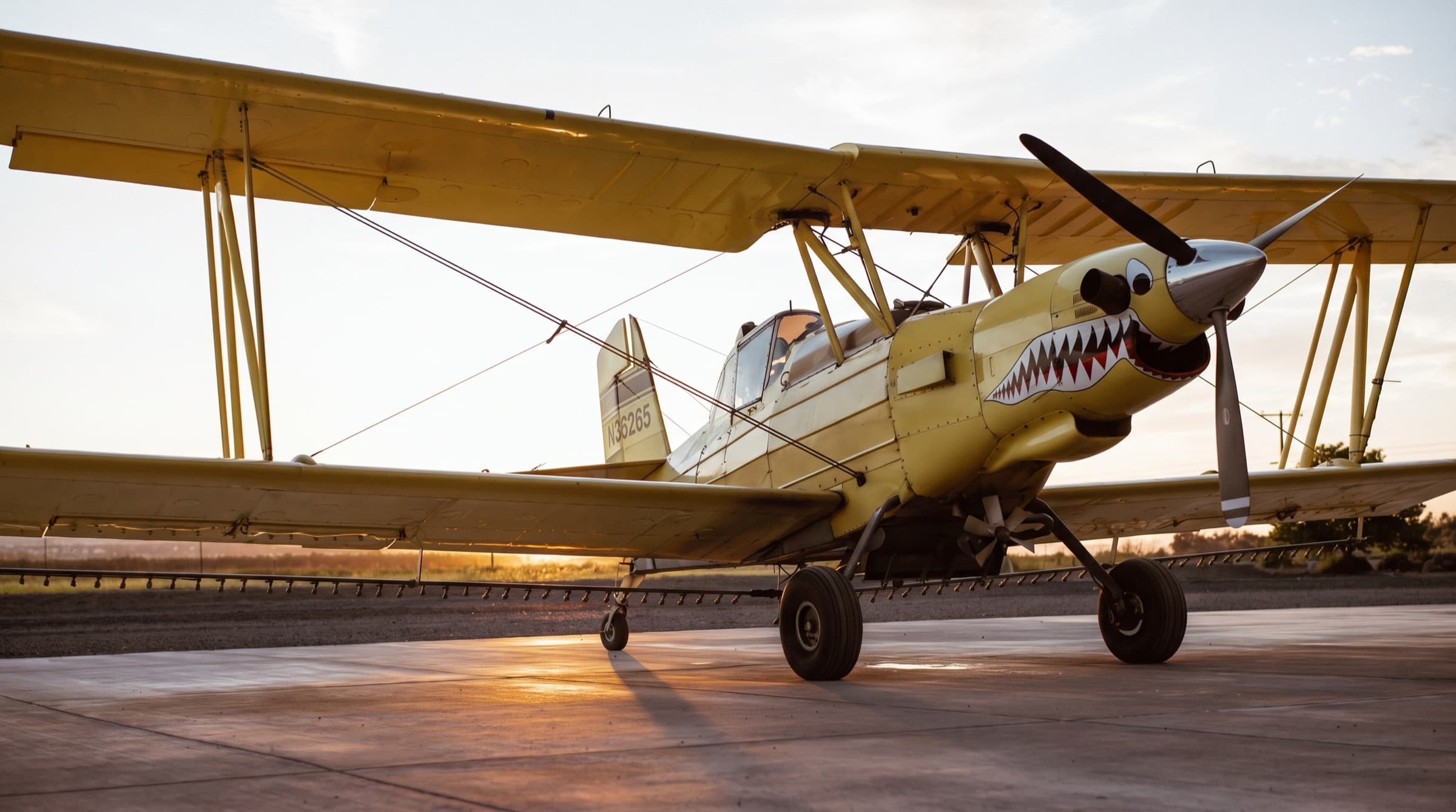
We hire seasonal and year-round ag pilots, loaders and ground crew. We fly five Schweizer Super B Ag Cats and one Air Tractor 602 from our airstrip at 4080 Clark Rd, Live Oak. Our season runs about March to September across Sutter, Yuba, Butte, Glenn, Colusa, Placer and Yolo counties. The business has roots in 1951, and we incorporated in 1964. You can check our DPR business license, number 30517, on the DPR lists. See the aircraft on our fleet page. Our pilots earn 20% of what their aircraft bills, and we need a DPR apprentice certificate or higher before you start. See the full job on our ag pilot job page.
Questions
Work one or more seasons on the ground for an operator first. Insurers seldom cover a 250-hour pilot who flies an ag plane alone. They accept a new pilot more often when an operator with a long, safe record supervises the pilot.
Yes, most of them are. In the northern Sacramento Valley, the season runs about March to September. Rice seeding comes in April and May, fertilizer from April to July, and most fungicide and insecticide work from June to August. Ask each operator about work outside the season.
Yes. DPR requires a Pest Control Aircraft Pilot Certificate for anyone who flies pest control in California. A new pilot starts as an apprentice under the direct supervision of a journeyman pilot. Each pilot also registers with the agricultural commissioner in each county of work.
No, but membership helps. The NAAA Job Board and Online Directory are open only to members. Without them, you can still call or visit operators and attend state ag aviation conventions. You can also use the DPR lists of licensees by county to find aerial work near you.