
From the hangar
Crop duster plane for sale: what buyers look for
By the Sutter Butte Dusters team · · 8 min read
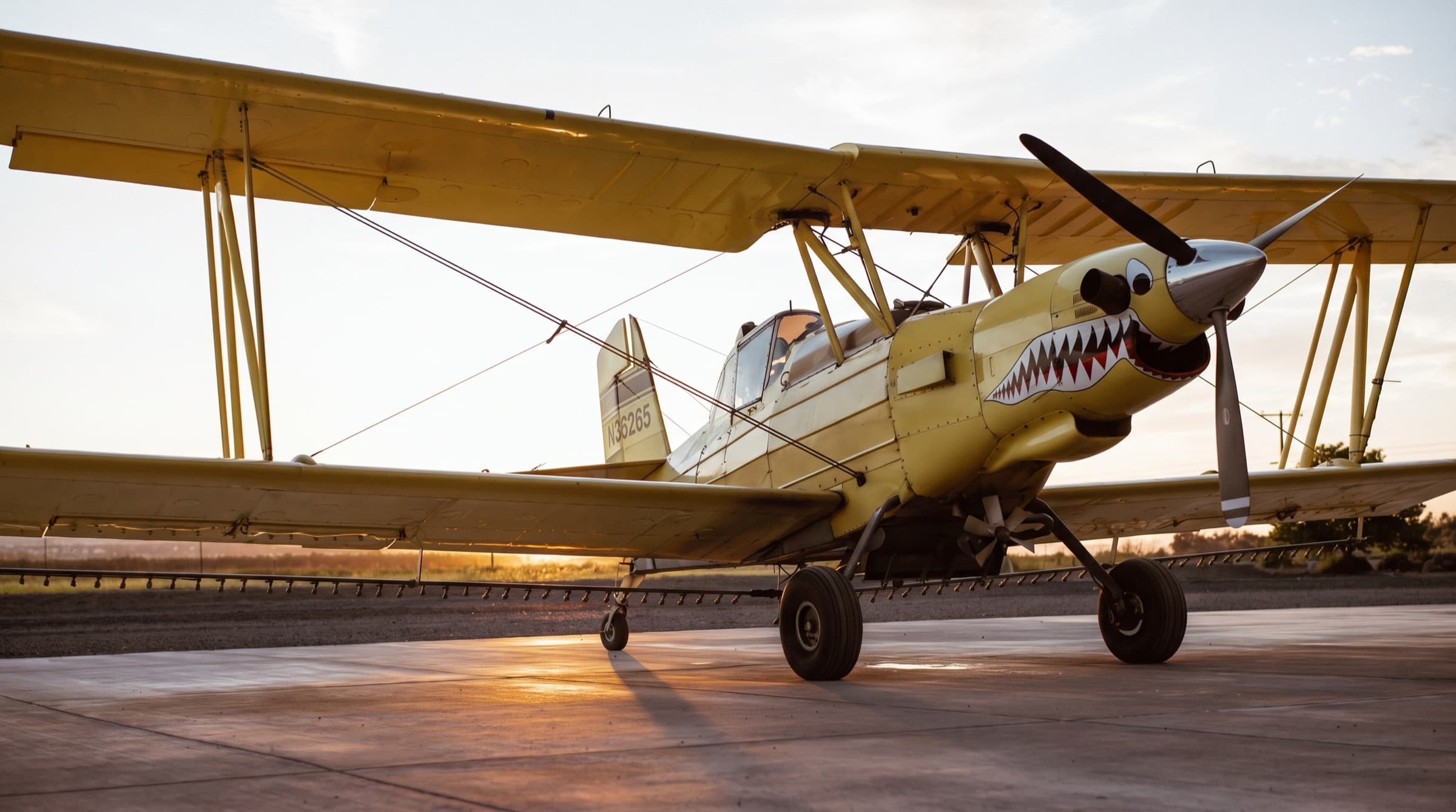
A buyer judges an ag airplane on its paperwork as much as its paint. When a buyer sees a crop duster plane for sale, they read the logbooks first, then examine the engine, the corrosion points and the hopper. This guide lists what buyers check, which records you must hand over, and what costs to expect when you sell.
What do buyers look for in a crop duster plane for sale?
Buyers look for four things: complete records, known engine time, a sound airframe and working spray equipment. An agricultural aircraft (ag aircraft) carries corrosive products every day, so a buyer expects wear and checks how well the owner controlled it. The table shows the main items and where the buyer finds each answer.
| What the buyer checks | Where the answer is | Why it matters |
|---|---|---|
| Airframe total time | Airframe logbook | Sets the baseline for fatigue and wear |
| Engine time since overhaul | Engine logbook | Often the largest single cost on an ag airplane |
| Propeller time since overhaul | Propeller logbook | Overhaul is due on a set time basis |
| Airworthiness directive status | AD compliance list | An open AD means work before the plane can fly |
| Major alterations | FAA Form 337 and STC paperwork | Proves that a hopper, engine or spray change is approved |
| Corrosion | Physical inspection | Ag chemicals attack metal, wood and fabric |
| Hopper and dispersal system | Physical inspection and a test run | Leaks and cracks stop work in the season |
| Damage history | Logbooks and the seller's disclosure | Each repair needs a record of approved data |
An airworthiness directive (AD) is an FAA rule that requires an inspection or a fix on a specific aircraft, engine or part. A supplemental type certificate (STC) is an FAA approval for a change to the original design.
Why do the logbooks matter most?
The logbooks matter most because they prove the airplane's condition in places that no one can see. The federal rule 14 CFR 91.417 lists the records that an owner must keep. These include total time in service, the status of life-limited parts, the inspection status and the AD status. Copies of FAA Form 337 for each major alteration are also part of the set.
When you sell, 14 CFR 91.419 requires you to transfer these records to the buyer at the time of sale. A gap in the logbooks forces the buyer to guess, and the guess lowers the offer.
Use this checklist to put the records in order before you list the airplane:
- Airframe, engine and propeller logbooks, in date order
- A current AD compliance list for the airframe, engine, propeller and appliances
- Each Form 337 and STC, with any flight manual supplements
- The entry for the last annual inspection
- The airworthiness certificate and the registration certificate
- The weight and balance record and the equipment list
- Work orders and parts receipts for the last engine overhaul
Under 14 CFR 91.409, most aircraft need an annual inspection within the preceding 12 calendar months to fly. Many ag airplanes also have a restricted category airworthiness certificate, which limits how the owner can use them. Our guide to FAA Part 137 for agricultural aircraft explains why an ag plane carries the word "RESTRICTED".
How do engine hours affect the price of a used crop duster for sale?
Engine time is one of the largest factors in the value of a used crop duster for sale. Buyers ask for the time since major overhaul (SMOH), which is the number of hours since the last engine rebuild. They compare it with the manufacturer's recommended time between overhauls (TBO). An engine near its TBO tells the buyer to budget for an overhaul soon.
The engine type changes the questions. For a radial piston engine, buyers ask for compression checks and oil analysis results. For a turbine such as the PT6A on the Air Tractor 602, they ask for hot section inspection records. Our comparison of the Air Tractor 602 and the Ag Cat explains the two engine types. An engine that sat unused for years can also have internal corrosion, even with low hours.
Where does corrosion hide on an ag airplane?
Corrosion hides where chemicals, dust and moisture collect. The FAA's Advisory Circular 43-4B, Corrosion Control for Aircraft, has a section on agricultural aircraft. It states that practically all chemicals used in dusting and spraying are corrosive to fabric, metal and wood.
The circular names these areas for protection and inspection:
- Wing-root fittings and wing-strut fittings
- Control-surface hinges, horns and attach bolts
- Control cables that are not stainless steel
- The lower and rear parts of the fuselage
- Tail-wheel wells and cable openings, where dust and spray get in
The buyer's mechanic will also examine the structure under and around the hopper, where product spills collect.
The same circular recommends a fresh-water wash of the exterior at least once a week. Records of washes and corrosion treatment help a seller prove that the airframe got this care. Do not cover corrosion with fresh paint before a sale. The pre-buy mechanic will find it, and the buyer will then doubt the rest of the airplane.
What do buyers check on the hopper and spray system?
The hopper and the dispersal system do the paid work of the airplane. The hopper is the tank that carries the product. The dispersal system is the pump, boom, nozzles or dry spreader that releases it. Run the buyer's check before you list the airplane.
Caution: rinse the hopper and the spray system before anyone inspects them. Product residue can expose the inspector to chemicals.
- Examine the hopper for cracks, leaks and stains at the seams.
- Open and close the gate, and check the seal.
- Run the pump and look for leaks at the boom and the valves.
- Check the boom and the nozzles for damage and corrosion.
- Examine the dry spreader, if the airplane has one, for cracks and dents.
- Test the GPS guidance system and the flow controller.
- Match each installed system to its STC or other approval.
Which Ag Cat for sale details do buyers ask about?
An Ag Cat for sale raises its own questions, because the models range from the first 1959 G-164 to the turboprop G-164B-20T. All of them share FAA type certificate 1A16. The serial number tells the buyer the model, the hopper size and the allowed maximum weight. Our history of the Grumman Ag Cat lists each model and the checks for an older airframe.
On fabric-covered surfaces, buyers want the date of the last recover and a fabric strength test result. Buyers also ask for the status of each life-limited part, which 14 CFR 91.417 requires in the records. Our guide to crop duster planes describes the main ag airplane types and their parts.
What does it cost when I sell my airplane?
The costs depend on how you sell and on the condition of the airplane. Agree in writing who pays each cost in the table.
| Cost | What it covers |
|---|---|
| Broker commission | Listing, marketing and buyer screening, usually a percentage of the price |
| Escrow fee | A neutral third party that holds the money and documents until both sides meet the terms |
| Title search | A search of the FAA Aircraft Registry record for owners and liens |
| Loan payoff and lien release | Payoff of any loan, and a signed release from the lender |
| Advertising | Ads in aircraft sale and ag aviation publications |
| Contract and legal review | The purchase agreement and closing documents |
| Preparation | Wash, records review, minor repairs and any overdue AD compliance |
| Inspection items | Repairs that the pre-buy inspection finds, as the agreement sets |
| Ferry or transport | A flight or a truck to the buyer; a plane that is not airworthy may need a special flight permit |
| Taxes | Sales or use tax and income tax; ask a tax professional |
The FAA's registry guide, REGAR-93, says that a loan document marked "PAID" is not enough to release a lien. The lender must sign a release that describes the recorded document, and there is no fee to record it.
How do you sell a crop duster plane, step by step?
The FAA forms are on the FAA aircraft registration forms page.
- Gather the logbooks, the AD list and each Form 337.
- Order a title search of the FAA Aircraft Registry record.
- Ask each lienholder for a signed lien release.
- Wash the airplane, and rinse the hopper and spray system.
- Choose how to sell: a broker, your own ad or a direct buyer.
- Sign a written purchase agreement with the price and the terms.
- Allow the buyer's pre-buy inspection at an agreed shop.
- Settle the inspection items as the agreement says.
Caution: do not sign the bill of sale until the money is in escrow or in your account.
- Sign the FAA Aircraft Bill of Sale, AC Form 8050-2.
- Give the buyer the records that 14 CFR 91.419 requires.
- Notify the FAA Aircraft Registry within 21 days of the sale.
- Cancel your insurance after the transfer is complete.
The 21-day notice comes from 14 CFR 47.41. A transfer of ownership ends your registration. For a paper certificate, complete the back and return it to the registry. The buyer then files a new Aircraft Registration Application, AC Form 8050-1, with the bill of sale and the $5 registration fee.
If you inherited the airplane, an heir can use the registry's Heir-at-Law form, REGAR-HEIR-1, when the estate has no executor or administrator. For an export sale, the registry guide REGAR-124E explains how the FAA cancels the U.S. registration.
Should you use a broker, list it yourself or sell to a direct buyer?
Each route trades money for time and work. A broker handles the listing and the calls for a commission. Your own listing puts your crop duster plane for sale in front of the same buyers, but you screen each caller yourself. A direct buyer makes one offer, with no listing, no commission and no wait. That offer is often lower than a retail price.
Selling an airplane in the northern Sacramento Valley
We fly five Ag Cats and one Air Tractor 602 from our base at 4080 Clark Rd in Live Oak. Our fleet page shows the airplanes that we fly across Sutter, Yuba, Butte, Glenn and Colusa counties for rice and orchard work. We also buy planes, so you can sell your airplane to a local buyer without a listing. If you want to sell your airplane, tell us about the plane on our we-buy-planes page. For questions before you decide, contact us or call (530) 695-2294.
Questions
There is no fixed price. The value depends on the model, the engine time since overhaul, the AD status, the completeness of the logbooks and the installed equipment. An appraisal and recent sales of the same model give a better guide than an asking price in an ad.
The buyer does. Under 14 CFR 91.419, the seller must transfer the status records and the maintenance records at the time of sale. The buyer may let the seller keep some maintenance records, but the buyer still must make them available to the FAA on request.
Yes. Under 14 CFR 47.41, a transfer of ownership ends your registration, and the certificate holder must notify the FAA Aircraft Registry within 21 days. For a paper certificate, complete the back and return it. The buyer then applies for a new registration with the bill of sale.
Yes. Some buyers accept airplanes that need repairs or that sat in storage for years. The buyer can truck the airplane, or a mechanic can check whether it qualifies for an FAA special flight permit to ferry it. Sutter Butte Dusters also buys planes.
