Ag pilot careers
Aerial firefighting: how ag planes became air tankers
By the Sutter Butte Dusters team · · 9 min read
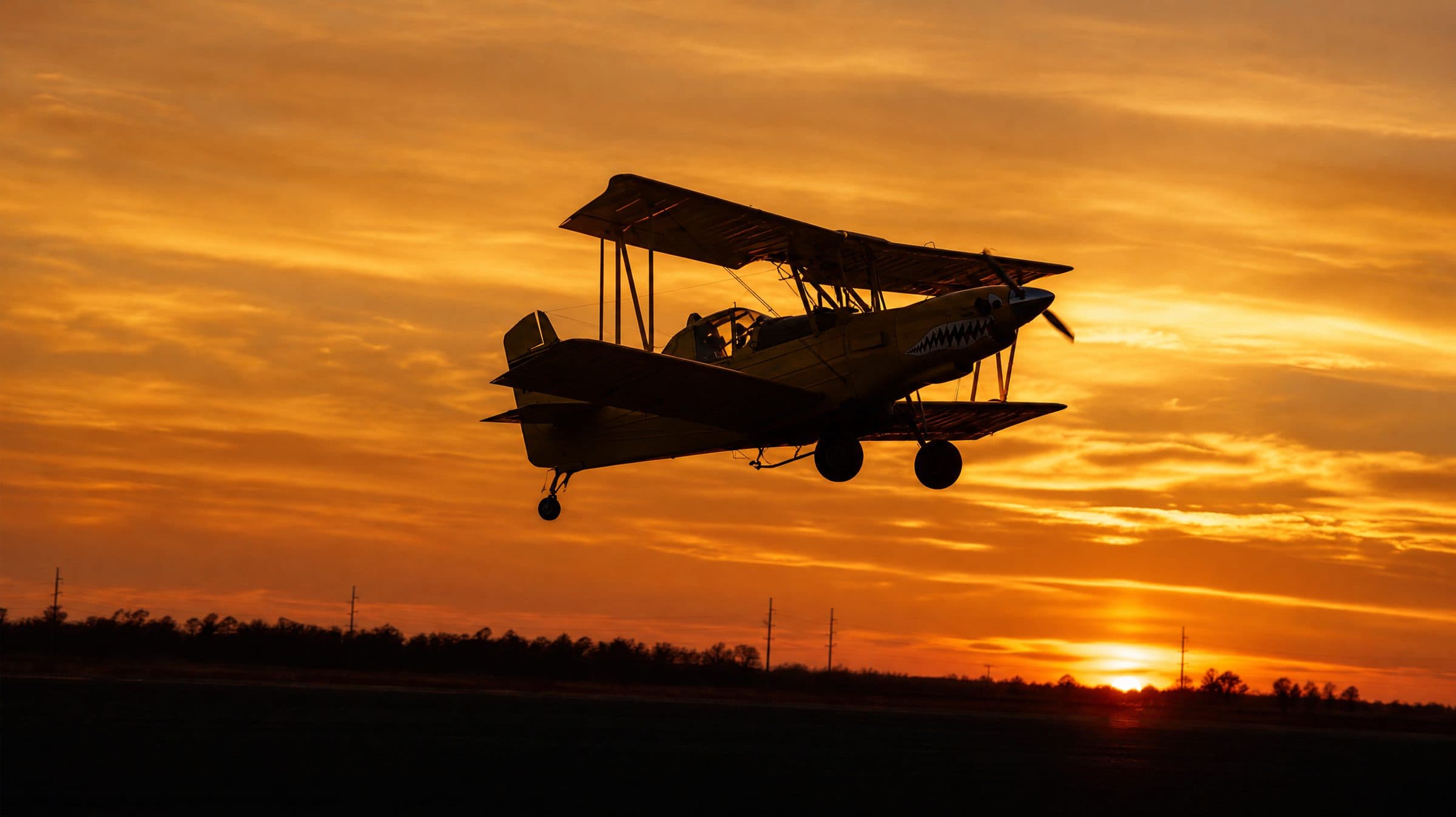
The first operational air tanker in the United States was a crop duster from Willows, in Glenn County. This guide covers aerial firefighting aircraft, pilot jobs and pay, and contracts. It also tells growers what to do when retardant lands on a field.
Where did air tankers start?
The National Wildfire Coordinating Group (NWCG) tells the story in its history of the first airtanker drop. In 1955, Willows Flying Service put a 170-gallon tank in a Boeing Stearman 75 ag plane at the Willows airport. The Fire Control Officer of the Mendocino National Forest had asked for it.
That Stearman, N75081, made the first drop on the Mendenhall Fire on August 12, 1955. In 1956, seven modified ag aircraft formed the first operational air tanker squadron in the United States. Local pilots flew them out of the Willows Airport to fires across California.
The first loads were plain water, and much of it evaporated before it reached the fire. Crews then added chemicals, and the early additive borate gave the name "borate bombers" to the planes. The NWCG history says that by 1959, heavy air tankers carried 2,000 gallons of retardant.
A plaque at the Willows Airport marks the birth of the air tanker program. Willows is the seat of Glenn County, about 34 miles northwest of our strip in Live Oak.
Which aerial firefighting aircraft fly in California?
Federal figures come from the National Interagency Fire Center (NIFC) airtanker page. CAL FIRE figures come from its aviation program fact sheet, dated June 2026. The Fire Boss figure comes from the federal scooper contract.
| Class | Example aircraft | Maximum load | Notes |
|---|---|---|---|
| Single engine air tanker (SEAT) | Air Tractor AT-802 class | Up to 800 gallons | Converted ag airplane; best on grass and sagebrush |
| Water scooper | AT-802 on amphibious floats (Fire Boss) | About 800 gallons in a Fire Boss; up to 1,600 in larger scoopers | Fills from a lake in as little as 12 seconds |
| State air tanker | Grumman S-2T (CAL FIRE, 23 aircraft) | Up to 1,200 gallons | Flies from CAL FIRE air attack bases |
| Large air tanker | Lockheed C-130H (CAL FIRE, 4 aircraft) and contract jets | 2,000 to 4,000 gallons | More maneuverable than a VLAT |
| Very large air tanker (VLAT) | DC-10 | Up to 9,400 gallons | Drops at least 250 feet above the vegetation |
| Military C-130 with MAFFS | Air National Guard and Air Force Reserve C-130 | Up to 3,000 gallons | Activated only when contract air tankers are committed or not available |
| Helicopter | CAL FIRE HAWK (S-70i), UH-1H Super Huey | Up to 1,000 and 360 gallons | Can refill close to the fire |
| Air attack and lead plane | OV-10 Bronco, King Air, Twin Commander | No load | Directs the drops from above |
NWCG gives about 9 pounds for a gallon of retardant, so an 800-gallon SEAT load weighs about 7,200 pounds.
CAL FIRE describes retardant as a slurry of a chemical salt compound, water, clay or a gum thickener, and a color agent. Pilots usually drop it ahead of or around a moving fire, not on the flames. The retardant slows the fire so ground crews can contain it.
How does a single engine air tanker work?
A single engine air tanker (SEAT) is an ag airplane with a fire tank and a fast release door. The Air Tractor AT-802A ag model has an 800-gallon hopper and a 1,295 shp turbine, as our guide to crop duster planes shows.
The federal contract sets the minimums for each SEAT class. The Department of the Interior (DOI) 2024 on-call SEAT contract has two classes:
- Type 3: a turbine of at least 1,220 shp, a tank of 800 to 1,799 gallons, and an approved gate. The gate is the door system that releases the load.
- Type 4: a turbine aircraft with a tank of 500 to 799 gallons.
Both classes fly only in daylight, under visual flight rules.
The Fire Boss is an AT-802 on amphibious floats. The pilot skims a lake and fills the tank without a landing. NIFC says a scooper needs water about 6.5 feet deep and 300 feet wide.
Our post on why crop dusters fly so low explains the ag side of this table.
| Item | Ag application | SEAT fire drop |
|---|---|---|
| Load | 400 gallons in our Ag Cats, 630 in our Air Tractor 602 | 800 gallons minimum for Type 3 |
| Release | Metered across a swath, pass after pass | The gate releases the load along a line on the fire |
| Direction | The pilot works from the grower's field map | An air attack supervisor or lead plane often directs the drop |
| FAA operator rule | Part 137 certificate | The federal SEAT contract also requires Part 137 |
Do crop dusters fight fires?
Some crop dusters do. The federal SEAT contract requires the operator to hold a 14 CFR Part 137 agricultural aircraft operator certificate, which our Part 137 guide explains.
Under 14 CFR 137.11(c), a federal, state or local government that flies these missions with public aircraft does not need the certificate.
Our Ag Cats carry 400 gallons, below the 500-gallon minimum for a Type 4 SEAT. Our Air Tractor 602 and Ag Cat comparison gives the full specifications.
In the northern Sacramento Valley, the hot, dry months of fire season are also spray season. An ag operator who sends a plane and a pilot to a fire contract loses them for that work.
How do ag pilots get aerial firefighting jobs?
SEAT pilots work for the private operators that hold the federal contracts. The 2024 contract lists these minimums for a pilot in command, and each operator can ask for more.
Caution: Valley spray work does not build mountain experience. The contract defines that experience as flight near terrain, across ridgelines and in high density altitude.
- Earn an FAA commercial pilot certificate with single engine land and instrument airplane ratings.
- Hold at least a second-class medical certificate.
- Log 1,500 hours total, with 1,200 hours in airplanes.
- Log 200 hours in single engine land airplanes.
- Log 100 hours of dispensing retardant, water on fires, or agricultural materials.
- Log 200 hours of low-level flight below 500 feet AGL. Part 137 dispensing counts.
- Log 200 hours in mountainous terrain, or 100 hours after an approved mountain flying school.
- Fly 25 hours in the make and model of the contract aircraft.
- Fly 100 hours in airplanes in the last 12 months.
- Complete the company training, the SEAT online courses and the National Aerial Firefighter Academy.
- Pass a mission flight evaluation by a DOI Office of Aviation Services inspector or designee.
A new pilot starts at Level II, with limits on work near other aircraft. Level I takes at least 1 calendar year at Level II, the second academy course and 25 supervised fire missions.
Our post on crop dusting jobs explains how ag pilots start. Large air tankers use a different path. An AOPA Flight Training article from 2022 said the Forest Service required 800 hours of pilot-in-command time for a tanker co-pilot. That co-pilot also needed commercial, multiengine and instrument ratings.
What is the aerial firefighting pilot salary?
No federal survey reports pay for fire pilots alone. The AOPA article said entry-level fire pilots earned a base salary of $40,000 to $45,000. Pilots also earned daily pay of "hundreds of dollars" for each day in the cockpit. The article said that pay of more than $200,000 a year was possible.
The pilot in that article flew an MD-87 large air tanker on a 160-day contract. The federal SEAT contract also limits the work:
- No more than 14 hours of duty in any 24-hour period.
- No more than 8 hours of flight in one duty period.
- No more than 42 hours of flight in 6 consecutive days.
Our post on crop duster pilot salary gives federal wage data for ag pilots.
How do aerial firefighting contracts work?
The agencies own some aircraft and hire the rest. NIFC says the USDA Forest Service manages the VLAT contracts. The Interior Department hires SEATs and scoopers on on-call contracts. Its U.S. Wildland Fire Service, set up by Secretary's Order 3448 on January 12, 2026, now runs that program.
The agency places a task order when it needs a plane. The operator supplies the aircraft, a pilot, a relief pilot, a fuel truck and a driver. The government pays a daily availability rate plus a rate for each flight hour.
The 2021 DOI scooper contract covered about 20 to 26 aircraft, with a shared ceiling of $46 million over 5 years. Its aircraft can go to fires anywhere in the lower 48 states and Alaska.
CAL FIRE vs federal: who sends the planes?
The land under the fire decides who is in charge. CAL FIRE protects the State Responsibility Area (SRA). Federal agencies protect federal land, such as the Mendocino and Tahoe national forests.
CAL FIRE's June 2026 fact sheet lists 69 aircraft, with 3 more C-130H air tankers planned. They fly from 1 air tanker base, 13 air attack bases and 11 helitack bases. The goal is to reach the most remote SRA fire in about 20 minutes and keep 95 percent of fires at 10 acres or less.
Butte County says the CAL FIRE air attack base at the Chico airport is home to an OV-10 and an S-2T. A NIFC news release says the McClellan Airtanker Base in Sacramento hosted MAFFS training on April 20 to 24, 2026.
What should growers and pilots do near a wildfire?
Fire traffic, TFRs and drones
Fire aircraft fly low, fast and close together. The FAA can issue a temporary flight restriction (TFR) over a fire under 14 CFR 91.137. Inside it, an aircraft generally must take part in the relief work under the direction of the official in charge. The rule lists a few narrow exceptions, and none of them covers an ag application job.
Warning: A drone inside a TFR puts low air tanker crews at risk. Under 14 CFR 107.47, drone pilots must obey the same restrictions.
- Check the NOTAMs for a TFR before each flight near smoke.
- Stay out of a TFR unless the incident commander directs you in.
- Keep spray drones and camera drones on the ground near an active fire.
- Call your applicator to reschedule if a TFR covers your field.
Retardant on a field
Long-term retardant is a fertilizer-based product. One Forest Service safety data sheet lists ammonium polyphosphate, clay and iron oxide. The Forest Service retardant clean-up guidance says the high fertilizer level can burn leaves. Plants can look dead after contact, but they usually grow back within one to two months.
Caution: Keep livestock and pets away from retardant puddles. If an animal drinks from one and looks ill, tell your veterinarian that it drank a fertilizer-based product.
- Photograph the drop with the date, the field location and the fire name.
- Report the drop to the agency in charge of the fire.
- Rinse retardant off plants, equipment and buildings as soon as possible.
- Cover standing puddles with sand or soil.
- Wash fruit and vegetables well before you use them.
- Ask your PCA and your buyer before you harvest a crop that took a drop.
- Call your organic certifier before you sell a crop from a certified field.
Our work in the northern Sacramento Valley
Aerial firefighting grew out of ag aviation, and the two trades still share pilots, airframes and the Part 137 rules. We are an ag operator, and we do not fly fire missions. Our five Ag Cats and one Air Tractor 602 fly seeding, crop protection and fertilizer work from Live Oak across seven valley counties. If you want to build those hours in the valley where air tankers began, see our ag pilot careers.
Questions
No rule sets a time, but the hours take years to build. The 2024 federal SEAT contract asks for 1,500 total hours, 100 hours of fire or ag dispensing and 200 low-level hours. A new pilot then flies at least 1 calendar year at Level II before Level I.
No federal survey tracks fire pilot pay alone. A 2022 AOPA Flight Training article reported a base salary of $40,000 to $45,000 for new fire pilots, plus daily pay for each day in the cockpit. It said experienced pilots could earn more than $200,000 a year.
A SEAT is a turbine ag airplane, often from the Air Tractor AT-802 family. A federal Type 3 SEAT needs a tank of at least 800 gallons, a turbine of at least 1,220 shp and an approved fire gate. The Fire Boss version sits on amphibious floats and scoops water from lakes.
Long-term retardant is a fertilizer-based product. The Forest Service says its high fertilizer level can burn leaves, but plants usually grow back within one to two months. Rinse it off plants, wash produce before you use it, and keep animals away from retardant puddles.