Ag pilot careers
Agricultural aircraft mechanic: A&P path, work and pay
By the Sutter Butte Dusters team · · 9 min read
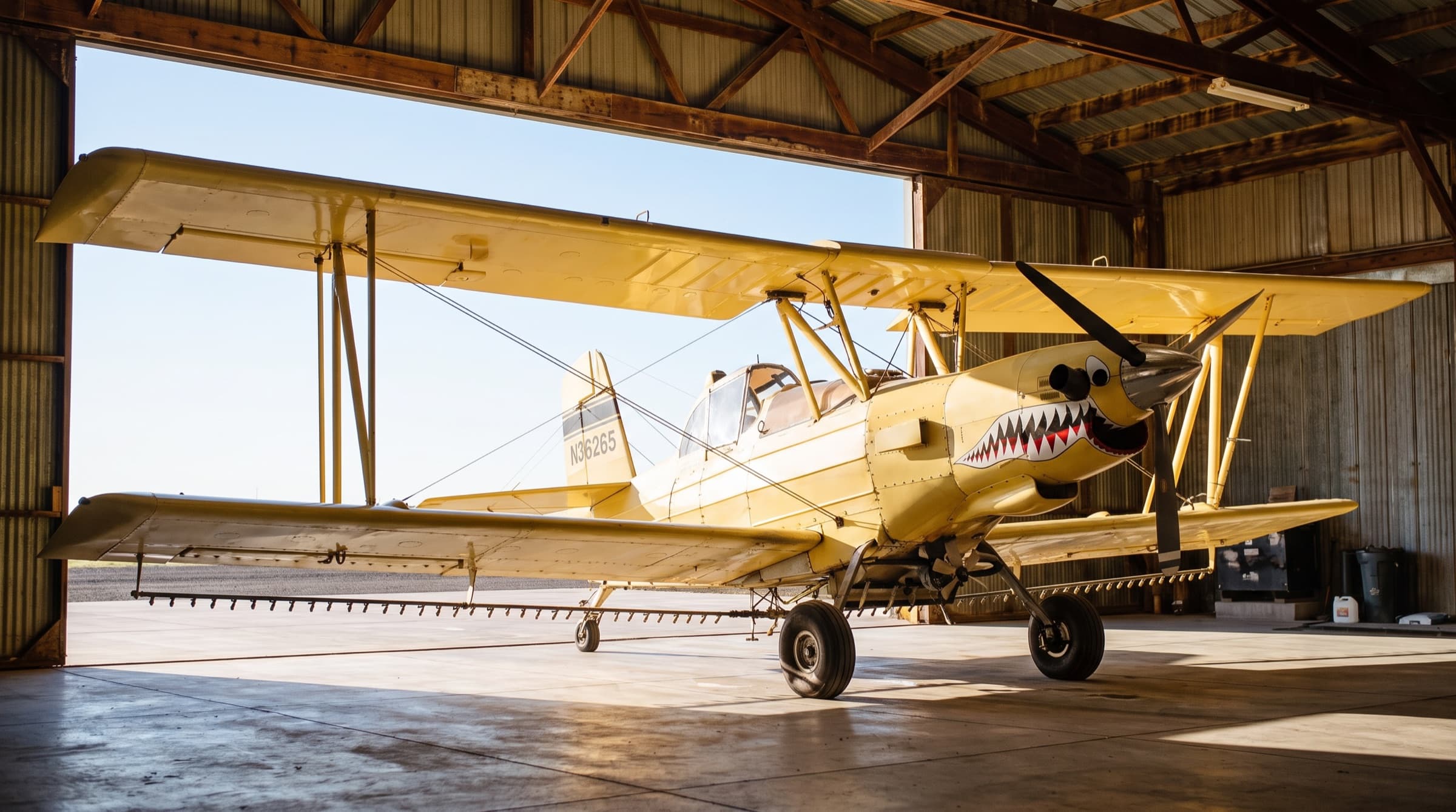
An agricultural aircraft mechanic keeps crop dusting airplanes safe through a season of short flights, heavy loads and corrosive products. The job needs the same FAA airframe and powerplant (A&P) certificate as any other aircraft mechanic, plus skills that a typical shop does not teach. This guide explains the certificate, the work, the inspections, the yearly rhythm and the pay.
What does an agricultural aircraft mechanic do?
An agricultural aircraft mechanic inspects, repairs and returns to service the aircraft that do aerial application (crop dusting). Aerial application is the work of applying seed, fertilizer and crop protection products from the air. The aircraft fly many short loads each day at heavy weights, close to the ground. Each load also leaves product residue on the airframe and in the spray system. For these reasons, wear and corrosion are a central part of the work.
| System | What the mechanic does |
|---|---|
| Engine and propeller | Inspects, troubleshoots and services the radial or turbine engine and the propeller |
| Airframe | Checks the structure, wing fittings, struts and control cables for cracks and corrosion |
| Spray system | Repairs the hopper gate, pump, valves, booms and nozzles |
| Landing gear | Services the brakes, tires and tailwheel |
| Records | Records each repair and inspection and signs for return to service |
Our overview of crop dusting jobs covers the rest of the crew.
How do you get an A&P certificate?
The FAA issues the mechanic certificate under 14 CFR Part 65, subpart D. The certificate has two ratings: airframe (A) and powerplant (P). The Bureau of Labor Statistics (BLS) says that employers may prefer mechanics who hold both ratings.
Under 14 CFR 65.71, you must be at least 18 years old and able to read, write, speak and understand English. You must also pass all the required tests within 24 months. You meet the experience rule in one of these ways (14 CFR 65.77):
| Route | What the FAA requires |
|---|---|
| Part 147 school | A graduation document from an FAA-certificated aviation maintenance technician school. The FAA says most programs take 18 to 24 months. |
| Experience, one rating | 18 months of practical experience that fits the rating |
| Experience, both ratings | 30 months of practical experience on airframe and powerplant work at the same time |
| Military | FAA credit for time worked in some military maintenance specialties |
Part 147 does not set a minimum number of class hours for a school. Instead, the curriculum must align with the FAA mechanic Airman Certification Standards (14 CFR 147.17). Near us, Sacramento City College runs an FAA-approved Part 147 program over four semesters. Its program page lists agricultural aircraft operators among the employers of aircraft maintenance technicians.
How does the experience route work?
The experience route costs less than a school, but you must prove each month of work. The FAA explains the experience requirements for aircraft mechanics.
Caution: Time in a training course does not count as practical experience.
- Get a maintenance job under the supervision of a certificated mechanic.
- Log each task, the time it took and your supervisor's signature.
- Reach 18 months for one rating or 30 months for both ratings.
- Bring your log and an employer statement to an FAA inspector for review.
- Pass the written test for the general section and for each rating.
- Pass the oral and practical tests with a Designated Mechanic Examiner.
The test rules are in 14 CFR 65.75 and 65.79. To use the certificate, you need 6 months of mechanic work or supervision in the past 24 months (14 CFR 65.83). The FAA can also accept a check of your skill.
What does ag aircraft maintenance involve?
The work covers two engine families, the spray system and corrosion. Our fleet has five Schweizer Super B Ag Cats and one Air Tractor 602.
What does a radial engine mechanic need to know?
Grumman and Schweizer built the Super B Ag Cat type (model G-164B) around radial piston engines. FAA type certificate 1A16 lists the Pratt & Whitney R-985 and R-1340 radials for this model. Some G-164B airframes carry a Walter M601E-11 turboprop under a supplemental type certificate. Our Grumman Ag Cat history explains how the engine options grew.
A radial engine mechanic must know about hydraulic lock. The FAA powerplant handbook says that oil or fuel can drain into the lower cylinders after a few minutes of shutdown. If the engine starts with liquid in a cylinder, a connecting rod can bend or break. The handbook gives this procedure to clear the lock.
Warning: Treat every propeller as live. A faulty magneto ground wire can let the engine fire when you turn the propeller.
Caution: Never turn the propeller backward to clear a lock. The liquid goes into the intake pipe and can cause a new lock.
- Remove the front or rear spark plug from each lower cylinder.
- Pull the propeller through in the normal direction of rotation.
- Let each piston push out the liquid.
After an annual or 100-hour inspection, the mechanic runs a piston engine before return to service. Under 14 CFR 43.15, the run checks power, the magnetos, fuel and oil pressure, and cylinder and oil temperatures.
What changes with a turbine engine?
The Air Tractor 602 type uses a Pratt & Whitney Canada PT6A turboprop. FAA type certificate A19SW lists the PT6A-45, PT6A-60AG and PT6A-65 series engines for this model. A turboprop is a gas turbine engine that turns a propeller through a reduction gearbox. The mechanic follows the engine maker's maintenance manual and runs the engine to the maker's recommendations after each annual or 100-hour inspection (14 CFR 43.15). Our Air Tractor 602 and Ag Cat comparison shows how the two types differ in the field.
Why does the spray system need so much care?
The spray system includes the hopper, the gate, the pump, the valves, the booms and the nozzles. A worn nozzle changes the flow, and a leaking valve can drip product outside the swath. The mechanic repairs these parts so that the operator can calibrate each load to the label rate. Our guide to spray nozzle types explains how nozzles control droplet size.
In California, this work also makes the mechanic a pesticide handler. Under 3 CCR 6000, "handle" includes the repair and cleaning of application equipment that may contain residues. The employer must train each handler before the first contact with a pesticide, then at least once a year (3 CCR 6724). A person who handles pesticides for commercial crop production must be at least 18 years old. Our post on the crop duster loader covers the same rules from the loading side.
How do ag chemicals cause corrosion?
FAA Advisory Circular 43-4B, Corrosion Control for Aircraft, says that almost all chemicals in dusting and spraying work are corrosive. Where the maker gives no corrosion program, it lists these precautions for ag aircraft:
- Coat fittings and metal structure with epoxy primer and a heavy corrosion preventive compound.
- Coat control cables that are not stainless steel, or replace them with corrosion-resistant cables.
- Inspect the critical structure at set intervals, and replace badly corroded parts.
- Wash the outside with clear fresh water at least once a week.
- Seal openings, such as tailwheel wells and cable holes, against dust and spray.
Which inspections does an ag aircraft need?
The Ag Cat and the Air Tractor 602 are restricted category aircraft, an FAA category for special-purpose work such as agriculture. The general inspection rules in 14 CFR 91.409 still apply to them.
| Inspection | When the rule requires it | Who may do it |
|---|---|---|
| Annual | Within the preceding 12 calendar months, unless the aircraft uses a progressive program (91.409(a)) | A mechanic with an Inspection Authorization (IA) (65.95) |
| 100-hour | Each 100 hours of time in service for aircraft that carry people for hire or give flight instruction for hire (91.409(b)) | An A&P mechanic (65.85 and 65.87) |
| 100-hour or annual | Within the preceding 100 hours of time in service, before ag work over a congested area (137.53) | An A&P for the 100-hour, an IA for the annual |
| Progressive | On an FAA-approved schedule, with a complete inspection within each 12 calendar months (91.409(d)) | Supervised by an IA, a repair station or the manufacturer |
The 100-hour inspection rule in 91.409(b) does not name ag work. The operating limitations and the maker's manuals can add requirements, so read them for each airframe. For each annual or 100-hour inspection, the mechanic uses a checklist with at least the items in Part 43, appendix D (14 CFR 43.15).
The IA is the next step up. You need A&P ratings in effect for at least 3 years, 2 years of active maintenance work and a passed written test (14 CFR 65.91). BLS says that advancement chances may be best for mechanics with an IA. Our guide to FAA Part 137 explains the operating rules for ag aircraft.
What does the year look like for an ag mechanic?
The mechanic's year follows the crop. In the northern Sacramento Valley, our flying season runs about March to September, and the busiest months are May through July. The dates change each year with the weather.
| Months | Typical mechanic work |
|---|---|
| October to February | Annual inspections, overhauls, corrosion repair and spray system rebuilds |
| March and April | Engine runs, spray system checks and calibration before the spring rush |
| May to August | Peak season: daily checks, quick repairs between loads and washdowns |
| September | Last jobs of the season, then the fleet comes in for inspection |
In season, the mechanic fixes a fault between loads. In winter, the work is slow and deep. Our crop dusting season calendar shows which jobs fly in each month.
What does a new ag mechanic do in week one?
A new mechanic at an ag operation can expect these tasks in the first week:
- Complete pesticide handler training before you touch a part with residue on it.
- Read the aircraft records, including recent inspections, open defects and airworthiness directives.
- Learn the maintenance manuals and inspection checklists for each aircraft type.
- Learn the loading, wash and fuel areas on the airstrip.
- Work next to an experienced mechanic on the first inspections and repairs.
What is the aircraft mechanic salary?
The BLS Occupational Outlook Handbook gives a median annual wage of $79,870 for aircraft mechanics and service technicians in May 2025. The lowest 10 percent earned less than $48,780. The highest 10 percent earned more than $128,890. The handbook does not list ag aviation as a separate industry.
BLS projects 5 percent growth for aircraft mechanics and service technicians from 2025 to 2035. It also projects about 13,100 openings each year for aircraft and avionics mechanics and technicians together. For pay at our operation, ask us about pay and the season schedule.
Why do some mechanics choose ag work?
Ag work suits a mechanic who wants to know the whole aircraft. An agricultural aircraft mechanic works on the engine, the airframe and the spray system of the same airplane. The work teaches radial and turbine engines, corrosion control and pesticide handler rules. The years also count toward the active work for an IA. The trade-off is summer work in heat, near pesticide residue and on a tight schedule. If you want to fly instead, read our post on agricultural pilot jobs.
Jobs at Sutter Butte Dusters
We do not have an open mechanic job right now. We hire ag pilots, loaders and ground crew. We fly five Schweizer Super B Ag Cats and one Air Tractor 602 from our airstrip at 4080 Clark Rd in Live Oak. Our work covers seven counties in the northern Sacramento Valley, from about March to September. The business has roots in 1951 and became a corporation in 1964. See the open jobs on our careers page.
Questions
The FAA says most Part 147 school programs take 18 to 24 months. Without a school, you need 18 months of documented practical experience for one rating or 30 months for both ratings. You then have 24 months to pass all the written, oral and practical tests.
Yes. You can work under the supervision of a certificated mechanic and log each task, the time it took and the supervisor's signature. An FAA inspector reviews your evidence. Time in a training course does not count, and only real maintenance work counts toward the 18 or 30 months.
No. An A&P mechanic can maintain an ag aircraft, do 100-hour inspections and approve most work for return to service. The annual inspection and approval of major repairs need an Inspection Authorization. To apply for one, you need A&P ratings for 3 years and 2 years of active maintenance work.
BLS gives a median wage of $79,870 for aircraft mechanics and service technicians in May 2025. It projects 5 percent job growth from 2025 to 2035. It also projects about 13,100 openings each year for aircraft and avionics mechanics and technicians together.