Crop dusting basics
What is crop dusting? A grower's guide to aerial application
By the Sutter Butte Dusters team · · 8 min read
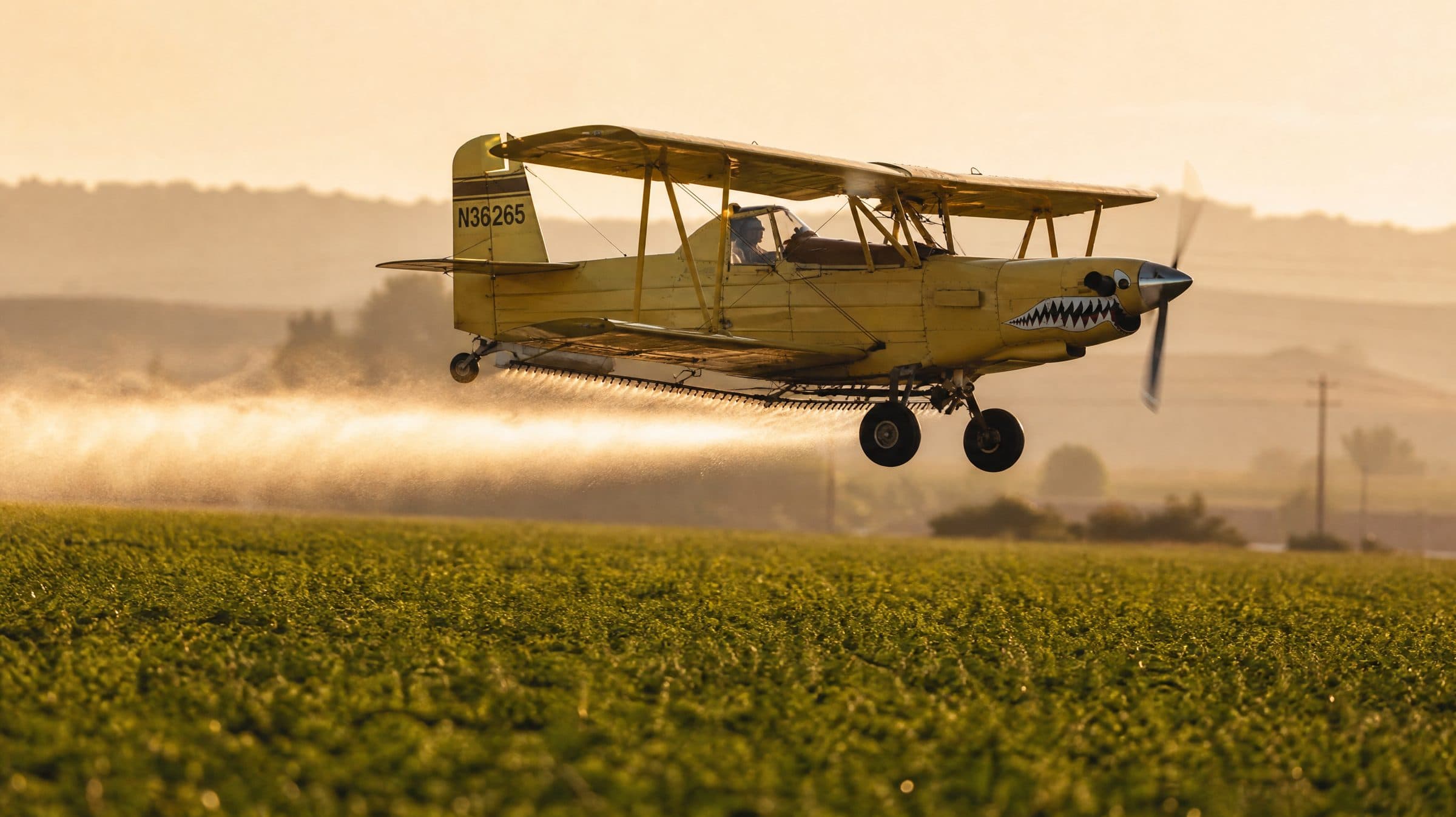
Crop dusting is the common name for aerial application: the work of putting seed, fertilizer or crop protection products on a field from an aircraft. The name is a century old, but the work is current, and aircraft treat more than a quarter of American cropland each year. This guide explains how a flight works, what controls drift, which aircraft fly, and how the trade began.
What is crop dusting?
The first pilots spread dry insecticide powders, and the Smithsonian says the name comes from those powders. Today many loads are liquid sprays from a boom under the wing. An ag plane still spreads granules, seed and dusting sulfur from its hopper. The hopper is the tank in front of the cockpit that holds the load.
The aerial applicator is the business that does the work, and "crop duster" can mean the pilot or the aircraft. Read what aerial application includes for the people on each job.
The product form decides the equipment on the aircraft:
| Product form | Equipment on the aircraft | Jobs in the northern Sacramento Valley |
|---|---|---|
| Liquid spray | Boom with nozzles under the wing | Herbicide, fungicide, insecticide and liquid fertilizer |
| Dry granules or pellets | Hopper and a spreader under the fuselage | Dry fertilizer on a growing crop (top-dressing) |
| Seed | Hopper and spreader | Rice seed on flooded checks and cover-crop seed |
| Dust | Hopper and spreader | Dusting sulfur for orchards and row crops |
The aerial applicator does not choose the pesticide or the rate. The product label sets the legal limits, and the grower's licensed pest control adviser (PCA) writes the recommendation. For the common product types, read what crop dusters spray.
How does crop dusting work?
The steps below describe a liquid spray job in a fixed-wing aircraft. They follow the Aerial Applicator's Manual, a national pilot study guide written under an agreement with the U.S. EPA.
The pilot and the ground crew do these steps on a typical job:
- Map the field edges, the power lines and the sensitive areas next to the field.
- Load the product and the water at the airstrip, to the rate on the written recommendation.
- Fly to the field and release smoke from the smoke generator to read the wind.
Caution: Do not start if the smoke rises and then flattens or moves sideways in a layer. This shows a temperature inversion, which can carry fine droplets off the field.
- Line up on the first swath with the GPS light bar.
- Hold the nozzles 8 to 12 feet above the crop for the full pass.
- Open the spray valve at the field edge, and close it at the far edge.
- Pull up, clear the obstacles, and level off before the turn.
- Turn back into the field on the next swath line.
- Repeat the passes until the field is complete or the load is empty.
- Return to the airstrip to reload, and save the as-applied map from the GPS.
The GPS light bar in front of the pilot shows when the aircraft is on the swath line. GPS replaced the human flaggers who once stood in the field to mark each pass. In the 2019 survey of the National Agricultural Aviation Association (NAAA), 99 percent of operators used GPS for swath guidance.
What are the key numbers on a spray job?
The swath is the width of crop that one pass covers. The operator measures it with a pattern test and enters it into the GPS guidance.
| Measure | Typical value in the Applicator's Manual |
|---|---|
| Release height for liquid sprays | 8 to 12 feet above the crop or tree canopy |
| Conventional spray volume | 5 to 15 or more gallons per acre |
| Low volume (LV) | 0.5 to 5 gallons per acre |
| Ultra low volume (ULV) | Less than 0.5 gallons per acre |
| Wind for a pattern test | Less than 10 mph |
The label, the PCA and the aircraft set the real numbers for each field. Read why crop dusters fly so low for the reasons behind the height.
What decides where the product lands?
Wind moves a droplet sideways while it falls, and heat and dry air shrink it. A smaller droplet travels farther before it lands, so the pilot pairs a low release height with nozzles that make larger droplets.
The manual names early morning as the best time when evaporation is a concern. The air is usually more humid then, and the wind is often low. Inversions are also more common early in the morning. In an inversion, a layer of warm air sits 20 to 100 or more feet above the ground and traps the cool air below it. Fine droplets can hang in that layer and move with it.
Pilots also use buffer zones. The manual describes untreated strips one or more swaths wide along the downwind edge. The pilot treats those strips later, when the wind blows back into the field. We check the wind before and during each job, and we wait if the wind is wrong.
Read more in spray drift and aerial application and aerial spraying near homes.
Which aircraft do the work?
Most ag aircraft today are airplanes built for farm work. In the NAAA's 2019 survey, 84 percent of ag aircraft were fixed-wing and 16 percent were helicopters. Turbine engines powered 83 percent of the fixed-wing aircraft and 71 percent of the helicopters.
The load decides how many acres a plane treats before it lands to refill. Air Tractor lists a 1,050 shp turbine engine for the AT-602. These hopper figures come from the manufacturer and the Smithsonian:
| Aircraft | Hopper capacity | Source |
|---|---|---|
| Air Tractor AT-602 | 630 US gallons | Air Tractor specifications |
| Air Tractor AT-502 | 500 gallons of spray | Smithsonian |
| Thrush | 400 gallons | Smithsonian |
Biplanes still fly in the trade. The Smithsonian says about 1,800 of the more than 2,600 Grumman Ag Cats built from 1959 to 1980 are still in use worldwide. Read crop duster planes for the main models, and helicopter or airplane for the rotor option.
Spray drones are the newest ag aircraft. The FAA requires a Part 137 certificate and an exemption for a drone that dispenses farm products. A drone works well on a small or irregular block, and an airplane covers large acreage in a short window. For drone prices, read drone spraying cost per acre.
Is crop dusting still done?
Yes. The NAAA, the industry trade group, gives these estimates on its industry facts page, from its 2019 survey:
- About 127 million acres of cropland treated each year, about 28 percent of cropland in production
- About 5.1 million acres of forest, where nearly all forest protection work is aerial
- About 4.8 million acres of public health and mosquito work
- About 3.8 million acres of cover crops seeded from the air
- About 1,560 aerial application businesses and about 3,400 ag pilots
Some acres get more than one treatment each year.
The rules differ by country. The European Union bans aerial spraying of pesticides under Article 9 of Directive 2009/128/EC, with limited exceptions. A member state may allow it in special cases: when there is no viable alternative or a clear benefit to health and the environment over ground spraying, with a product approved for aerial use, a certified operator and the best available anti-drift equipment, and not close to homes.
In the United States, the FAA's Part 137 rule certifies the operator, the product label controls the pesticide use, and states add their own licenses. In California, the Department of Pesticide Regulation issues pest control aircraft pilot certificates at apprentice and journeyman levels, for manned and unmanned aircraft. Read FAA Part 137 for agricultural aircraft and pesticide application rules in California for details.
Crop dusting history: from a 1921 test to turbine ag planes
On August 3, 1921, near Troy, Ohio, Army Lieutenant John A. Macready flew a modified Curtiss JN-4 Jenny over 6,000 catalpa trees. Etienne Dormoy of McCook Field built a side-mounted hopper for 100 pounds of powdered lead arsenate. Macready flew 20 to 35 feet over the trees and landed five times to refill. The FAA historian's account says the plane did in minutes what ground crews needed days to do.
| Year | Event | Source |
|---|---|---|
| By 1925 | Huff-Daland in Georgia builds the Duster from its Petrel 5 biplane; the company later becomes Delta Air Lines | Smithsonian |
| After 1945 | Surplus military trainers sell for as little as $250 and become crop dusters | Smithsonian |
| Early 1950s | Over 5,000 farm aircraft; a plane sprays 60 to 70 acres an hour, a tractor sprayer 100 acres a day | FAA historian |
| 1950 | The Texas A&M AG-1, a plane designed for farm work and pilot safety, first flies | FAA historian |
| 1953 | Leland Snow's S-1 first flies | Smithsonian |
| 1959 | Grumman starts Ag Cat production, which runs to 1980 | Smithsonian |
| 1970 | Leland Snow founds Air Tractor in Olney, Texas | Smithsonian |
| 1977 | Air Tractor becomes the first ag-plane maker to offer a factory turbine engine, on the AT-302 | Smithsonian |
Converted war planes had a high accident rate, so Fred Weick gave the AG-1 a seat built to survive a 40 G shock. In August 1953, a pilot crashed the AG-1 near Lubbock, Texas, and his only injury was a bruised thumb. The Smithsonian's history of agriculture by air traces the later planes, such as the Grumman Ag Cat and the Air Tractor 602.
When does an aircraft beat a ground rig?
An aircraft makes the most sense when the ground or the calendar works against a ground rig. In an NAAA example from Mississippi, an Air Tractor AT-502B with a 60-foot swath treats 1,800 acres in a 12-hour day. A ground rig with a 90-foot boom treats 450 acres in the same time. Consider an aircraft in these cases:
- The field is a flooded rice check, or the ground is too wet for a sprayer.
- The treatment window is short and the acreage is large.
- You want no wheel tracks or soil compaction.
A ground rig can be the better choice on a small field next to homes or other sensitive areas. Our post on aerial spraying vs a ground rig compares the two. For the factors that set the price, read what aerial application costs per acre.
Our post on how to hire a crop duster lists what to have ready before you call. For the months of each job, see the season calendar for aerial work.
We fly these jobs across Sutter, Yuba, Butte, Glenn and Colusa counties from our airstrip at 4080 Clark Rd in Live Oak. Our fleet is five Ag Cats and one Air Tractor 602. We seed rice onto flooded checks and apply herbicide, fungicide, insecticide and fertilizer. See our aerial application services, or get a quote for your field.
Questions
The first crop dusters in the 1920s spread dry insecticide powders, such as lead arsenate, and the name stayed with the trade. Today an ag plane often carries a liquid spray on a boom. It can still spread dry products, such as dusting sulfur, granular fertilizer and seed, from its hopper.
Yes. The Grumman Ag Cat is a biplane built for farm work, and the Smithsonian says about 1,800 Ag Cats remain in use worldwide. Many newer ag planes are turbine monoplanes, such as the Air Tractor. Our fleet has five Ag Cats and one Air Tractor 602.
The grower and the grower's licensed pest control adviser (PCA) decide. The PCA writes a recommendation with the product, the rate and the timing, and the product label sets the legal limits. The aerial applicator puts that product on the right field, at the label rate, inside the treatment window.
Yes. The operator needs an FAA Part 137 agricultural aircraft operator certificate, and the product label controls how a pesticide may be applied. States add their own rules. In California, the Department of Pesticide Regulation certifies pest control aircraft pilots at apprentice and journeyman levels.